Development of an exploratory preoperative laboratory-based score for 24-month mortality after major lower extremity amputation in geriatric diabetic foot patients
24 months
Abstract
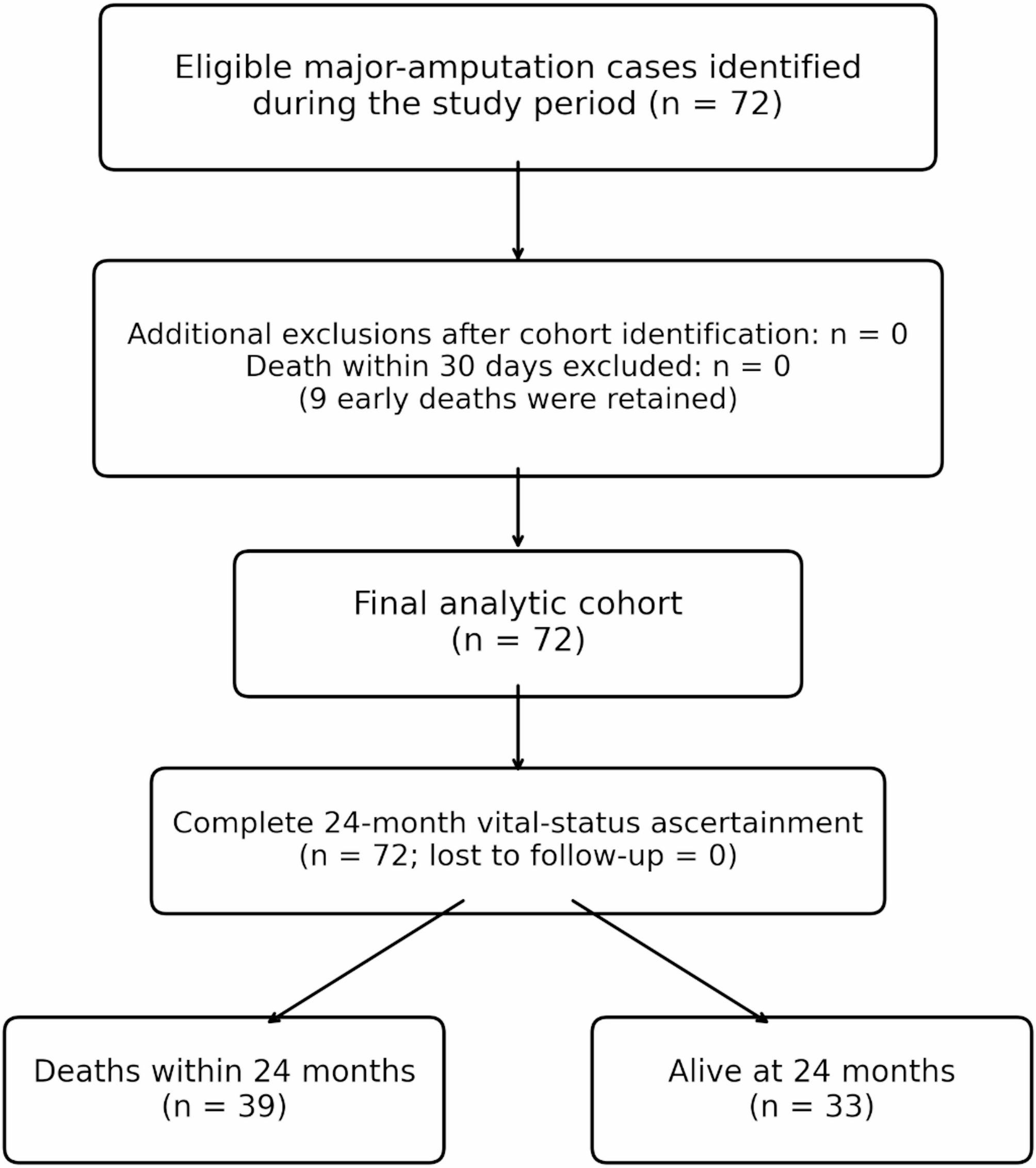
Background: Major lower extremity amputation for diabetic foot complications is associated with substantial mortality, particularly in older adults. We evaluated whether routinely available preoperative laboratory parameters provide prognostic information for 24-month mortality and developed an exploratory laboratory-based risk score. Methods: This retrospective cohort study included 72 patients aged ≥ 65 years who underwent transtibial or transfemoral amputation for diabetic foot complications between January 2021 and June 2023 at a tertiary referral center. Vital status was ascertained through July 31, 2025. Associations with 24-month all-cause mortality were evaluated using Cox proportional hazards regression. A 3-point score was derived from laboratory predictors using receiver operating characteristic analysis and Youden-index-based thresholds. Model discrimination and calibration were assessed, and bootstrap optimism correction was applied to the fixed three-biomarker Cox model. The proposed score was additionally compared with the Prognostic Nutritional Index (PNI), Geriatric Nutritional Risk Index (GNRI), and Hemoglobin–Albumin–Lymphocyte–Platelet (HALP) score. Results: Thirty-nine patients (54.2%) died within 24 months. Kaplan–Meier-estimated 24-month survival was 45.8% (95% CI 34.1–56.8%). In multivariable Cox analysis, higher hemoglobin (adjusted HR 1.302, 95% CI 1.041–1.628; p = 0.021), lower platelet count (adjusted HR 0.9966, 95% CI 0.9939–0.9994; p = 0.017), and lower albumin (adjusted HR 0.868, 95% CI 0.813–0.927; p < 0.001) were independently associated with mortality. One point was assigned for hemoglobin > 10.3 g/dL, platelet count < 342.5 × 10⁹/L, and albumin < 28.5 g/L. Patients with scores ≥ 2 had substantially lower 24-month survival than those with scores 0–1 (8.0% vs. 66.0%; log-rank p < 0.001). The score had an AUC of 0.798 for 24-month mortality. The underlying Cox model had an optimism-corrected C-index of 0.712. The score showed numerically higher discrimination than GNRI (AUC 0.739) and PNI (0.735), and higher discrimination than HALP (0.590). Conclusions: A simple score based on albumin, hemoglobin, and platelet count showed promising prognostic discrimination for 24-month mortality after major amputation in this geriatric diabetic foot cohort. Quantitative ischemia severity and standardized neuropathy and frailty assessments were unavailable, and the score was derived and evaluated in the same derivation cohort, while bootstrap optimism correction was limited to the fixed three-biomarker Cox model. It should therefore be regarded as exploratory, should not replace comprehensive clinical and vascular assessment, and requires external validation before clinical use.
From the paper
- Participants
This retrospective cohort study included 72 patients aged ≥ 65 years who underwent transtibial or transfemoral amputation for diabetic foot complications between January 2021 and June 2023 at a tertiary referral center.
- Result
In multivariable Cox analysis, higher hemoglobin (adjusted HR 1.302, 95% CI 1.041–1.628; p = 0.021), lower platelet count (adjusted HR 0.9966, 95% CI 0.9939–0.9994; p = 0.017), and lower albumin (adjusted HR 0.868, 95% CI 0.813–0.927; p < 0.001) were independently associated with mortality.
Quoted word for word from the full text on link.springer.com.
- Modelling and theory
- Diabetic foot complications
- Albumin
- Geriatric Nutritional Risk Index
- Hemoglobin
- Humans
The paper
BMC Geriatrics, Oct 17, 2026, CC BY