Isotemporal substitution in 24-hour movement behaviors and frailty risk in older adults: a compositional data analysis
Dose-response
Abstract
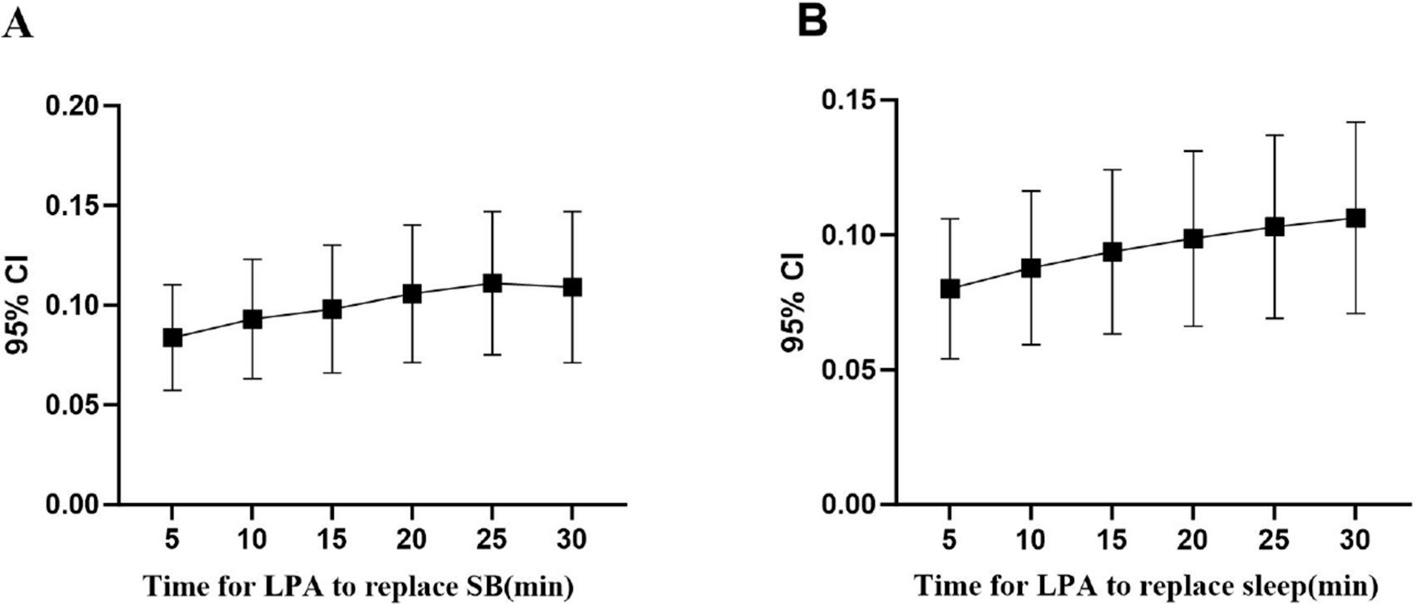
With the rapid aging of the population, frailty has become a critical public health priority. Currently, empirical evidence regarding the association between 24-hour movement behaviors and frailty in older adults remains limited. This study aims to investigate the association between the composition of 24-hour movement behaviors and frailty among community-dwelling older adults in China, and to estimate the predicted differences in frailty scores under hypothetical time reallocation among different behaviors. A total of 239 community-dwelling older adults aged 60 years and older were enrolled and wore wrist-worn accelerometers for 7 consecutive days to objectively measure their sedentary behavior (SB), light-intensity physical activity (LPA), moderate-to-vigorous physical activity (MVPA), and sleep duration (SP). Frailty was assessed using the Fried frailty phenotype. Compositional data analysis and isotemporal substitution models were used to examine the association between 24-hour movement behavior composition and frailty scores, and to estimate the predicted differences in frailty scores under hypothetical time reallocation among behaviors. Among the 239 participants, 38 were classified as frail, yielding a frailty prevalence of 15.90%. The composition of 24-hour movement behaviors was significantly associated with frailty scores (adjusted R² = 0.21, P < 0.001). MVPA was negatively associated with frailty scores ( β = −0.74, 95% CI: −1.00, −0.48; P < 0.001), while SB ( β = 0.62, 95% CI: 0.20, 1.04; P < 0.01) and SP ( β = 0.47, 95% CI: 0.01, 0.89; P < 0.05) were positively associated. In hypothetical reallocation models, reallocating 15 min from MVPA to SP, SB, or LPA was associated with predicted increases in frailty scores of 0.280, 0.278, and 0.252 points, respectively; the reverse substitutions were associated with predicted decreases of 0.202, 0.199, and 0.173 points, respectively. Dose-response analysis revealed that the upward slope of the curve when MVPA was reduced was steeper than the downward slope when MVPA was increased. In this cross-sectional sample, MVPA and SB were the behavioral components most closely associated with frailty scores. Under hypothetical time reallocation, replacing SB with MVPA was associated with lower predicted frailty scores; however, these findings cannot establish causality or intervention effects. Longer sleep duration was also associated with higher frailty scores, a finding that differs from some previous reports and warrants further investigation. Not applicable.
- Light-intensity physical activity
- Moderate-to-vigorous physical activity
- Sedentary behavior
- Fried frailty phenotype
- Light-intensity physical activity duration
- Humans
The paper
Hunan University of Technology
BMC Geriatrics, 13 Oct 2026, Open access, CC BY-NC-ND