Eye inflammation persisted in older mice but resolved in young
In an experiment tracking six young and eight old male mice, eye inflammation persisted in older animals through day 68 after disease induction.
Our read
Mechanisms- Studied:
- Experiments in young and old male mice, 10 to 68 days, against young mice
- What changed:
- Eye inflammation persisted in old mice, with median cumulative scores of 52.25 versus 4.25 in young mice during the chronic phase
- The catch:
- Only 6 young and 8 old mice contributed to the inflammation comparison
Editor of record: Boris Djordjevic · AgingResearch.News
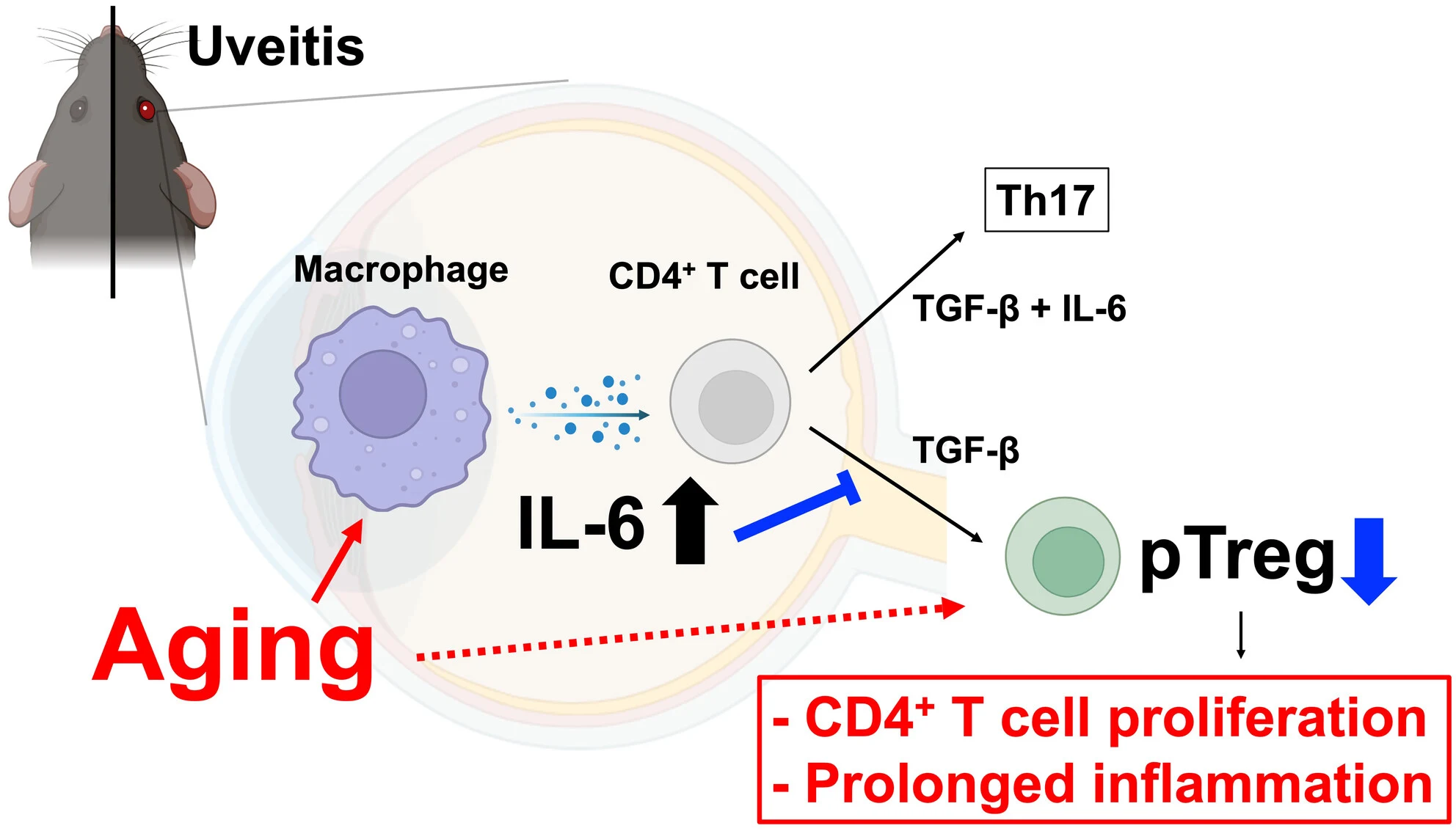
Male C57BL/6J mice aged seven weeks or 20 months underwent an experiment that induced autoimmune uveitis, eye inflammation caused by an immune attack. Researchers tracked six young and eight old mice from 10 to 68 days after induction. Inflammation began and peaked later in old mice. It resolved rapidly in young mice but persisted through day 68 in old mice.
In separate experiments with mouse cells grown in the lab, macrophages, immune cells that engulf debris, from old mice were less able to prompt the formation of regulatory T cells, which help restrain inflammation. T cells also divided more when grown with aged macrophages. Blocking signaling by interleukin-6, an immune signaling protein, removed the differences between young and aged macrophage cultures in T cell division and regulatory T cell formation.
Why it matters
Uveitis threatens vision, with older people bearing the greatest burden of visual impairment. Understanding how aging changes immune responses could guide approaches to resolving persistent inflammation.
Caveats
The experiments used induced eye disease in male mice; they do not show whether targeting this signaling would help older people with uveitis.
Where the evidence stands
Inflammation
- 1,071 independent labs in 77 countries
- 210 findings against
- Funders: National Natural Science Foundation of China and others
- 394 of 4,744 findings with company ties
IL-6 signaling
- 13 independent labs in 8 countries
- 1 finding against
- Funders: National Natural Science Foundation of China and others
The paper
Department of Ophthalmology and Visual Sciences Washington University School of Medicine St. Louis Missouri USA
Aging Cell, Nov 26, 2026, Open access, CC BY


Comments
Be the first to comment.