More reproduction did not shorten food-restricted worms’ lives
Worms deprived of food for 24 hours retained their survival benefit when food odor increased reproduction, challenging an explanation based on saving resources.
Our read
Interventions- Studied:
- Experiments in unmated Caenorhabditis elegans hermaphrodites, 24 h
- What changed:
- Lifespan did not differ between food-restricted worms induced to reproduce more and those without food odor
- The catch:
- Food-restricted worms could die before selection for assays, potentially masking costs during treatment
- In the record:
- One of 5,861 papers on dietary restriction on record: 20 with results in people, 222 in animals. Its result on survival agrees with 3 of 6 other findings on record; 2 point the other way and 1 found no change.
- Why it’s aging research:
- It studies an intervention with evidence of extending healthy life.
Editor of record: Boris Djordjevic · AgingResearch.News
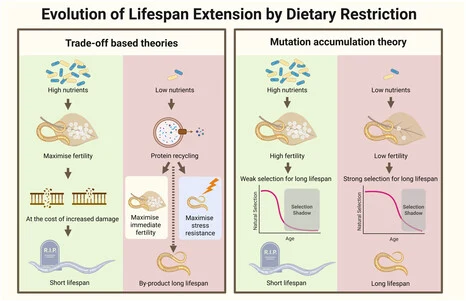
Caenorhabditis elegans worms went without food for 24 hours, with or without food odor, in experiments testing why dietary restriction extends lifespan. Fully fed worms served as controls. Restriction improved survival. Food odor increased reproduction under restriction without reducing its survival benefits. The results challenged the idea that eating less extends life by shifting resources from reproduction to maintaining the body.
The authors also developed a mathematical model of lifespan evolution. They proposed that suppressed fertility could strengthen natural selection against death under food restriction, allowing longer life to evolve without requiring a trade-off between reproduction and survival. They also proposed that mutation accumulation—the buildup of genetic changes—could account for reduced survival when food was plentiful.
Why it matters
Dietary restriction raises a question about the evolution of aging: why would scarce food favor longer life? The work tests whether that response requires diverting resources from reproduction to maintaining the body.
Caveats
The evolutionary explanation came from a model, not measurements of mutation accumulation. The model assumed food conditions lasted long enough for a stable mix of ages to develop; the experiments used one laboratory worm strain.
The paper
Mutation Accumulation Underpins Evolution of Lifespan Extension by Dietary Restriction
School of Biological Sciences University of East Anglia
Aging Cell, Nov 5, 2026, Open access, CC BY
Comments
Be the first to comment.