An interpretable ANFIS-NSGA-II framework for evidence-stratified modular wearable risk fusion in elder-health monitoring
Abstract
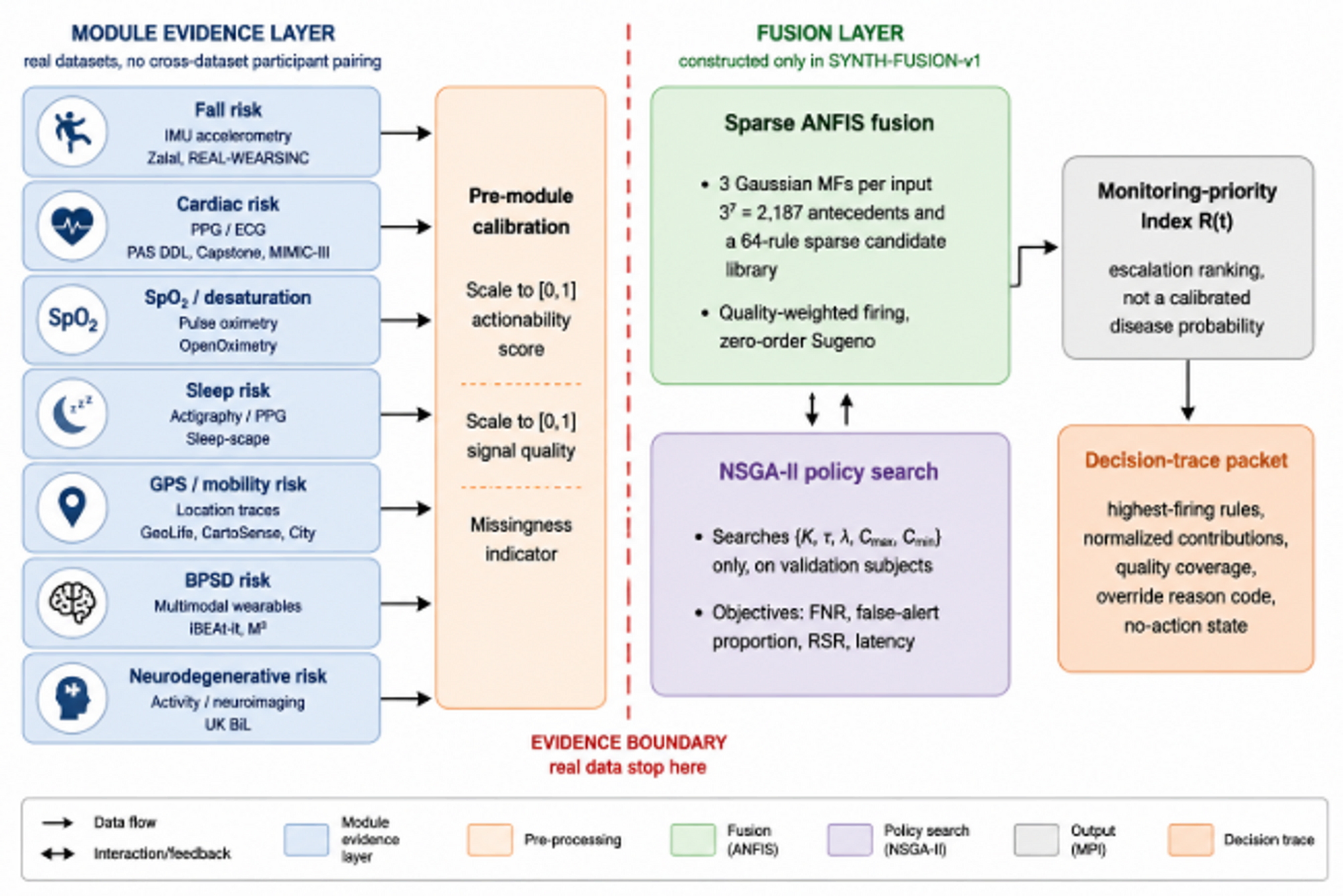
Wearable health monitoring spans fall, cardiac, oxygenation, sleep, mobility, behavioural and long-horizon neurodegenerative indicators that arise from different sensors, labels and time scales. This study presents an evidence-stratified Adaptive Neuro-Fuzzy Inference System optimized with the Non-dominated Sorting Genetic Algorithm-II (ANFIS-NSGA-II) that fuses module-specific actionability scores into an interpretable monitoring-priority index (MPI) without treating heterogeneous risks as equivalent disease probabilities. Because no synchronized seven-modality older-adult cohort was available, the complete fusion mechanism is evaluated in a controlled subject-indexed synthetic benchmark of 240 subjects and 2,880 observation windows, while real datasets provide module-level evidence and prospective validation targets. The full 3 7 antecedent grid is reduced to a training-derived 64-rule library by an explicitly specified ranking criterion, and the Pareto-selected policy retains 20 active rules. On 48 held-out subjects the frozen policy achieved an area under the receiver operating characteristic curve (AUROC) of 0.914 (95% participant-cluster bootstrap CI 0.871–0.948), area under the precision–recall curve (AUPRC) 0.888 (0.824–0.935), sensitivity 0.868 (0.779–0.935) and specificity 0.751 (0.639–0.832). Paired participant-cluster comparisons show that logistic regression, a generalized additive model, a random forest and a quality-weighted mean all reach discrimination that is statistically indistinguishable from the proposed model after correction for multiple comparisons; the proposed model is significantly better only than a max-risk rule. Ablations show that the 17 mandatory anchor rules alone are significantly worse than the selected policy (AUROC 0.861), that relaxing the anchor requirement lets the optimizer reach significantly higher discrimination with only 8 rules, and that quality-weighted marginalization is preferable to zero-filling but significantly inferior to simple imputation when signal quality is uniformly high, the alternatives converging only when quality is genuinely variable. A scenario analysis that varies interaction strength, interaction identity, label noise, target functional family and the share of escalation propensity driven by unobserved latent state quantifies how much of the reported performance reflects recovery of the authors' own generating mechanism: without label noise the target is deterministic conditional on the seven scores and the generator's subject-level offset, the model attains 72–98% of the oracle discrimination computed from the true propensity, and it exceeds logistic regression in only 1 of 14 scenarios. The contribution is therefore an auditable, reproducible fusion and policy-selection architecture rather than a gain in predictive accuracy, and every quantitative result is a proof-of-concept methodological finding on synthetic data. Prospective synchronized multimodal validation with clinician evaluation remains necessary before any clinical use.
The paper
KCG College of Technology; Vel Tech Rangarajan Dr. Sagunthala R&D Institute of Science and Technology
Scientific Reports, 12 Oct 2026, Open access, CC BY-NC-ND