Immune-cell traps induce senescence-related changes in eye cells
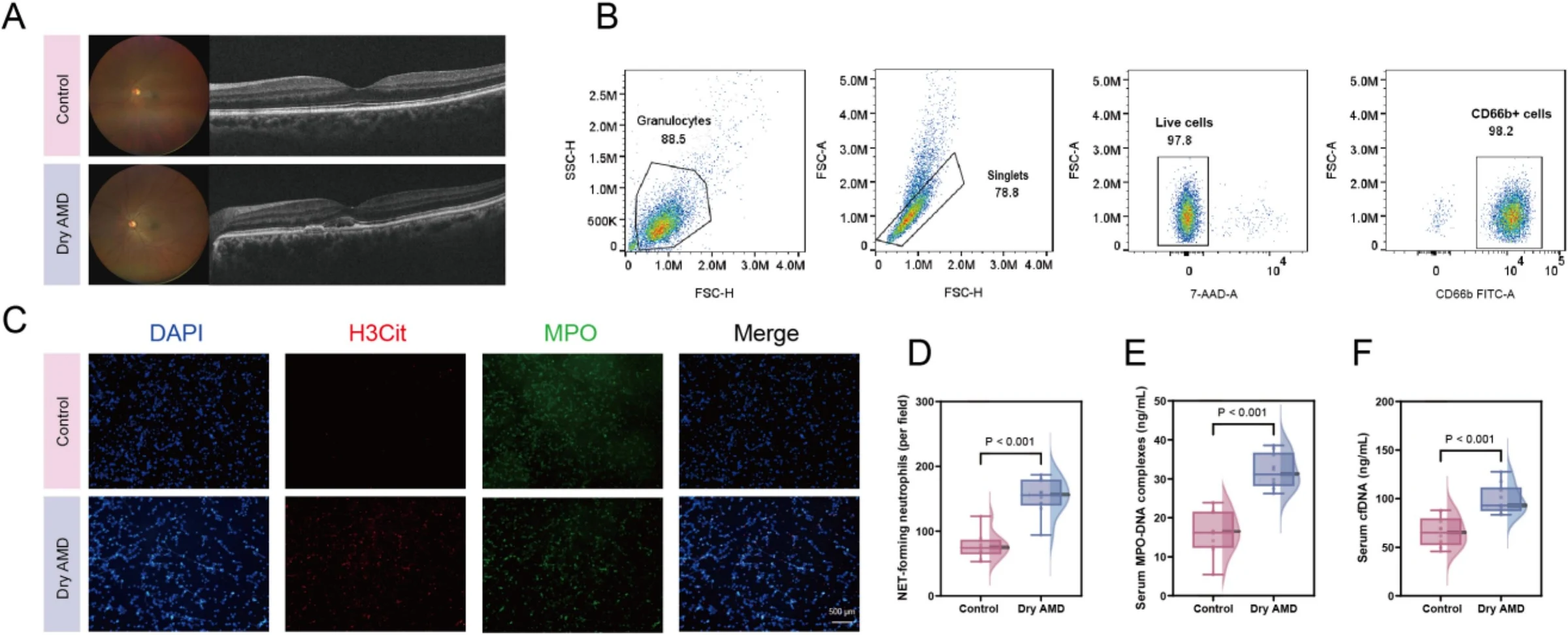
Experiments in lab-grown human retinal pigment cells found changes associated with senescence, a state in which cells stop dividing.
Our read
Mechanisms- Studied:
- Experiments in mice
Editor of record: Boris Djordjevic · AgingResearch.News
ARPE-19 cells, a human retinal pigment epithelial cell line grown in the lab, developed senescence-related changes after exposure to neutrophil extracellular traps in experiments. These traps are webs of material released by neutrophils, a type of immune cell. An enzyme that breaks down DNA markedly weakened the effects.
Trap exposure increased the amount of HIF-1α, a protein that regulates gene activity, in cell nuclei without an obvious change in its total amount. Reducing activity of the gene that produces this protein reduced the senescence-related changes. Restoring expression of its downstream target, the SLC2A1 gene, partly restored those changes. In mice given sodium iodate to induce retinal injury, suppressing trap formation reduced retinal damage, preserved retinal pigment cell structure and improved retinal function.
Why it matters
For dry age-related macular degeneration, the work addresses how immune-cell traps may contribute to retinal injury through changes associated with cell senescence.
Caveats
The cell experiments used the ARPE-19 cell line, and the mouse experiments involved chemically induced retinal injury. They do not show whether the same pathway contributes to dry age-related macular degeneration in people.
Where the evidence stands
GSK484
- 3 independent labs in 2 countries
- Funders: National Center for Advancing Translational Sciences and others
SLC2A1
- 21 independent labs in 12 countries
- 1 finding against
- Funders: National Natural Science Foundation of China and others
Comments
Be the first to comment.