Tool enriches senescent cells in lab-grown cultures
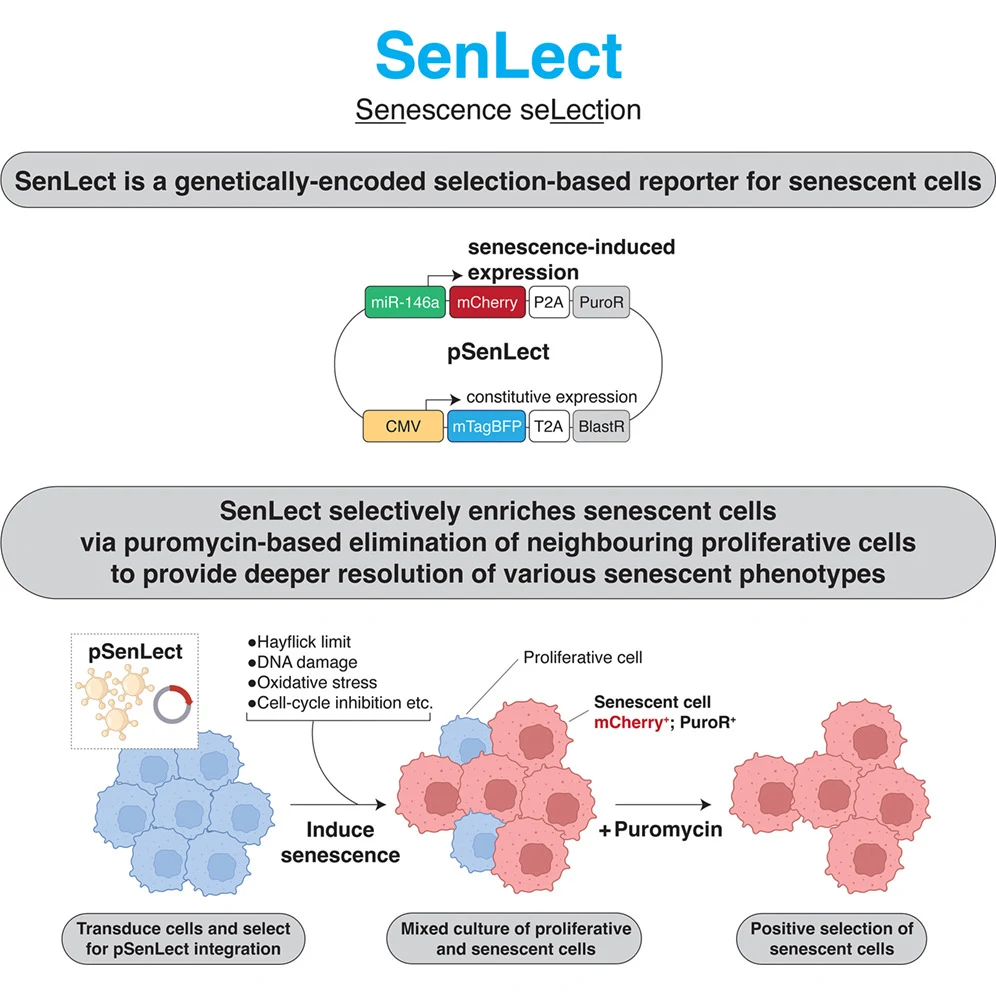
In cell-culture experiments, SenLect labeled senescent cells and enriched them by selectively eliminating neighboring cells that were still dividing.
Our read
Mechanisms- Studied:
- Experiments in senescent cells in lab-grown cultures
- What changed:
- SenLect increased the proportion of senescent cells in cultures by eliminating neighboring dividing cells
- The catch:
- Enrichment was measured only in cultured cells, not in living tissue
Editor of record: Boris Djordjevic · AgingResearch.News
Senescent cells grown in the lab were the target of experiments to develop SenLect, a system encoded in cells’ DNA that labels and enriches them. Senescence is a state in which cells stop dividing. Cultures of these cells often also contain cells that continue dividing, which can obscure the molecular features researchers want to study.
SenLect used a DNA control region that responds to senescence to selectively eliminate neighboring, dividing cells. This enriched the senescent cells remaining in the culture. Existing reporters typically detect senescent cells without purifying them. Sorting-based isolation, another approach, can stress fragile senescent cells and lead to cell loss.
Why it matters
For aging research on cellular senescence, purer cell cultures may make it easier to study molecular features that dividing cells can obscure.
Caveats
The experiments tested cells grown in the lab, leaving open how the system would work in living tissue.
The paper
A genetically encoded system to purify senescent cells
Cell Reports Methods, Nov 2026, CC BY-NC
Comments
Be the first to comment.