Gene change reduced dementia-linked protein clumps in mice
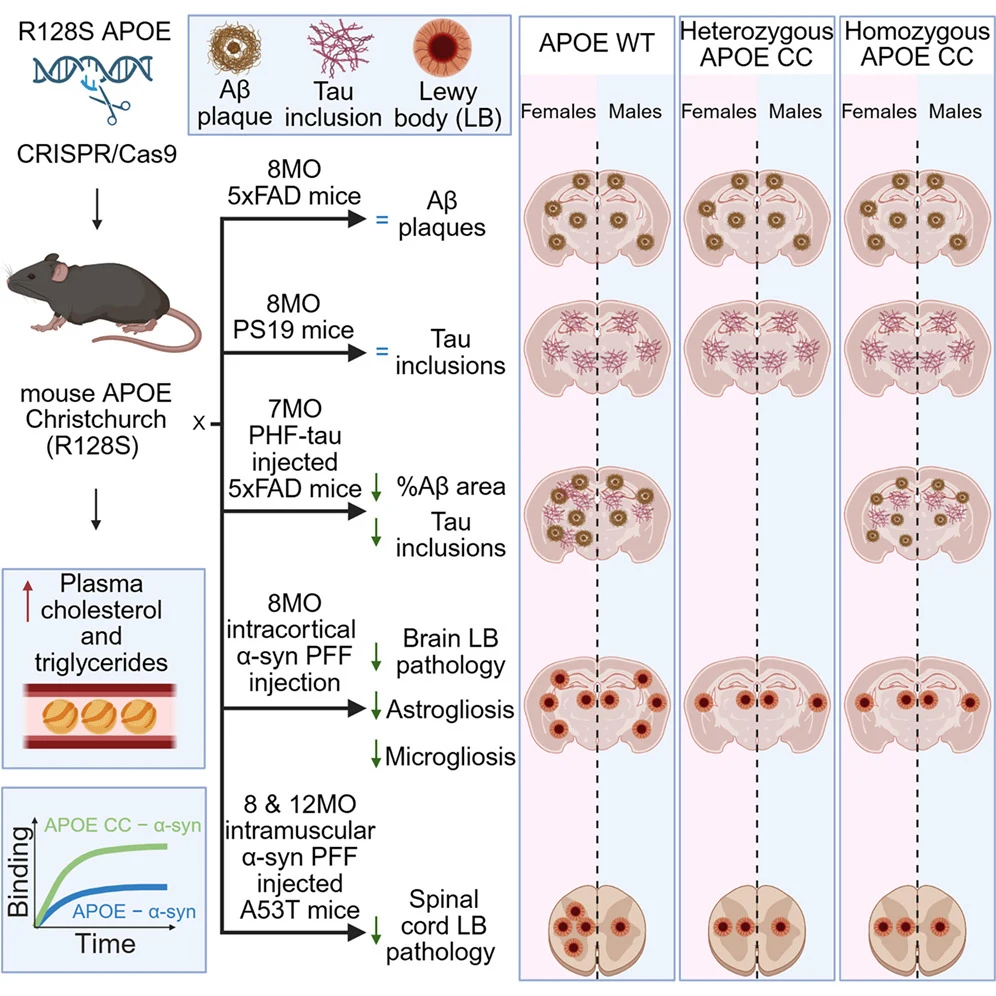
Experiments in genetically engineered mice found that the Christchurch mutation reduced some protein clumps associated with Alzheimer’s disease and other dementias.
Our read
Mechanisms- Studied:
- Experiments in female mice injected with aggregated tau, 3 months
- What changed:
- Female mice carrying APOE Christchurch had fewer brain tau clumps than controls after tau injection
- The catch:
- Only 3 females per group supported the tau-clump reduction
- In the record:
- One of 3,919 papers on APOE on record: 1,041 with results in people, 97 in animals.
Editor of record: Boris Djordjevic · AgingResearch.News
Mice with the Christchurch mutation engineered into their own APOE gene underwent experiments tracking dementia-linked protein buildup. APOE provides instructions for a protein that transports fats. In an Alzheimer’s mouse model, the mutation reduced amyloid-beta buildup and amyloid-triggered tau abnormalities after researchers injected Alzheimer’s-related tau into the brain. Amyloid-beta and tau are proteins linked to Alzheimer’s disease. The mutation did not change either protein’s abnormalities in separate genetically engineered mouse models without those injections.
The mutation also reduced the formation and spread of alpha-synuclein clumps in the brain. This protein is linked to Parkinson’s disease and dementia with Lewy bodies. The altered APOE protein bound more strongly to alpha-synuclein than the unaltered version did. Mice carrying the mutation also had higher blood cholesterol and triglycerides, another type of fat.
Why it matters
Age-related brain diseases involve several kinds of protein buildup. These experiments address whether APOE’s effects extend beyond the proteins most closely associated with Alzheimer’s disease.
Caveats
The experiments tested a mutation in mice’s own APOE gene, leaving open whether it would have the same effects in people.
Where the evidence stands
APOE
- 308 independent labs in 54 countries
- 127 findings against
- Funders: National Institute on Aging and others
- 207 of 1,485 findings with company ties
APP
- 93 independent labs in 24 countries
- 4 findings against
- 69 trials, 15 with no results posted
- Funders: National Institute on Aging and others
- 34 of 223 findings with company ties
- 68 of 69 trials sponsored by developers of drugs aimed at it
The paper
Mouse APOE Christchurch protects against Aβ-induced tau and α-synuclein aggregation
Oregon Health & Science University
Cell Reports, Nov 10, 2026, Open access, CC BY-NC

Comments
Be the first to comment.