Intermittent fasting enhances muscle repair in mice
Experiments in mice found that intermittent fasting expanded muscle stem cells and helped their descendants multiply and merge into muscle fibers.
Our read
Interventions- Studied:
- Experiments in mice with injured skeletal muscle
- What changed:
- Mice on intermittent fasting regenerated injured skeletal muscle more effectively
- The catch:
- Outcomes cover muscle repair, not preservation of muscle with age
- In the record:
- One of 813 papers on intermittent fasting on record: 195 with results in people, 209 in animals.
- Why it’s aging research:
- An intervention with evidence on lifespan or healthspan.
Editor of record: Boris Djordjevic · AgingResearch.News
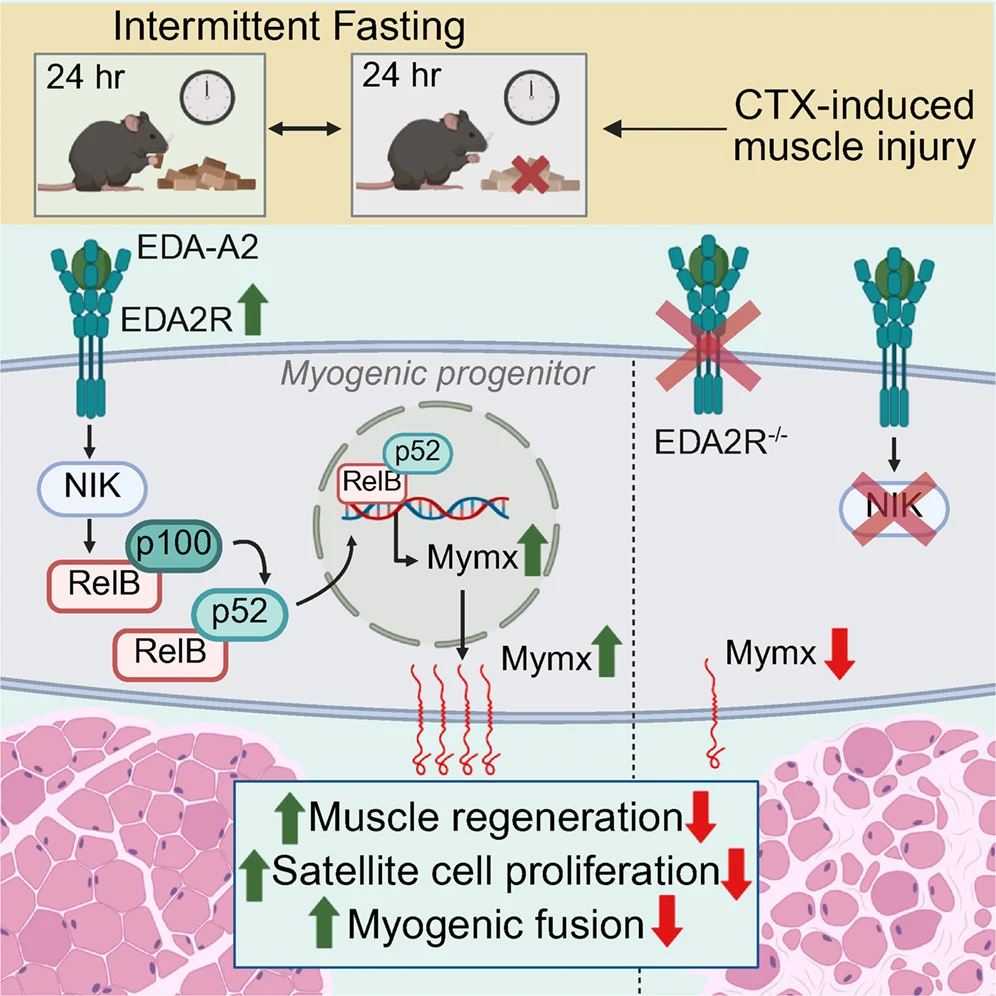
Mice on an intermittent fasting regimen regenerated injured skeletal muscle more effectively in animal experiments. Fasting expanded satellite cells, adult muscle stem cells that supply new cells for repair. It also helped their descendants multiply and merge into muscle fibers. These effects were absent when researchers depleted the satellite cells.
In myoblasts, cells that develop into muscle fibers, fasting-induced signaling increased activity of the gene for Myomixer, a protein that helps cells merge. Mice lacking either of two components of this signaling pathway did not show fasting’s muscle-forming effects. The findings also suggested that mice with Duchenne muscular dystrophy, a muscle-wasting disease, benefited from intermittent fasting.
Why it matters
Muscle repair matters for maintaining muscle as bodies age. The authors suggest that fasting-induced regeneration holds potential for aiding recovery from muscle damage.
Caveats
The evidence concerns muscle repair in mice, not improved recovery in people or preservation of muscle with age.
Where the evidence stands
Intermittent fasting
- 234 independent labs in 49 countries
- 87 findings against
- Funders: National Institutes of Health and others
- 48 of 985 findings with company ties
EDA2R
- 8 independent labs in 8 countries
- Funders: National Research Foundation and others
- 3 of 10 findings with company ties


Comments
Be the first to comment.