Low vitamin D linked to greater frailty in adults
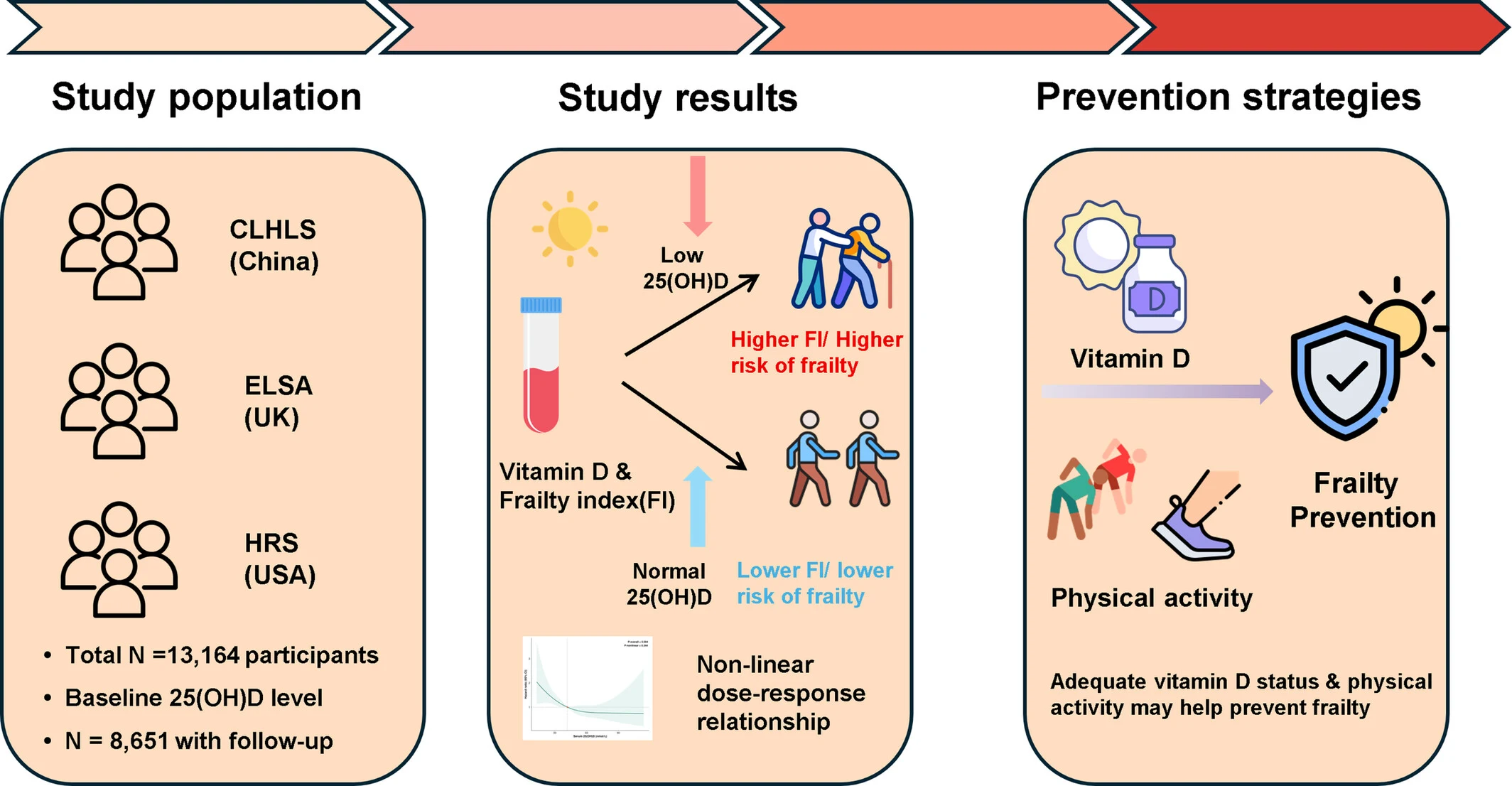
Low versus normal vitamin D was linked to a 76% higher relative risk of developing frailty in China and 27% in England.
Our read
Populations- Studied:
- Cohort study of initially non-frail middle-aged and older adults (Dose-response, multicenter)
- What changed:
- Frailty risk with low vitamin D was higher in China (76%) and England (27%), but not clearly different in the US
- The catch:
- Vitamin D was measured only at baseline, missing changes during follow-up
- In the record:
- The 399th paper on 25-hydroxyvitamin D with results in people; 1,149 on record in all. Its result on frailty agrees with 2 of 8 other findings on record; 3 point the other way and 3 found no change.
Editor of record: Boris Djordjevic · AgingResearch.News
Adults aged 65 or older in China and 50 or older in England and the United States made up three prospective cohort studies totaling 13,164 participants. Researchers measured blood vitamin D at enrollment and assessed frailty using a score based on accumulated health problems. They tracked new frailty among participants who were not frail initially.
Low vitamin D—50 nanomoles per liter or less—was linked to higher frailty scores in all three cohorts compared with levels above that threshold. Low levels were also linked to higher risk of developing frailty in China and England. The corresponding US estimate’s range of likely values included no difference. The link between higher vitamin D and lower risk of developing frailty was stronger among more physically active participants in all three cohorts.
Why it matters
For frailty in later life, the authors suggest vitamin D may be a modifiable target for prevention.
Caveats
The authors note that poorer health could contribute to lower vitamin D, and other differences between participants could partly explain the links. The findings do not cover people younger than 65 in China or younger than 50 in England and the United States.
From the paper
- Participants
This study included 13,164 participants: 2038 from CLHLS (mean age, 85.42 years), 6061 from ELSA (mean age, 66.61 years), and 5065 from HRS (mean age, 74.55 years).
Results, 3.1 Baseline Characteristics of the Study Population
- Limitation
First, as an observational study, it cannot completely exclude the possibility of residual confounding or reverse causation, despite adjustment for a range of potential confounders and the consistent direction of findings across multiple cohorts.
Quoted word for word from the full text on onlinelibrary.wiley.com.
Vitamin D is part of Rhonda Patrick's supplement routine and David Sinclair's daily regimen in LifespanMore supplements
The paper
School of Public Health Shanxi Medical University Taiyuan China
Food Science & Nutrition, Nov 13, 2026, Open access, CC BY

Comments
Be the first to comment.