Reducing a brain-development protein shortened life in flies
Experiments reducing Ankle2 in adult fly nerve cells also impaired movement and accelerated nerve-cell loss, suggesting a role in maintaining neurons as they age.
Our read
Mechanisms- Studied:
- Preprint: experiments in adult fruit flies
- What changed:
- Reducing Ankle2 in adult fly nerve cells shortened lifespan
- The catch:
- Reported rescue outcomes cover movement and protein accumulation, not lifespan
Editor of record: Boris Djordjevic · AgingResearch.News
Adult fruit flies underwent experiments that reduced Ankle2, a protein involved in brain development, either across nerve cells or in those controlling movement. Both approaches shortened lifespan, impaired movement and accelerated nerve-cell loss. Reducing Ankle2 throughout life produced more severe effects.
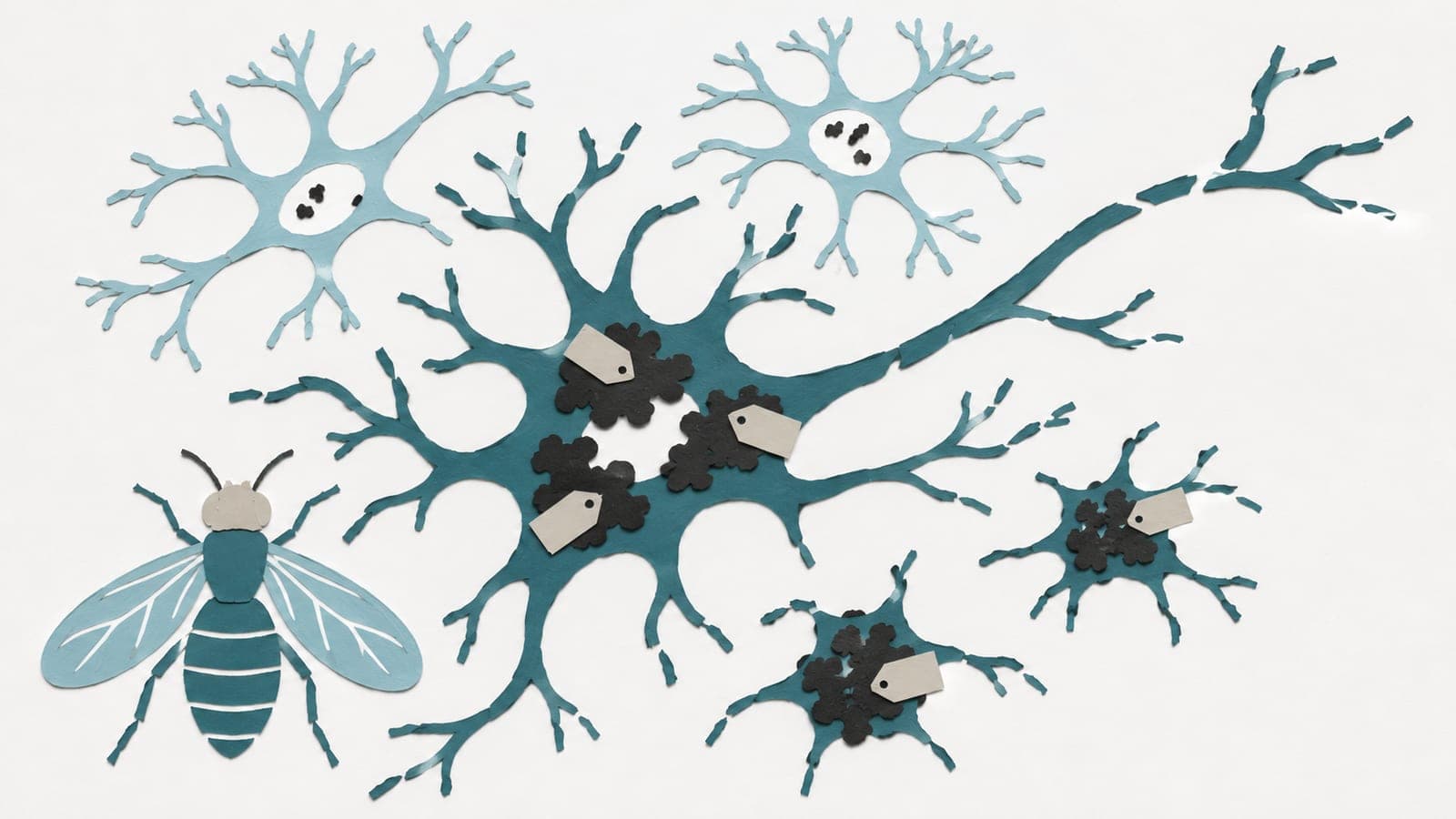
Flies lacking Ankle2 accumulated proteins tagged for disposal throughout the central nervous system. Mutant flies also had lower activity of proteasomes, the machinery that breaks down proteins. These findings supported the authors’ interpretation that protein clearance was impaired. Producing human ANKLE2 in flies rescued their movement and protein-accumulation problems. Reducing VRK1/Ballchen, an enzyme inhibited by Ankle2, also rescued those problems. The authors concluded that this developmental pathway remained important for maintaining protein balance and nerve-cell resilience during aging.
Why it matters
Protein clearance helps nerve cells maintain themselves as they age. The authors propose that this pathway provides a link between genes involved in developmental disorders and age-related nerve-cell degeneration.
Caveats
The experiments tested gene reductions in flies, so they do not show whether the same effects occur in aging human nerve cells. The work is a preprint and has not been peer-reviewed.
The paper
The ANKLE2-VRK1 pathway promotes neuronal resilience by preserving proteostasis during aging
University of Utah
bioRxiv, Nov 16, 2026, Open access, CC BY-NC-ND, Preprint, not yet peer-reviewed


Comments
Be the first to comment.