Brain chemical byproducts linked to neuron formation in humans
A postmortem observational study of young and aged individuals and people with Parkinson disease dementia linked chemical byproducts to gene activity involved in neuron formation.
Our read
Mechanisms- Studied:
- Preprint: cross-sectional study of people with and without Parkinson disease dementia
- What changed:
- Dopamine and serotonin breakdown products were linked to gene activity marking neuron formation, even after accounting for diagnostic group
- The catch:
- Chemical byproduct changes could follow reduced neuron formation rather than precede it
- In the record:
- One of 6 papers on 5-HIAA on record: 1 with results in people, 1 in animals.
- Why it’s aging research:
- It studies organisms or tissues that aged naturally.
Editor of record: Boris Djordjevic · AgingResearch.News
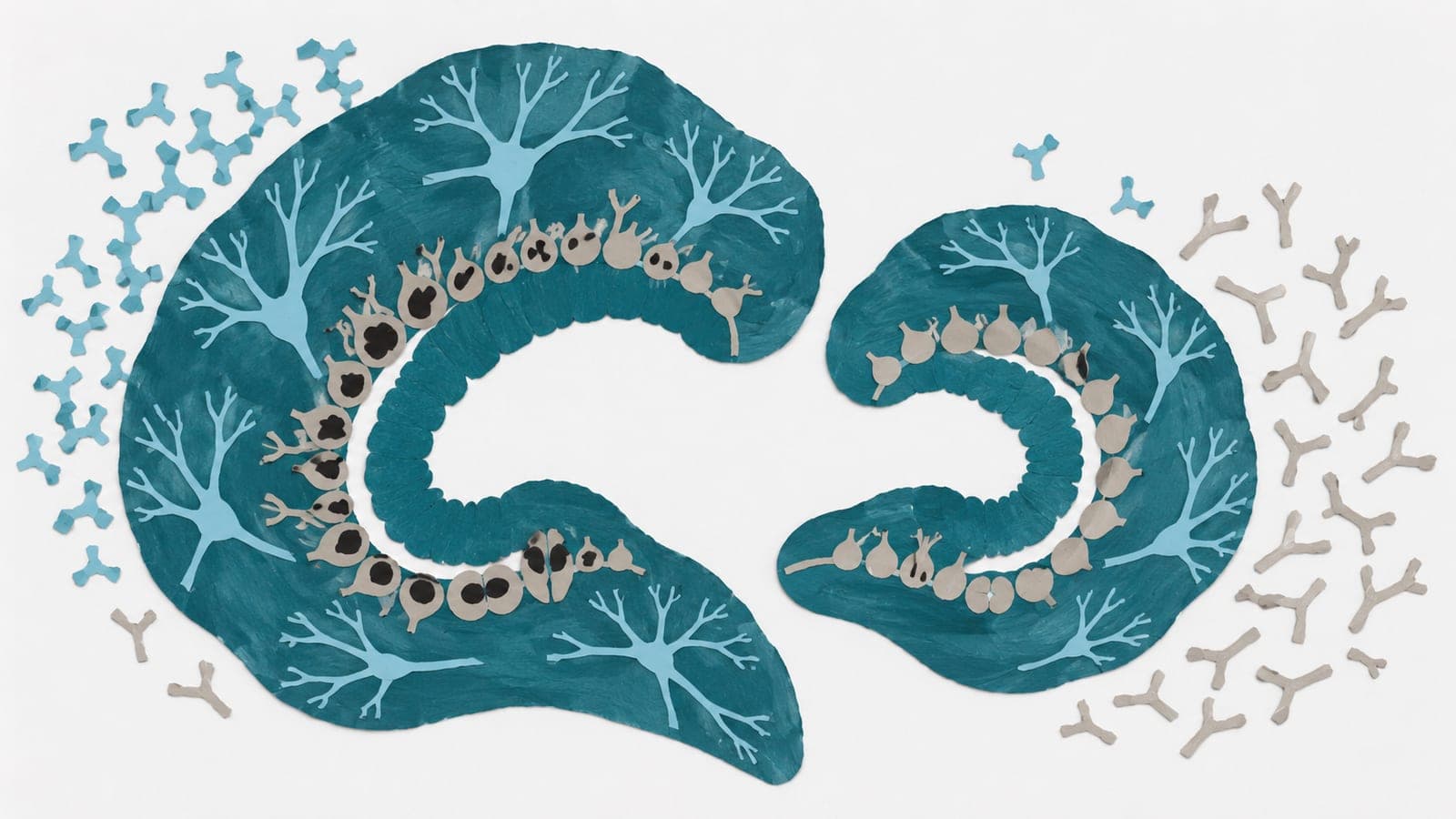
Human hippocampus tissue was examined after death in an observational study of young and aged individuals and people with Parkinson disease dementia. The hippocampus is a brain region involved in memory. Researchers measured gene activity related to new-neuron production and maturation, alongside dopamine, serotonin and their breakdown products.
Gene activity marking immature neurons and dividing cells was markedly lower throughout the hippocampus in dementia cases. Dopamine and serotonin levels were unchanged, but a dopamine breakdown product was lower and a serotonin breakdown product was higher in dementia cases. Both breakdown products were associated with the activity of these genes even after accounting for diagnostic group.
Why it matters
New-neuron formation is thought to support memory and emotional regulation. The authors suggest that changes in dopamine and serotonin systems may connect impaired neuron formation with cognitive decline in Parkinson disease dementia.
Caveats
Gene activity in postmortem tissue was a proxy for neuron formation, not a direct count of new neurons. The measurements could not show which changes came first, and the preprint has not been peer-reviewed.
The paper
The University of Sydney
bioRxiv, Nov 4, 2026, Open access, CC BY-NC-ND, Preprint, not yet peer-reviewed

Comments
Be the first to comment.