Brain wiring links to different thinking skills with age
In 86 adults, brain scans showed widespread white matter changes, while older people relied on different nerve pathways than younger adults for executive tasks.
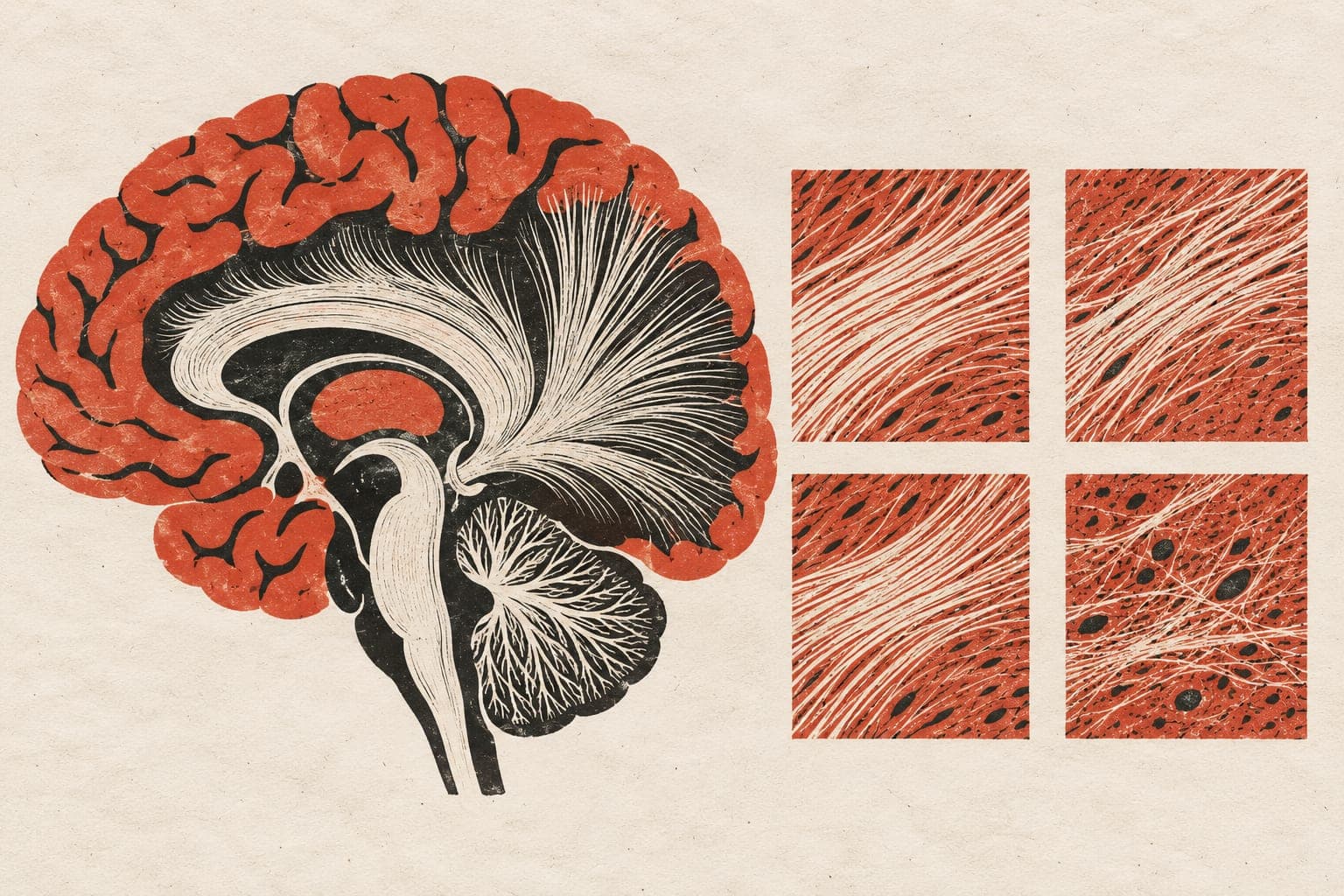
In an observational study of 86 cognitively normal adults, including 33 younger and 53 older participants, researchers analysed brain white matter to track structural changes across age groups. White matter forms the nerve fibre tracts that connect brain regions.
Brain scans revealed widespread differences across the whole brain in older adults. Compared with younger participants, older adults had lower neurite density, a measure of nerve cell fibres, alongside greater water diffusion. Age also altered how these pathways related to mental performance. Younger adults showed stronger links between memory and tracts connecting the brain hemispheres. In contrast, older adults relied more on limbic and projection pathways for language and executive function, the mental skills used for planning and focus.
Why it matters
Understanding how white matter alters with age, and how different neural pathways support thinking across life, may help identify markers of healthy brain aging and cognitive decline. These regional patterns also suggest specific cellular targets for studying why certain brain pathways are vulnerable to aging.
Caveats
The study was cross-sectional, comparing separate groups at a single time rather than following individuals as they aged. The findings were reported in a preprint and rely on a relatively small group of 86 volunteers.
The paper
Microstructural heterogeneity of white-matter aging and its age-dependent coupling to cognition
Brown University
bioRxiv, 9 Oct 2026, CC BY-NC-ND, Preprint, not peer-reviewed