Oldest mice showed stronger brain responses to loud sounds
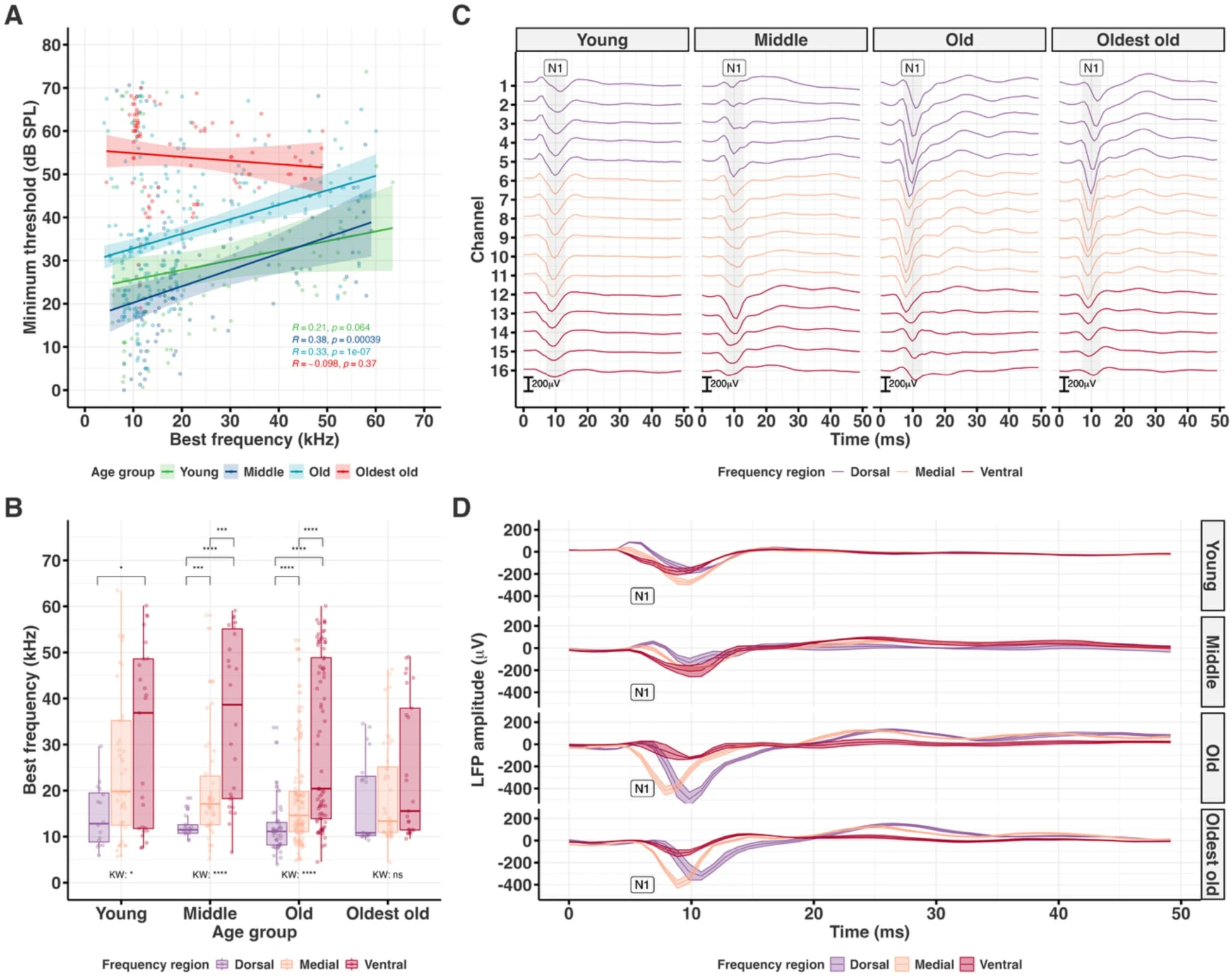
Recordings from 495 sites in 41 mice across four age groups found heightened responses mainly in brain regions that process low- and mid-pitched sounds.
Our read
Mechanisms- Studied:
- Preprint: experiments in 41 CBA/CaJ mice of both sexes, against young animals
- What changed:
- Oldest mice had larger N1 amplitudes at 80 dB SPL: -397 ± 154 µV against young -164 ± 133 µV
- The catch:
- Sedation sensitivity can differ with age and confound sound-evoked neural responses
- Why it’s aging research:
- It looks at how biology varies with age or lifespan.
Editor of record: Boris Djordjevic · AgingResearch.News
In an experiment in 41 CBA/CaJ mice of both sexes, researchers compared sound responses across four age groups: 4–6, 8–14, 24–25 and 27–31 months. They recorded electrical signals at 495 sites in the inferior colliculus, a midbrain area that processes sound, while sedated mice heard noise bursts. These signals reflect combined inputs that excite or restrain nearby nerve cells.
At high sound levels, the oldest mice showed stronger initial responses than younger groups in regions that process low- and mid-pitched sounds. The region that processes high-pitched sounds showed no such increase. At low-to-moderate sound levels, the oldest mice had weaker responses across all three regions.
Why it matters
Age-related hearing loss may involve regional changes in the balance between signals that excite and restrain nerve cells in the brain, the authors suggest.
Caveats
The analysis used recording sites as separate units even though multiple sites came from each mouse. The oldest group included seven mice, and the preprint has not been peer-reviewed.
The paper
University of South Florida
bioRxiv, Sep 11, 2026, Open access, CC BY-NC, Preprint, not yet peer-reviewed
Comments
Be the first to comment.