Body electrical measure linked to disease burden in adults
Each degree lower relative to age- and sex-expected readings was associated with 13.3% higher adjusted prevalence of disease in at least one clinical category.
Our read
Biomarkers- Studied:
- Preprint: cross-sectional study of 94,552 adults aged 18 to 90 years
- What changed:
- Disease prevalence was 13.3% higher per 1° lower phase angle relative to age- and sex-expected values
- The catch:
- Diagnoses could not be centrally rechecked because source clinical records were unavailable
Editor of record: Boris Djordjevic · AgingResearch.News
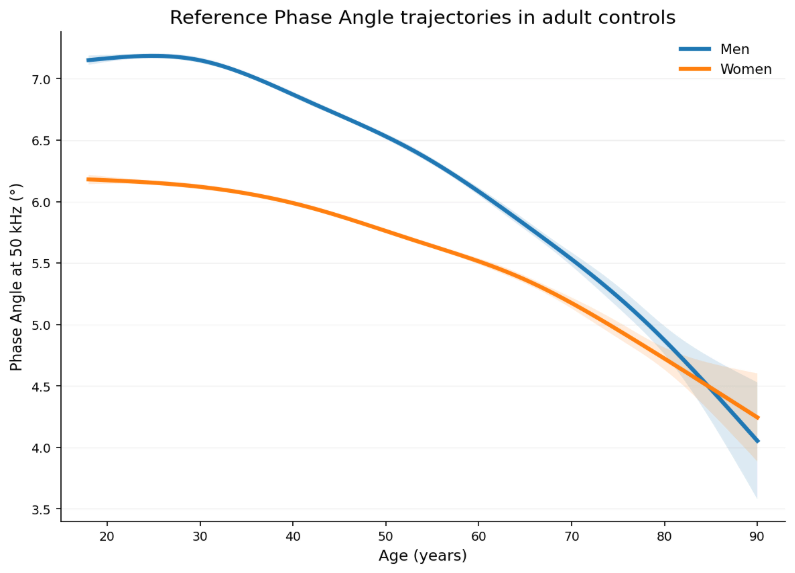
Among 94,552 adults aged 18 to 90, including 60,803 women, an observational analysis examined phase angle, a measure of the body’s electrical properties. Researchers compared each person’s reading with the value expected for their age and sex.
They examined clinically confirmed diagnoses in five categories: heart and blood vessel disease, cancer, psychological conditions, chronic inflammatory disease and metabolic syndrome, a cluster of risk factors for diabetes and heart disease. The analysis included 51,955 controls and 42,597 people with at least one affected category. Readings further below age- and sex-expected values were associated with more affected categories. Compared with controls, the adjusted difference was −0.154 degrees with one affected category and −0.391 degrees with four or more.
Why it matters
Phase angle varies with age and sex, raising the question of whether lower readings reflect expected age differences or a greater burden of disease.
Caveats
The analysis linked readings with existing diagnoses, leaving open whether illness contributed to lower readings. This preprint has not been peer-reviewed, and its findings cover adults aged 18 to 90.
From the paper
- Participants
The sample included 94,552 adults: 51,955 controls with no known disorders or diseases and 42,597 participants with at least one clinically confirmed diagnosis within the five predetermined domains.
- Limitation
The cross-sectional design does not establish causality or temporal sequence, but the lrge number of participants provides enough power for all statistical analyses.
Quoted word for word from the full text on researchsquare.com.
The paper
BioTekna; Florida State University
Research Square, Nov 20, 2026, Open access, Preprint, not yet peer-reviewed


Comments
Be the first to comment.