Worsening frailty linked to death risk across blood pressure trends
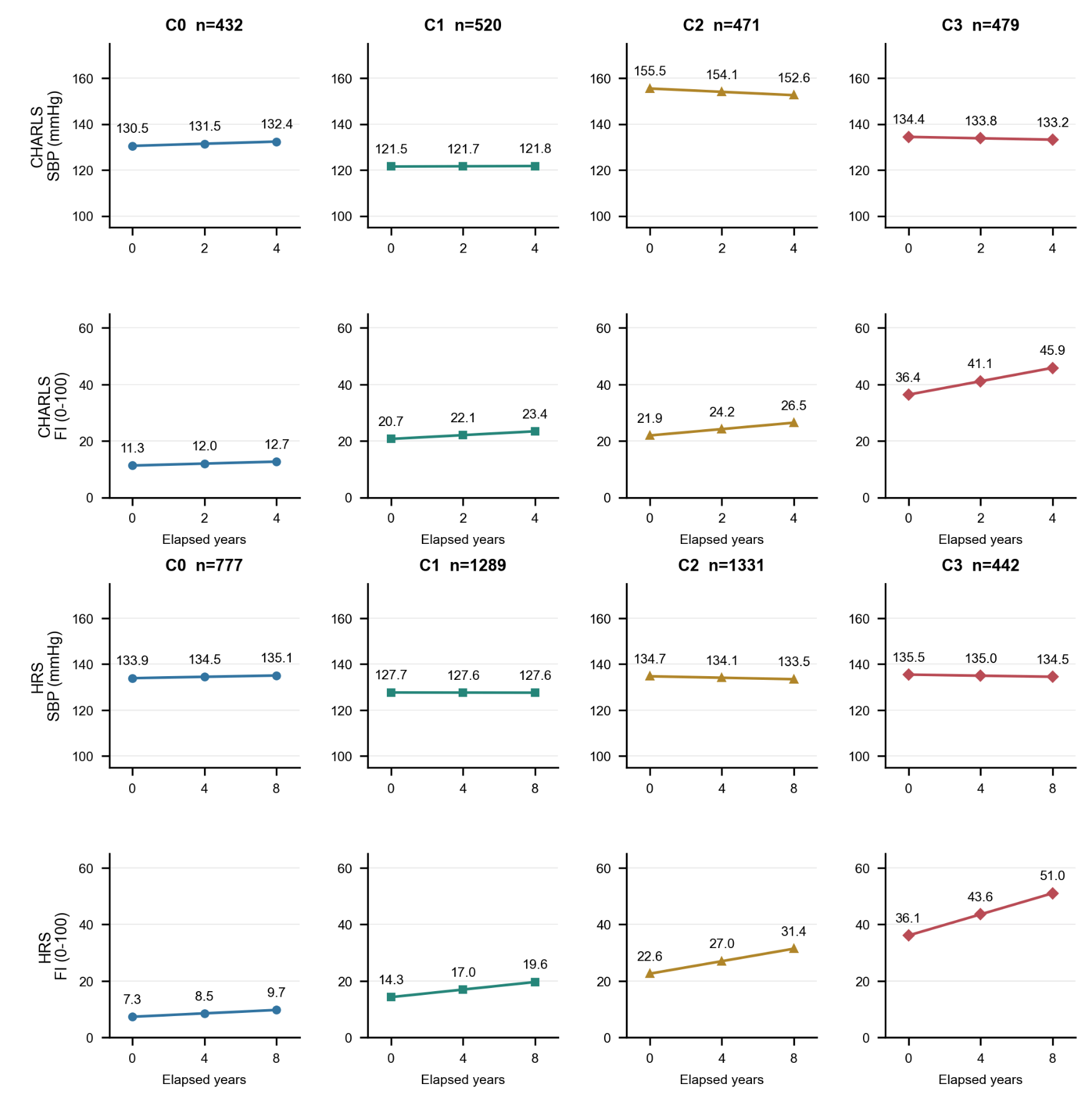
The highest-frailty group had 1.65 times the death rate in China and 2.21 times in the US compared with the lowest-frailty group.
Our read
Populations- Studied:
- Preprint: study in people
Editor of record: Boris Djordjevic · AgingResearch.News
Adults aged 65 or older—1,902 in China and 3,839 in the US—contributed three paired blood pressure and frailty assessments to an observational analysis. Researchers tracked systolic pressure, the upper number in a blood pressure reading, and a 30-item score of health problems and limitations. Assessments spanned four years in China and eight in the US, followed by monitoring for deaths and reported heart disease or stroke.
Rapidly worsening frailty was linked to higher mortality whether blood pressure fell, stayed relatively steady or rose. Blood pressure’s direction itself showed no mortality association. The highest-frailty groups also had higher rates of reported cardiovascular disease. Grouping people by both measures did not predict outcomes better than initial measurements plus the pace of frailty change.
Why it matters
Falling blood pressure after 65 may reflect successful treatment or deteriorating health. The authors say it warrants assessing frailty alongside blood pressure.
Caveats
Only about half of baseline-eligible participants completed all three assessments, favoring younger, less frail survivors; weighting could not remove unmeasured selection. Heart disease and stroke were self-reported, and this preprint has not been peer-reviewed.
From the paper
- Result
The highest-FI class—ordinary-to-moderate SBP with high, rapidly rising frailty—had mortality hazard ratios (HRs) versus the lowest-FI class of 1.65 (95% CI 1.18–2.31) in CHARLS and 2.21 (1.64–2.97) in HRS, and CVD HRs of 3.21 (1.88–5.49) and 2.51 (1.32–4.77).
- Limitation
IPSW addressed measured selection among documented landmark survivors and produced stable weights, but it cannot reconstruct outcomes of formation-period decedents, correct unobserved health trajectories or establish generalizability to all adults aged 65 years and older.
Quoted word for word from the full text on researchsquare.com.
The paper
Nanyang Central Hospital; First Affiliated Hospital of Henan University of Traditional Chinese Medicine
Research Square, Nov 5, 2026, Open access, Preprint, not yet peer-reviewed

Comments
Be the first to comment.