Age and bladder cancer stage linked to different death risks
Bladder-cancer death was linked more strongly to stage, with a hazard ratio of 22.92 for stage IV versus stage 0a.
Our read
Populations- Studied:
- Preprint: study in people
Editor of record: Boris Djordjevic · AgingResearch.News
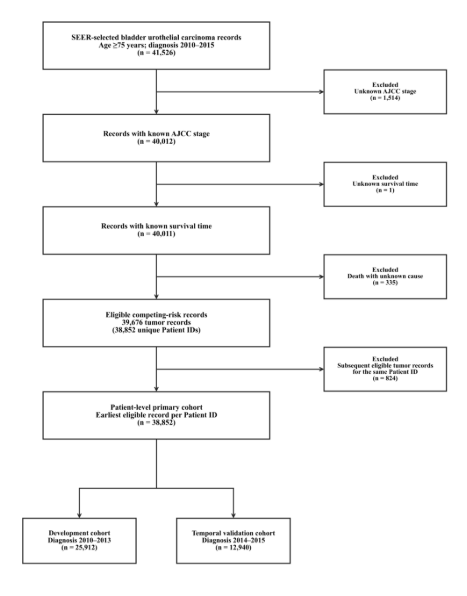
Adults aged 75 or older with bladder urothelial carcinoma, a cancer of the bladder lining, were studied in a retrospective observational cohort of 38,852 people diagnosed in 2010–2015. Researchers analyzed registry records over an 84-month observation window. Hazard ratios compared death rates among people still alive at a given time. For deaths from other causes, the hazard ratio was 3.68 for those aged 90 or older versus 75–79.
Other-cause death rates predominated near diagnosis in stages 0a, 0is and I. Sustained shifts to higher other-cause death rates occurred at approximately 40.5 months in stage II and 56.5 months in stage III. No stable crossover emerged in stage IV. Nevertheless, bladder-cancer deaths remained more frequent overall at 84 months in stages II and III.
Why it matters
Older adults with bladder cancer face health threats beyond their cancer. The authors suggest that the changing balance may inform the timing and focus of follow-up assessments, without replacing an individual assessment of an older person’s health.
Caveats
The retrospective registry analysis could not establish that age or stage caused the death-rate differences; differences in patients’ underlying health or care may also have contributed. The cohort included only adults aged 75 or older, and the preprint has not been peer-reviewed.
From the paper
- Participants
Among 38,852 patients, stage IV versus stage 0a was associated with a bladder-cancer death hazard ratio of 22.92 (95% confidence interval 21.24–24.72).
- Result
Among 38,852 patients, stage IV versus stage 0a was associated with a bladder-cancer death hazard ratio of 22.92 (95% confidence interval 21.24–24.72).
- Limitation
Residual confounding limits interpretation of the adjusted associations, and an age category cannot substitute for these clinical measures.
Quoted word for word from the full text on researchsquare.com.
The paper
Lanzhou University Second Hospital
Research Square, Nov 5, 2026, Open access, Preprint, not yet peer-reviewed



Comments
Be the first to comment.