Chest infection linked to death after hip fracture surgery
Infection before surgery was linked to higher relative death rates than no infection, with adjusted hazard ratios of 2.68 at 30 days and 1.71 at one year.
Our read
Populations- Studied:
- Preprint: cohort study of 1,922 older adults undergoing hip fracture surgery, 1-year (Multicenter)
- What changed:
- 30-day risk of death was higher with preoperative chest infection than without it (hazard ratio 2.68)
- The catch:
- Unmeasured infection severity, antibiotic regimens, and treatment timing could affect the mortality association
- Why it’s aging research:
- Biological age, frailty, function, multimorbidity or death.
Editor of record: Boris Djordjevic · AgingResearch.News
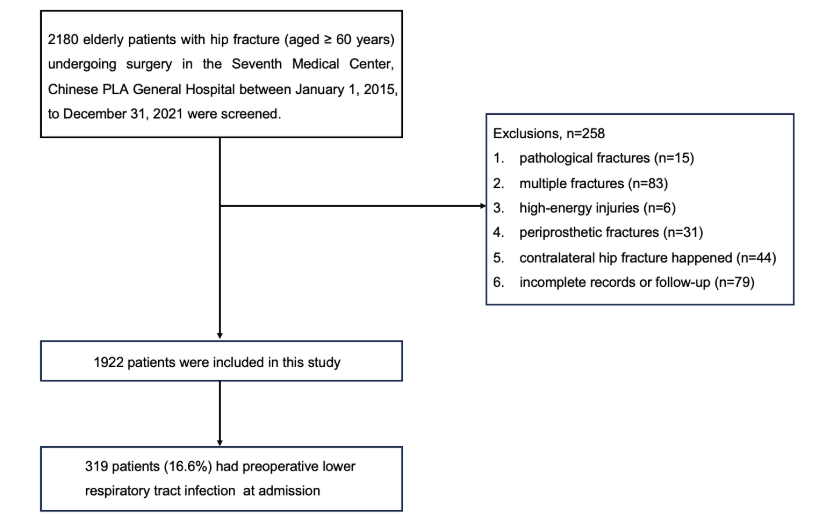
Adults aged 60 or older who underwent hip fracture surgery at one trauma center—1,922 patients—were included in a retrospective cohort study covering 2015–2021. Medical records identified lower respiratory tract infections, which affect the lower airways or lungs, in 319 patients before surgery.
Infections were associated with higher mortality at both 30 days and one year after surgery. The links remained after adjustment for factors including other illnesses, nutrition, surgical factors and postoperative complications. Heart-related events after surgery occurred in 8.8% of patients with infection versus 2.9% without infection. New pneumonia occurred in 21.6% versus 6.8%, respectively.
Why it matters
For older adults with hip fractures, the authors recommended screening for lower respiratory infections and including them in assessments of surgical risk.
Caveats
The retrospective comparison relied on medical records; patients with infections may have been sicker in ways the adjustments did not capture. All patients were aged 60 or older and underwent hip fracture surgery at one center; the preprint has not been peer-reviewed.
From the paper
- Participants
This retrospective cohort study included 1,922 elderly patients (≥ 60 years) who underwent hip fracture surgery at a single Level I trauma center between 2015 and 2021.
- Result
In fully adjusted models, preoperative LRTI was independently associated with increased 30-day mortality (HR 2.68, 95% CI 1.67–4.33) and 1-year mortality (HR 1.71, 95% CI 1.30–2.26).
- Limitation
First, this was a single-center retrospective study, subject to selection bias and residual confounding.
Quoted word for word from the full text on researchsquare.com.
- Hip fracture
- Preoperative lower respiratory tract infection
- New-onset pneumonia
- Postoperative cardiac events
- Neutrophil-to-lymphocyte ratio
- Humans
The paper
Beijing Tongren Hospital
Research Square, Nov 3, 2026, Open access, Preprint, not yet peer-reviewed


Comments
Be the first to comment.