Mental distress modifies the association between cost-related barriers and cervical cancer screening adherence: interaction and stratified analyses of BRFSS 2024
Abstract
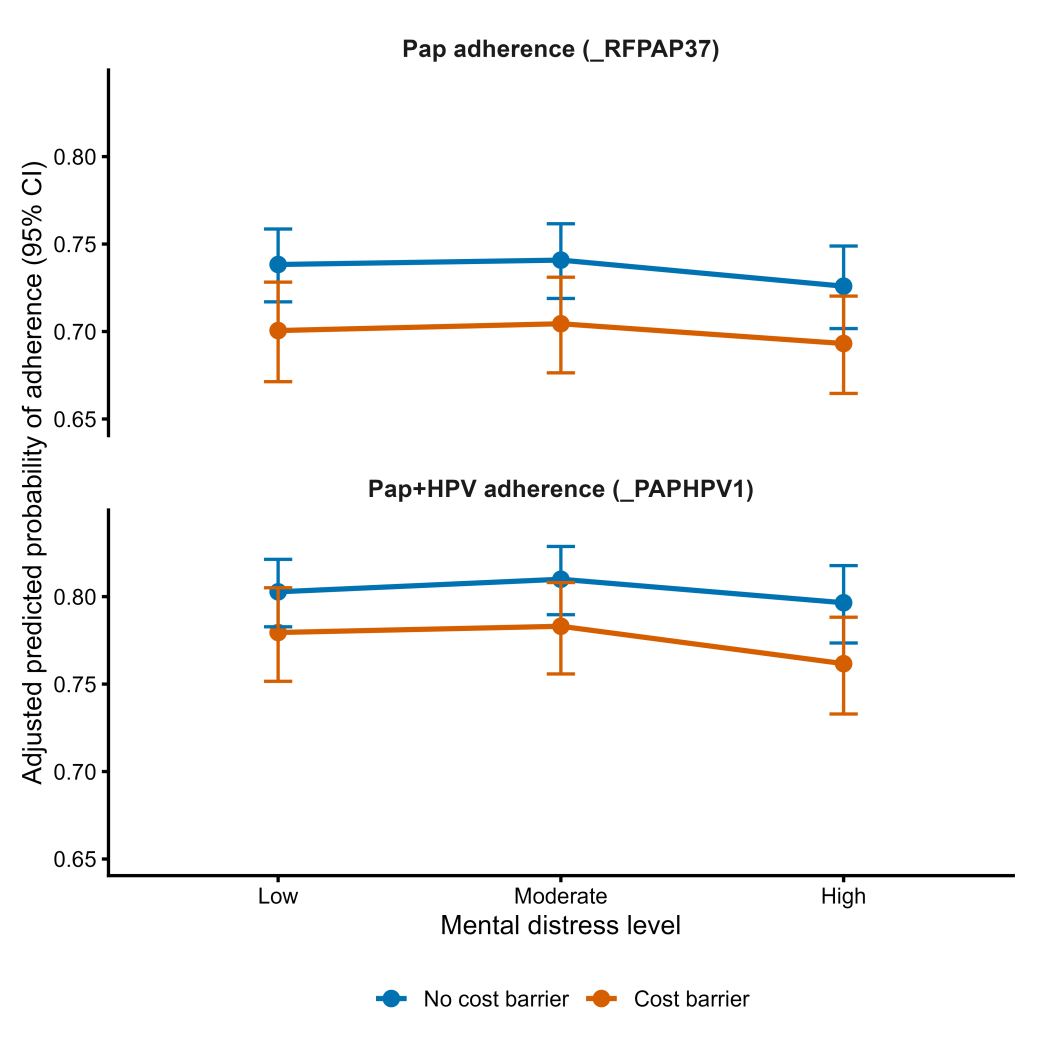
Background: Cost-related barriers and mental distress may jointly influence preventive service use, but their combined association with cervical cancer screening adherence is not well characterized in recent U.S. surveillance data. Methods: We analyzed 2024 Behavioral Risk Factor Surveillance System (BRFSS) data among female respondents. The primary outcome was Pap-related cervical cancer screening adherence (_RFPAP37); a sensitivity outcome used Pap+HPV adherence (_PAPHPV1). Mental distress was categorized as low, moderate, or high using _MENT14D, and cost-related barriers were defined by MEDCOST1. We fitted unadjusted and adjusted logistic regression models including an interaction term, adjusting for age group, education, income, marital status, race/ethnicity, insurance coverage, personal doctor status, and routine checkup. We also estimated stratified effects, adjusted predicted probabilities, and absolute risk differences. Results: The primary analytic sample included 101,580 women; 66,417 were included in complete-case adjusted models. Overall Pap adherence was 66.6% and was lower among women reporting cost-related barriers (54.5% vs 68.6%). Cost-related barriers were associated with lower Pap adherence in unadjusted (OR 0.52, 95% CI 0.49–0.56) and adjusted models (OR 0.83, 95% CI 0.76–0.90). Mental distress showed a graded inverse association with adherence (adjusted trend OR 0.96, 95% CI 0.94–0.99). Adjusted predicted probabilities showed lower adherence across distress strata among women with cost-related barriers, with absolute differences of about 3.3–3.8 percentage points. Findings were directionally consistent for the Pap+HPV outcome. Conclusions: In BRFSS 2024, cost-related barriers and mental distress were independently associated with lower cervical cancer screening adherence. Financial navigation and mental health–informed outreach may help improve screening uptake.
The paper
The Yancheng School of Clinical Medicine of Nanjing Medical University
Research Square, 11 Oct 2026, Preprint, not peer-reviewed