Duration of GLP-1 Receptor Agonist Therapy and Nephrolithiasis Risk in Type 2 Diabetes: A Multicenter Retrospective Cohort Study
Multicenter
Abstract
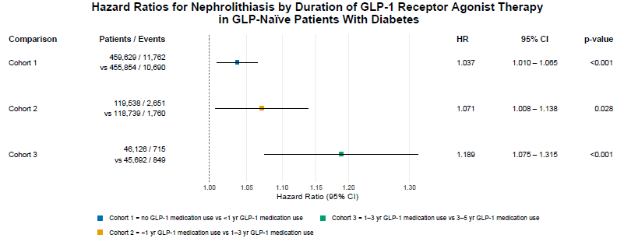
Purpose Glucagon-like peptide-1 receptor agonists (GLP-1 RAs) improve glycemic control and metabolic health, but their association with nephrolithiasis remains poorly defined. We evaluated the relationship between GLP-1 RA exposure duration and incident nephrolithiasis among adults with type 2 diabetes mellitus (T2DM). Methods Using the TriNetX Research Network, adults with T2DM were stratified according to GLP-1 RA exposure as no exposure, < 1 year, 1–3 years, or 3–5 years. Patients with chronic kidney disease, prior nephrolithiasis, bariatric surgery, or prior sodium-glucose cotransporter-2 inhibitor exposure were excluded. Pairwise propensity score matching and time-to-event analyses were performed. Two complementary analyses were conducted: a broader T2DM cohort evaluating nephrolithiasis risk across GLP-1 RA exposure durations and a secondary cohort restricted to patients with at least 5 years of established T2DM. Results In the broader T2DM cohort, shorter GLP-1 RA exposure was associated with higher nephrolithiasis risk. No exposure was associated with greater risk than < 1 year of exposure (HR 1.037, 95% CI 1.010–1.065; p = 0.006), < 1 year was associated with greater risk than 1–3 years (HR 1.071, 95% CI 1.008–1.138; p = 0.028), and 1–3 years was associated with greater risk than 3–5 years (HR 1.189, 95% CI 1.075–1.315; p = 0.001). In the cohort restricted to patients with at least 5 years of T2DM, no significant differences were observed among the longer GLP-1 RA exposure-duration comparisons, indicating the absence of a progressive duration-response relationship in patients with established diabetes. Conclusion Longer GLP-1 RA exposure was associated with lower nephrolithiasis risk in the broader T2DM population. However, this duration-response relationship was not observed among patients with at least 5 years of established T2DM. These findings suggest that the association between GLP-1 RA exposure duration and nephrolithiasis may differ according to diabetes chronicity and warrant prospective investigation.
From the paper
- Participants
For the no GLP-1 RA exposure versus < 1 year comparison, each matched cohort included 117,174 patients, with a mean age of 58.5 ± 13.6 years in both groups.
- Result
No exposure was associated with greater risk than < 1 year of exposure (HR 1.037, 95% CI 1.010–1.065; p = 0.006), < 1 year was associated with greater risk than 1–3 years (HR 1.071, 95% CI 1.008–1.138; p = 0.028) …
Quoted word for word from the full text on researchsquare.com.
The paper
Pennsylvania State University; Penn State Milton S. Hershey Medical Center
Research Square, Sep 20, 2026, Open access, Preprint, not peer-reviewed


