Hypertension care-cascade states, multimorbidity and functional outcomes in China and the United States: parallel longitudinal cohort analyses
4 years
Abstract
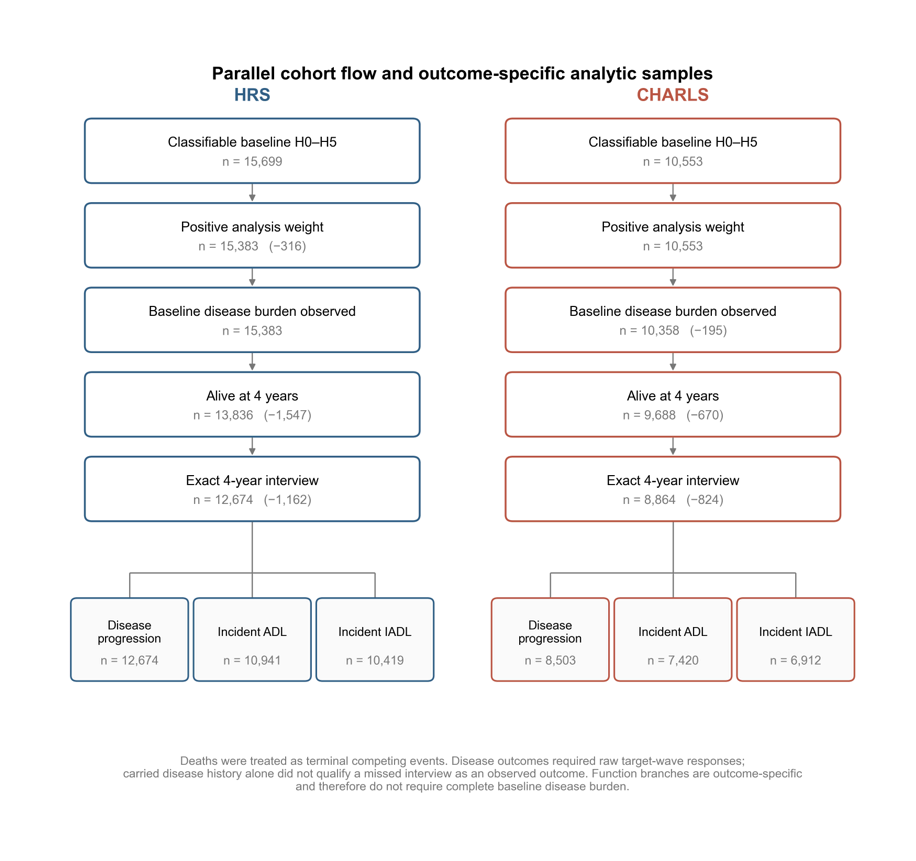
Background Hypertension care cascades usually end at blood-pressure control. Whether care-cascade position also distinguishes later multimorbidity and loss of independence in ageing populations is uncertain. Methods We conducted parallel longitudinal analyses of the China Health and Retirement Longitudinal Study (CHARLS) and the US Health and Retirement Study (HRS). We compared survey-detected elevated blood pressure without reported diagnosis or antihypertensive medication (H1) with antihypertensive treatment and elevated blood pressure at the survey visit (H3), with H3 versus H4 (treatment and controlled blood pressure) as a secondary comparison. Primary analyses were restricted to common systolic and diastolic blood-pressure support and used overlap and inverse-probability-of-censoring weights. Exact four-year, full-wave discrete-time and multistate models evaluated newly reported non-hypertension disease and incident activities-of-daily-living (ADL) and instrumental-activities-of-daily-living (IADL) disability. We also derived a cross-fitted disease-function mismatch phenotype. Results Of 26,252 participants with a classifiable baseline state, 10,553 were in CHARLS and 15,699 in HRS. At four years, H1 versus H3 was associated with lower odds of newly reported non-hypertension disease in CHARLS (odds ratio 0.662, 95% confidence interval 0.471 to 0.931; risk difference −8.14 percentage points) but not conclusively in HRS (0.934, 0.740 to 1.179; −1.30 percentage points). Full-wave disease associations kept the same direction, whereas ADL and IADL associations differed by cohort and observation window. The secondary H3 versus H4 comparison identified a repeated CHARLS ADL risk-marker signal that did not replicate in HRS. Higher disease-function mismatch was associated with lower odds of subsequent disease and disability in both cohorts, and adding it raised the functional-outcome area under the curve by 0.048 to 0.055. Conclusions Hypertension care-cascade position carried information about later recorded disease accumulation beyond survey blood pressure, while functional associations were cohort- and time-window-dependent. Disease-function mismatch supplied complementary information about future disability but requires external validation. These observational results support coupling hypertension care assessment with multimorbidity review and multidomain functional assessment in ageing populations.
The paper
Shanghai University of Medicine and Health Sciences; Shanghai Pudong New Area Dongming Community Health Service Center
Research Square, 14 Aug 2026, CC BY, Preprint, not peer-reviewed