Lower body roundness linked to low muscle mass and function
Compared with low-stable body roundness, moderate-stable and high-rising patterns had adjusted odds ratios of 0.12 and 0.04 for developing low muscle mass and function.
Our read
Biomarkers- Studied:
- Cohort study of 5,688 middle-aged and older Chinese adults without sarcopenia, 4 years
- What changed:
- Low muscle mass with impaired function developed less often with high-rising versus low-stable body roundness: 2.4% versus 14.8%
- The catch:
- Early muscle loss can lower waist circumference and body roundness before sarcopenia is detected
- In the record:
- The 165th paper on body roundness index with results in people; 285 on record in all.
Editor of record: Boris Djordjevic · AgingResearch.News
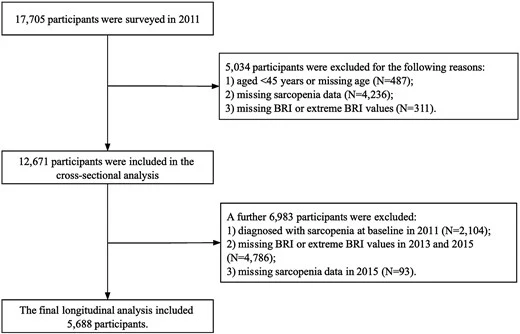
Among 12,671 middle-aged and older Chinese adults, researchers examined body roundness and sarcopenia, a condition involving low muscle mass and function. The prospective cohort study used data from 2011 to 2015. A baseline cross-sectional analysis linked lower body roundness index, a measure of abdominal shape, to greater odds of sarcopenia.
The follow-up analysis included 5,688 participants without sarcopenia at baseline; 490 developed it. Participants with moderate-stable or high-rising body roundness patterns had lower odds of developing sarcopenia than those with low-stable patterns. Researchers assessed sarcopenia using muscle mass estimated from body measurements, along with strength and physical performance. The authors suggested that lower body roundness might reflect a body build with fewer reserves.
Why it matters
The findings suggest that abdominal body shape warrants further investigation as a potential marker of vulnerability to sarcopenia in middle and older age.
Caveats
Estimating muscle mass from body measurements may partly account for its apparent link with a body-shape index. The findings in middle-aged and older Chinese adults do not establish the same pattern in younger people.
From the paper
- Participants
The cross-sectional analysis included 12 671 middle-aged and older Chinese adults, and the longitudinal analysis included 5688 participants without baseline sarcopenia.
- Result
Higher BRI was inversely associated with prevalent sarcopenia in the fully adjusted model (OR = 0.25, 95% CI: 0.23–0.27).
- Events by group
Incident sarcopenia occurred in 382 of 2585 participants (14.8%) in the low-stable group and 95 of 2552 (3.7%) in the moderate-stable group.
Results, Association between BRI trajectories and the incidence of sarcopenia
- Limitation
First, ASM was estimated using a validated anthropometric equation rather than measured by dual-energy X-ray absorptiometry (DXA), potentially misclassifying sarcopenia status.
Quoted word for word from the full text on academic.oup.com.
The paper
Fujian University of Traditional Chinese Medicine
Postgraduate Medical Journal, Nov 17, 2026, Open access


Comments
Be the first to comment.