Liver patterns on heart scans linked to heart failure risk
Among people with no coronary artery calcium, high liver scores were linked to about 2.5-fold higher five-year heart failure incidence than low scores.
Our read
Biomarkers- Studied:
- Cohort study of 36,823 adults undergoing cardiac CT, mean 1411 days (Dose-response, independent replication, multicenter, registered NCT04075162)
- What changed:
- Heart failure risk was higher with higher liver radiomics scores (adjusted hazard ratio 1.48)
- The catch:
- Incomplete medication and socioeconomic data could confound the association with heart failure
Editor of record: Boris Djordjevic · AgingResearch.News
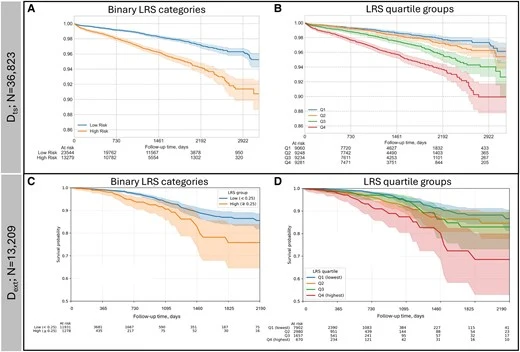
Among 59,237 people undergoing computed tomography scans to assess calcium in heart arteries, an observational analysis linked liver-image patterns to later heart failure. Researchers developed a liver score in 9,205 CLARIFY participants, tested it in 36,823 others and evaluated it in 13,209 Houston Methodist participants. Average follow-up was 1,411 days in CLARIFY and 470 days in Houston.
Higher scores were associated with heart failure in both validation groups. In CLARIFY, the association remained after adjustment for clinical factors and body mass index, a measure of weight relative to height. Among 17,806 CLARIFY participants, adding the score modestly improved prediction beyond artery calcium and PREVENT, an existing heart failure risk model. Among participants with no artery calcium, five-year heart failure incidence was 2.96% with high liver scores versus 1.17% with low scores.
Why it matters
For efforts to prevent heart failure as people age, the work examines whether routine heart scans contain useful risk information beyond conventional scores.
Caveats
Liver-image patterns may have tracked shared metabolic problems that also predicted heart failure, rather than a liver process responsible for it. The findings came from people undergoing coronary calcium scans and may not extend to other populations.
From the paper
- Participants
The study included 59 237 participants, comprising 46 028 individuals in the CLARIFY cohorts (Dtr, n = 9205; Dts, n = 36 823) and 13 209 individuals in Dext.
- Follow-up
The mean follow-up was 1411 days (SD 760.1) in the pooled Dtr and Dts cohorts (1144 HF events) and 470 days (SD 596) in Dext (212 HF events).
- Result
In the internal validation cohort (Dts, n = 36 823), continuous LRS was significantly associated with incident HF [Model 0: hazard ratio (HR) 1.63 per SD, 95% confidence interval (CI) 1.52–1.74; P < 0.001].
- Events by group
At 5 years, HF incidence in the PREVENT-Low group was 3.08% for high LRS compared with 1.08% for low LRS, while in the PREVENT-High group, incidence reached 29.45% vs. 17.50%, respectively.
Results, Incremental prognostic value beyond CAC and PREVENT scores
Quoted word for word from the full text on academic.oup.com.
The paper
Liver radiomics on routine cardiac CT identifies hepatic stress states that predict heart failure
Georgia Institute of Technology and Emory University
European Heart Journal Cardiovascular Imaging, Nov 13, 2026


Comments
Be the first to comment.