Earlier rehabilitation linked to lower mortality in Parkinson’s
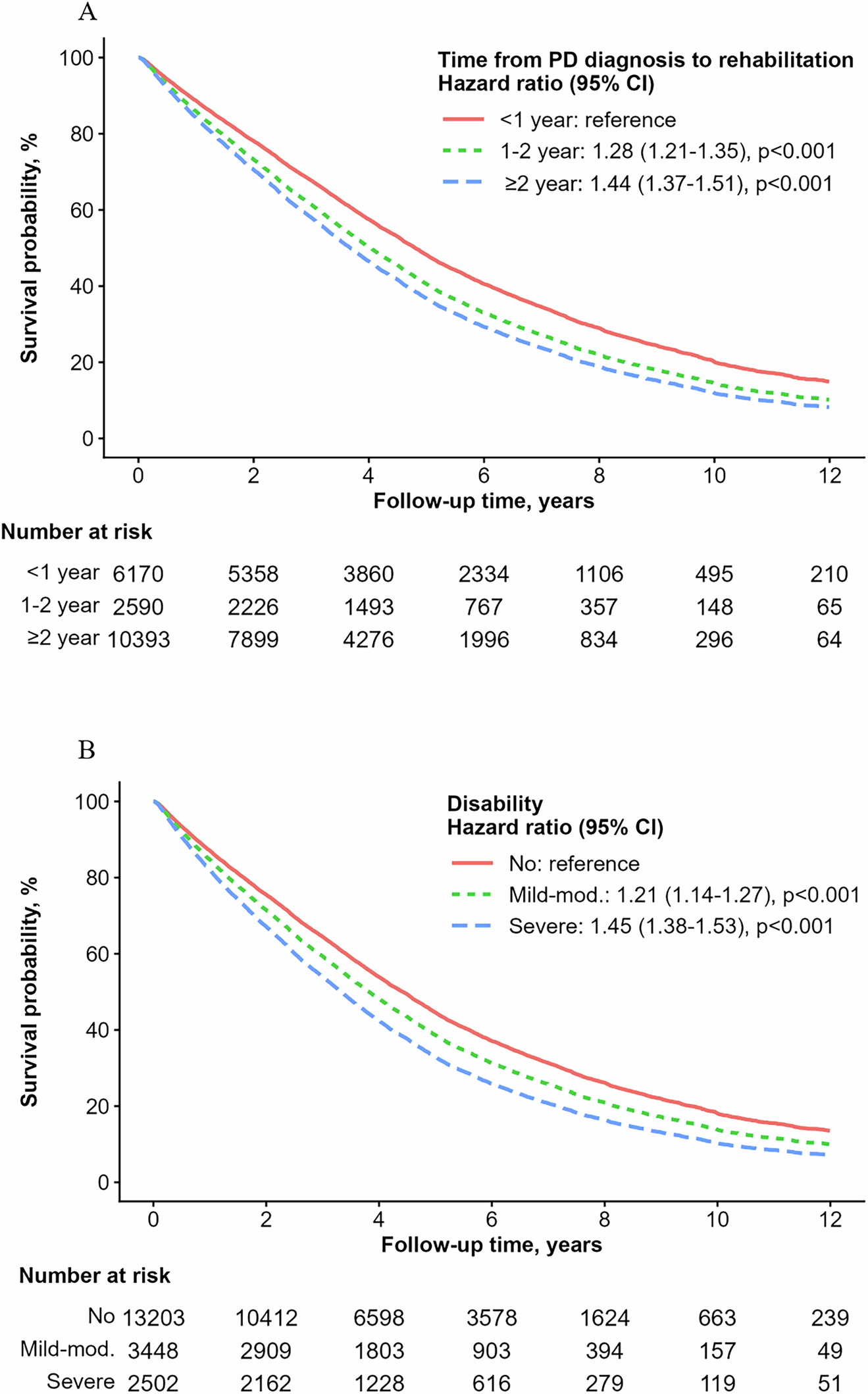
Starting rehabilitation 1–2 years after diagnosis was linked to a 28% higher relative rate of death than starting within one year.
Our read
Populations- Studied:
- Cohort study of 19,153 Korean patients with Parkinson's disease receiving rehabilitation (Dose-response)
- What changed:
- The hazard of death was 44% higher with rehabilitation starting at 2 years or later versus within 1 year
- The catch:
- Greater health awareness and self-management among early rehabilitation patients could independently lower mortality
Editor of record: Boris Djordjevic · AgingResearch.News
In South Korea, 19,153 people newly diagnosed with Parkinson’s disease who later received rehabilitation were studied in a nationwide retrospective cohort using insurance records. Researchers tracked deaths through December 2023, with follow-up lasting up to 15 years. Rehabilitation involved individualized, one-on-one sessions lasting at least 30 minutes.
After accounting for recorded health and social factors, starting rehabilitation at least two years after diagnosis was associated with a 44% higher mortality hazard than starting within one year. A mortality hazard measures the rate of death at a given time during follow-up. Delays of 1–2 years were linked to a 28% higher hazard. The association between earlier rehabilitation and lower mortality held across all disability groups.
Why it matters
Rehabilitation is part of Parkinson’s disease management, but its relationship with long-term survival has been uncertain. The authors said the findings support systematic rehabilitation referral at diagnosis.
Caveats
The authors note that people receiving earlier rehabilitation may have been more inclined to seek care, potentially contributing to the survival difference. All participants received rehabilitation in South Korea; the findings do not cover people who never received it.
From the paper
- Participants
After excluding individuals with incomplete data (n = 10,088), the final study cohort comprised 19,153 participants who were followed longitudinally until 31 December 2023 for all-cause mortality (Fig. S1 in the Supplement).
- Follow-up
During a follow-up period of up to 15 years, 11,339 deaths were documented among the 19,153 enrolled patients (cumulative mortality rate, 59.2%).
- Result
… those beginning therapy at 1–2 years after diagnosis demonstrated a 28% increased mortality hazard (HR, 1.28 [95% CI, 1.21–1.35]), while those starting at 2 years or later showed a 44% increased mortality hazard (HR, 1.44 [95% CI, 1.37–1.51]).
- Limitation
First, because this was a retrospective cohort study using nationwide claims data, PD-specific clinical measures, including the Hoehn and Yahr scale and Unified Parkinson’s Disease Rating Scale, were not available.
Quoted word for word from the full text on nature.com.
The paper
Yonsei University
NPJ Parkinson's Disease, Jul 27, 2026, Open access

Comments
Be the first to comment.