Drug class tied to lower death risk on tafamidis in heart amyloidosis
Sodium-glucose cotransporter 2 inhibitors were linked to lower relative death rates versus nonuse, with hazard ratios of 0.56 at one year and 0.62 at five years.
Our read
Interventions- Studied:
- Cohort study of 5,683 tafamidis-treated adults with ATTR-CM, against SGLT2 inhibitor nonusers (Multicenter)
- What changed:
- Death from any cause was lower among SGLT2 inhibitor users than nonusers at five years (hazard ratio 0.62)
- The catch:
- Differences in patients’ health could influence both prescribing and death risk despite matching
- In the record:
- The 24th paper on mineralocorticoid receptor antagonists with results in people; 189 on record in all.
Editor of record: Boris Djordjevic · AgingResearch.News
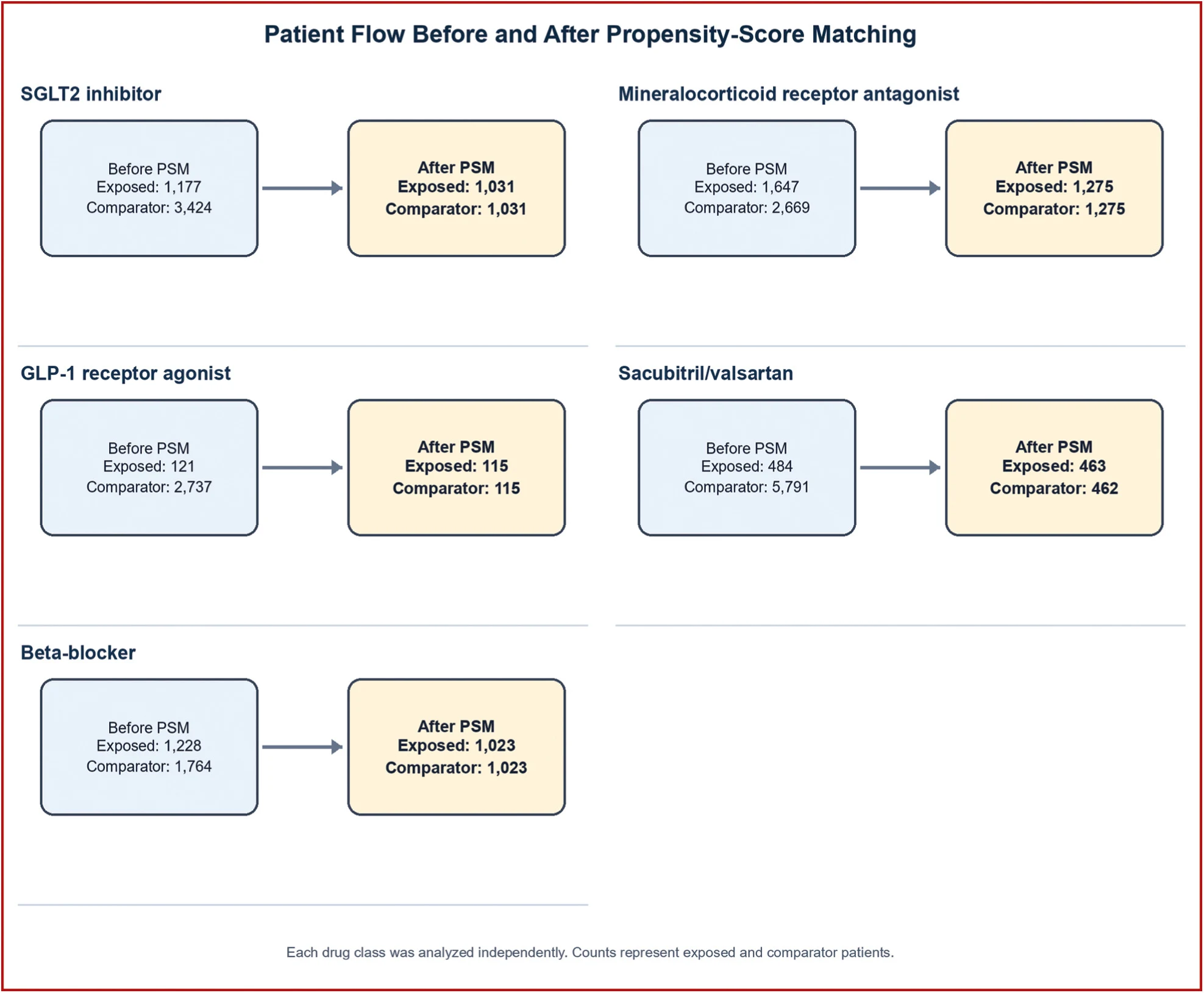
The 5,683 adults with transthyretin amyloid cardiomyopathy, a disease involving protein buildup in the heart, averaged 78.1 years old; 81% were male. All were prescribed tafamidis, which stabilizes the protein, between 2019 and 2025 in a multicenter retrospective cohort study.
Researchers matched users and nonusers of each drug class on patient characteristics. They defined medication use within 90 days of starting tafamidis. Sodium-glucose cotransporter 2 inhibitors were linked to lower mortality at one and five years, and fewer heart failure hospitalizations and major cardiovascular events at five years. Mineralocorticoid receptor antagonists were linked to more atrial fibrillation, an irregular heartbeat, acute kidney injury and emergency department visits. Beta-blockers were linked to more adverse cardiovascular events and emergency department visits. Neither class was linked to better survival. The authors called these adverse signals hypothesis-generating.
Why it matters
For older adults with this form of heart failure, the findings bear on which medicines might add benefit alongside tafamidis.
Caveats
Matching could not rule out differences in patients’ health that influenced both prescribing and outcomes. The findings concern tafamidis-treated patients, mostly older men, and require prospective confirmation before changing clinical practice.
Where the evidence stands
Mineralocorticoid receptor antagonists
- 22 independent labs in 13 countries
- 5 findings against
- Funders: National Heart, Lung, and Blood Institute and others
- 4 of 41 findings with company ties
Beta-blockers
- 55 independent labs in 30 countries
- 12 findings against
- Funders: National Institute on Aging and others
- 7 of 81 findings with company ties
- Mineralocorticoid receptor antagonists
- Beta-blockers
- TTR
- NR3C2
- Transthyretin amyloid cardiomyopathy
- Humans
The paper
The University of Texas Medical Branch at Galveston; University of Minnesota
Archives of Cardiovascular Diseases, Oct 6, 2026


Comments
Be the first to comment.