Inflammation linked to early artery plaque in middle age
In 3,471 symptom-free adults followed for six years, inflammation markers were linked to artery plaque beyond cholesterol and blood pressure.
Our read
Populations- Studied:
- Study in people
Editor of record: Boris Djordjevic · AgingResearch.News
Among 3,471 symptom-free Madrid bank employees aged 40–55 without prior cardiovascular disease, a prospective, longitudinal cohort study examined links between inflammation and artery plaque. Women made up 36% of participants. Participants had blood tests and artery imaging at enrollment and after three and six years. Ultrasound measured plaque deposits in neck and thigh arteries.
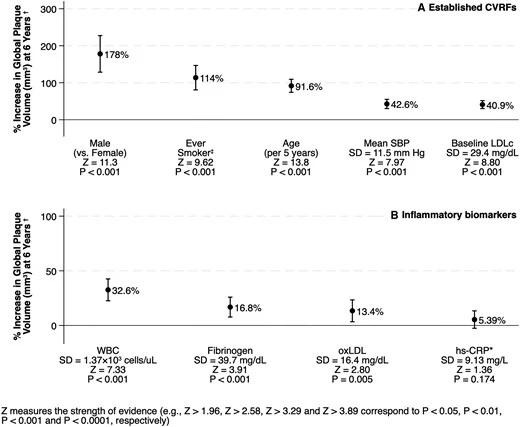
White blood cell count, an inflammation marker, had the strongest association among the inflammation markers. An increase of one standard deviation—a measure of variation between participants—in average white blood cell count was associated with an estimated 32.6% greater plaque volume at six years. The analysis accounted for age, sex, smoking, cholesterol and blood pressure. The marked association appeared only above the median, or middle, white blood cell count. C-reactive protein, another inflammation marker, did not predict greater plaque volume.
Why it matters
Artery plaque can develop by middle age without symptoms. The findings bear on how inflammation fits into efforts to prevent cardiovascular disease as people grow older.
Caveats
The authors note that excluded participants were somewhat older and had less favorable risk profiles, potentially weakening the measured associations. They also caution that the mostly European/White, middle-aged bank-employee population limits how widely the findings apply.
From the paper
- Participants
The PESA-CNIC-Santander (NCT01410318) is a prospective, longitudinal cohort study that, between June 2010 and February 2014, enrolled 4184 asymptomatic employees of the Santander Bank in Madrid (aged 40–55 years, 36% women) with no prior history of CVD.
- Limitation
We primarily focused on a European/White, middle-aged cohort of bank employees, so the generalizability of our findings to other populations should be made with caution.
Quoted word for word from the full text on academic.oup.com.
The paper
Inflammation and early atherosclerosis beyond traditional risk factors: an imaging study
Hospital de la Santa Creu I Sant Pau; Centro Nacional de Investigaciones Cardiovasculares Carlos III (CNIC)
European Heart Journal, Nov 10, 2026
Comments
Be the first to comment.