Social risks linked to frailty over time in older adults
Longitudinal data from 15,733 older adults linked a new measure of later-life insecurity to differences in frailty between people and changes within individuals.
Our read
Biomarkers- Studied:
- Cohort study of 15,733 older adults in England, 2004/05 to 2018/19
- What changed:
- Older adults became frailer as their social risks increased over time
- The catch:
- Becoming frail can increase social risks, including receipt of health-related benefits
- Why it’s aging research:
- Biological age, frailty, function, multimorbidity or death.
Editor of record: Boris Djordjevic · AgingResearch.News
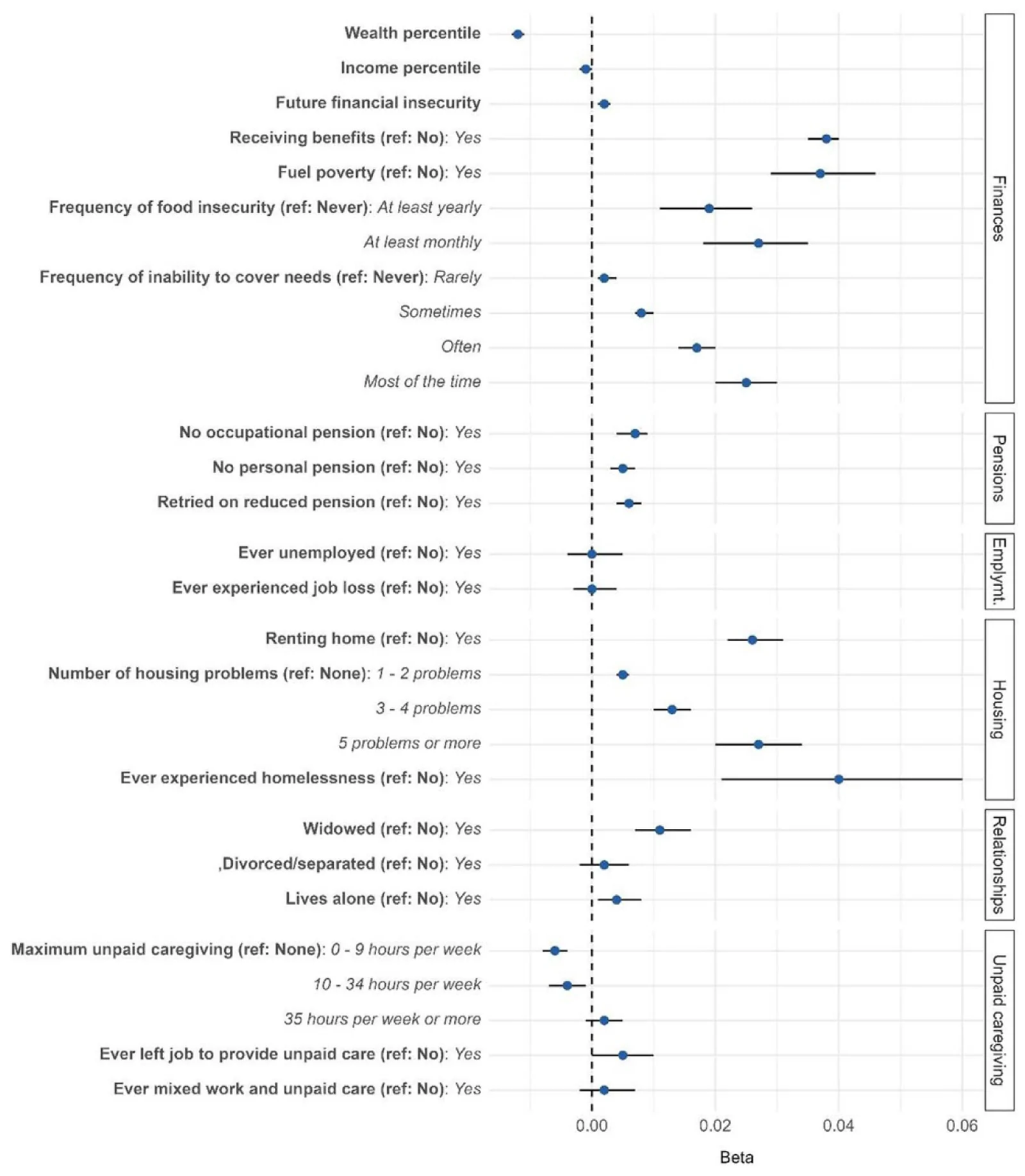
An observational study of 15,733 older adults from the English Longitudinal Study of Ageing examined links between social risks and frailty, a state of increased vulnerability to health problems. The researchers developed a Later Life Precarity Index covering risks related to finances, pensions, employment, housing, relationships and unpaid caregiving.
Multiple social risks were strongly and independently associated with frailty. Links were particularly strong for finances, housing, difficulty affording fuel and uncertain access to food. In models using repeated observations over time, the index was associated with both differences in frailty between people and changes within the same person. It performed substantially better in these models than standard measures of socioeconomic status: wealth and education.
Why it matters
The authors suggest that tracking diverse, changing social risks may help researchers understand how health inequalities evolve in later life.
Caveats
This observational study cannot establish that social insecurity caused frailty. Its findings concern older adults in the English Longitudinal Study of Ageing, not necessarily other populations.
Where the evidence stands
Pensions
- 1 lab in 1 country
- Funders: National Natural Science Foundation of China and 2 more
From the paper
- Limitation
Firstly, despite using longitudinal models that attempt to minimise the bias due to unobserved variables, our findings cannot be taken as proof of a causal relationship between precarity and frailty and nor do we claim this.
Quoted word for word from the full text on cambridge.org.
The paper
Later life precarity and longitudinal frailty trajectories in older adults
University of Edinburgh
Ageing and Society, Mar 25, 2026, Open access


Comments
Be the first to comment.