Healthier diets linked to lower risk of multiple diseases
The highest versus lowest quarters of one diet score had hazard ratios of 0.87 for a first disease and 0.75 for progression to multiple diseases.
Limit: Smoking differences could account for some of the association between diet and disease
Edited by Boris Djordjevic · AgingResearch.News
This prospective observational study followed 148,858 UK Biobank participants initially free of cancer, heart and blood vessel disease, chronic respiratory disease and type 2 diabetes. Researchers calculated four diet-quality scores from reports of food eaten over 24 hours.
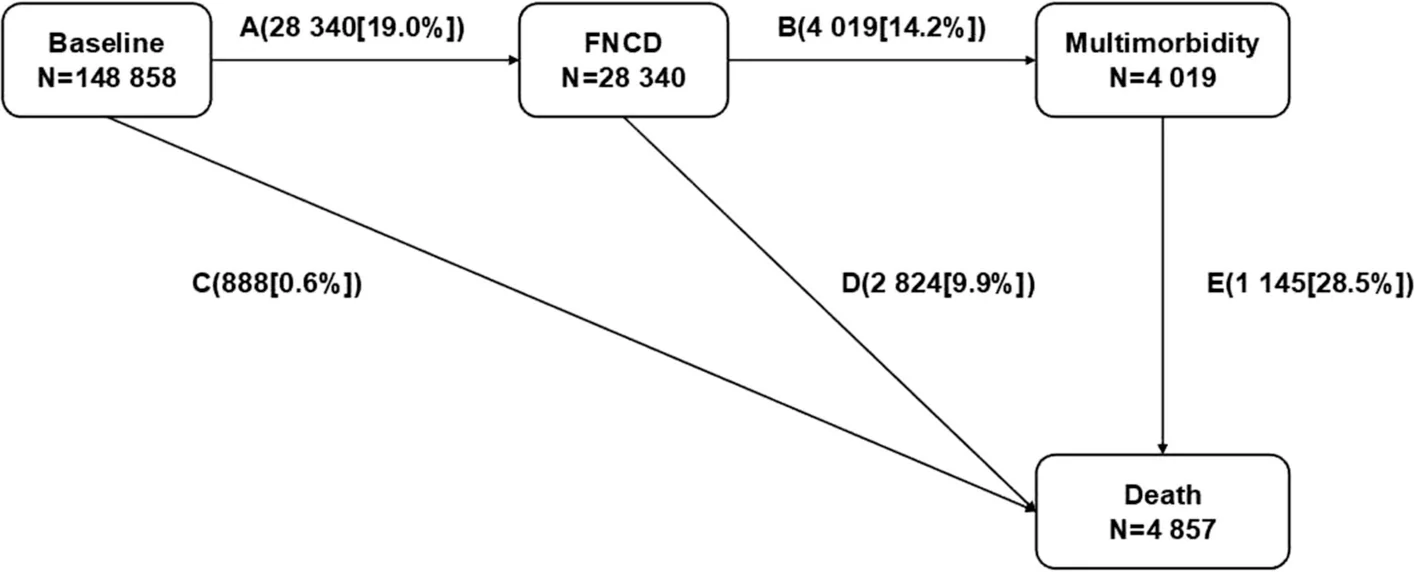
Over a median 12.5 years, 28,340 participants developed at least one of these diseases, and 4,019 developed at least two, the study’s definition of multimorbidity. Higher scores on all four measures were associated with lower risks of a first disease and progression to multimorbidity. For one score, the highest versus lowest quarters had hazard ratios of 0.87 and 0.75, respectively; values below one indicate lower risk over time. Higher scores were also linked to lower risk of death before any of these diagnoses, but not to death after a first disease or multimorbidity.
Why it matters
The buildup of chronic diseases is a concern in aging. This study addresses whether diet before a first diagnosis is linked to that progression.
Caveats
This observational study cannot establish that diet caused the differences. The analysis covered only four disease groups and began with people free of them.
From the paper
- Participants
During a median follow-up of 12.5 years(SD 1.28), a total of 28,340 participants (transition A) experienced at least one NCDs and afterward 4,019(transition B) further developed multimorbidity.
- Follow-up
During a median follow-up of 12.5 years, 28,340 participants experienced at least one NCDs, 4,019 developed multimorbidity, and 4,815 dead.
- Result
For transitions from baseline to FNCD and subsequent to multimorbidity, large reduction was seen for DASH when extreme quartiles were compared (HR 0.87 [95% CI 0.84, 0.90] and 0.75 [95% CI 0.69, 0.82], respectively).
- Limitation
First, our participants were recruited from UK resident and the components in some diet-quality indexes are classified by quintiles, deciles, or medians based on the populations under study.
Quoted word for word from the full text on link.springer.com.
The paper
Harbin Medical University
BMC Public Health, Aug 3, 2026, Open access
Comments
Be the first to comment.