Turning practice improved mobility in early-stage Parkinson’s disease
After 12 weeks, the turning-practice group completed a mobility test 1.79 seconds faster than the conventional-exercise group, after accounting for starting scores.
Blinded, registered NCT07442370
Limit: A treating physiotherapist knew group assignments when timing mobility tests, risking inflated improvements
Edited by Boris Djordjevic · AgingResearch.News
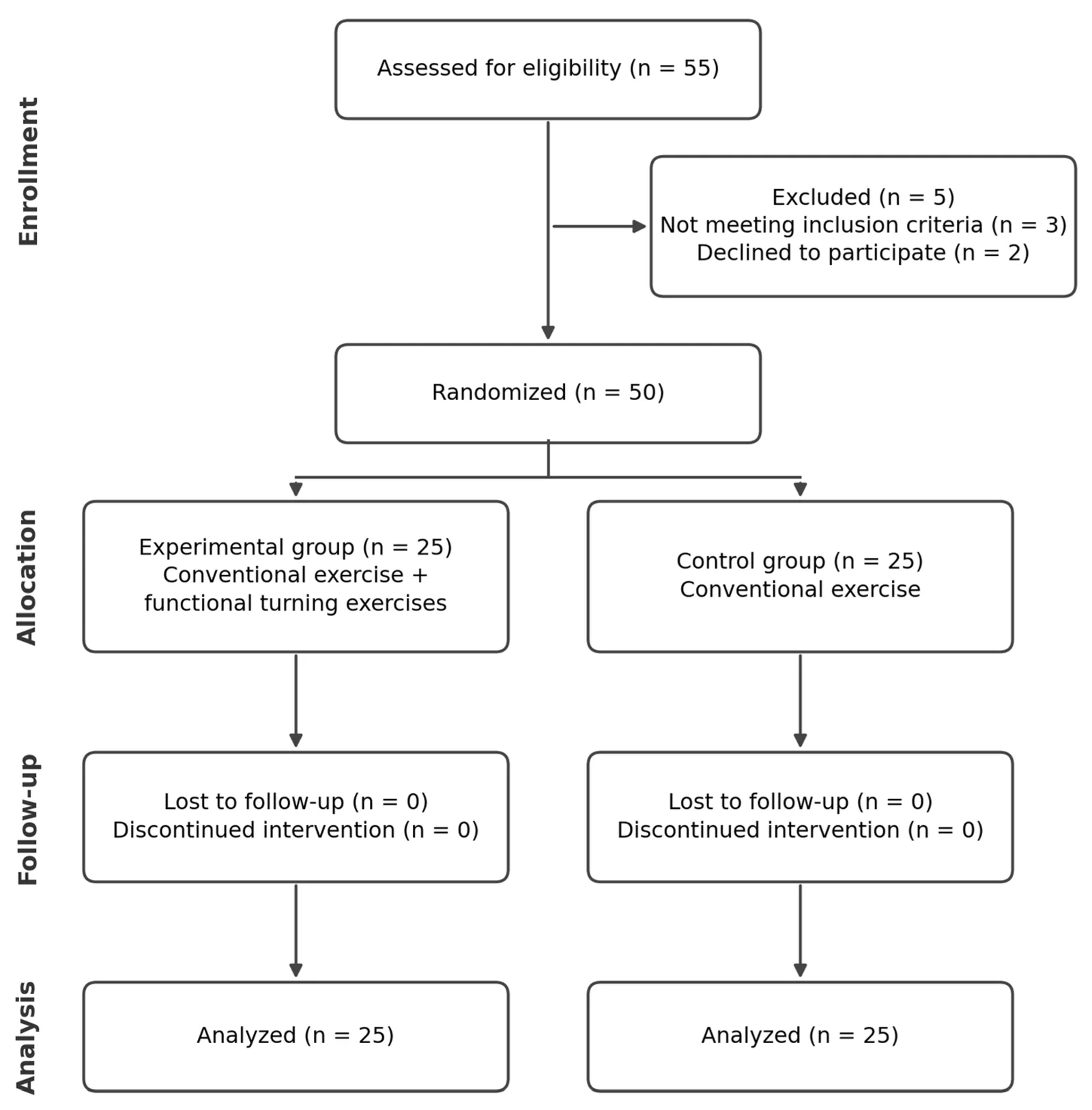
Fifty high-functioning people aged 50–70 with early-stage Parkinson’s disease took part in a randomized trial comparing two exercise programs. Both groups exercised for 45–50 minutes three times weekly for 12 weeks. In one group, 25 participants spent 18–20 minutes per session practicing turns and the remaining time doing conventional exercises. The other 25 did conventional exercises throughout.
The main outcome was the Timed Up and Go test, which times standing up, walking, turning and sitting down. After accounting for starting scores, results favored the turning group by 1.79 seconds on this test. Walking speed was 0.116 meters per second higher, and scores on a balance test were 1.84 points higher. All participants completed the study.
Why it matters
Turning frequently precipitates falls in Parkinson’s disease, making it an important focus for efforts to preserve mobility.
Caveats
Assessors knew which program participants received, and training partly rehearsed the test tasks; the authors described the effects as unusually large. Results covered only 12 weeks in high-functioning people with early-stage Parkinson’s disease; falls and turning quality were not measured.
From the paper
- Result
Twenty-four participants in the experimental group and none in the control group improved by at least 0.082 m/s in gait speed and by at least 2 points in the BBS (risk difference 0.96; 95% CI 0.76 to 0.99 for both).
- Absolute difference
Twenty-four participants in the experimental group and none in the control group improved by at least 0.082 m/s in gait speed and by at least 2 points in the BBS (risk difference 0.96; 95% CI 0.76 to 0.99 for both).
- Limitation
First, all outcome assessments were performed by one of the treating physiotherapists, who was aware of group allocation at the week-12 assessment, and neither participants nor physiotherapists were blinded; this introduces a risk of performance and detection bias, particularly for the BBS.
Quoted word for word from the full text on mdpi.com.
- Structured turning practice within a conventional exercise program
- Parkinson's disease
- Timed Up and Go test
- 10-meter walk test
- Berg Balance Scale
- Humans
The paper
Üsküdar University
Journal of Clinical Medicine, Oct 16, 2026, Open access


