Two blood pressure drugs linked to lower Parkinson’s risk
Irbesartan and olmesartan had hazard ratios of 0.588 and 0.797 for Parkinson’s disease; the abstract did not specify the comparison drugs.
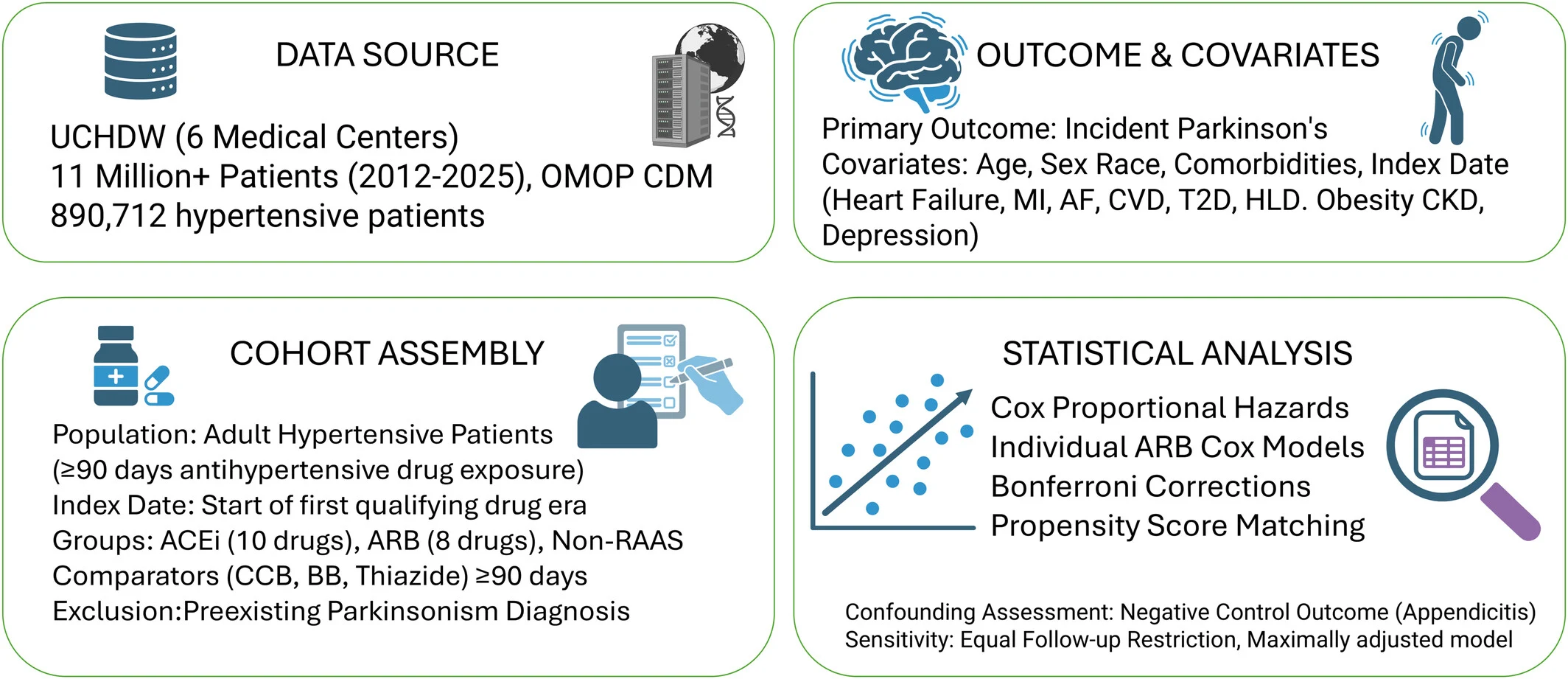
Multicenter
Limit: Smoking, socioeconomic position, and education could confound the association; none were adjusted for
An observational cohort study examined electronic health records for 890,712 patients with high blood pressure across six University of California academic medical centers from 2012 to 2025. Researchers compared people starting medications, focusing on individual angiotensin receptor blockers, a class of blood pressure drugs. They adjusted for demographic factors, nine preexisting medical conditions and the date patients started medication.
Irbesartan and olmesartan were associated with a lower risk of a new Parkinson’s diagnosis. Their hazard ratios, which compare the rate of diagnosis during follow-up between groups, were 0.588 and 0.797, respectively. Only irbesartan met the stricter statistical threshold used to account for testing multiple drugs. An additional analysis that matched patients with similar characteristics supported both associations.
Why it matters
Parkinson’s is an age-related disease. The findings support further investigation of the body’s blood-pressure-regulating system as a possible target for Parkinson’s drugs.
Caveats
This observational study cannot establish that either drug prevented Parkinson’s disease. The abstract did not specify the comparison drugs or patients’ ages or sex; the cohort comprised people with high blood pressure.
From the paper
- Participants
Eprosartan was excluded because only 8 exposed patients were identified.
- Follow-up
There were 10 891 incident PD events over a median follow-up of 4.49 years for comparators, 4.69 years for ACEi, and 3.70 years for ARB users (Table 1).
- Result
Drug-specific Cox analysis identified irbesartan (HR = 0.588, 95% CI 0.434 to 0.796, p = 0.0006) and olmesartan (HR = 0.797, 95% CI 0.665 to 0.956, p = 0.015) as associated with lower PD risk.
- Limitation
The UCHDW is restricted to California academic medical centers, which may limit generalizability to other healthcare settings and prescribing environments.
Quoted word for word from the full text on onlinelibrary.wiley.com.
The paper
University of California-Irvine
Fundamental & Clinical Pharmacology, Oct 19, 2026


