Older breast cancer survivors may have unmet home-care needs
Among yearly records classified as high need, 59.6% showed no Medicare home-health use in an observational study of older breast cancer survivors.
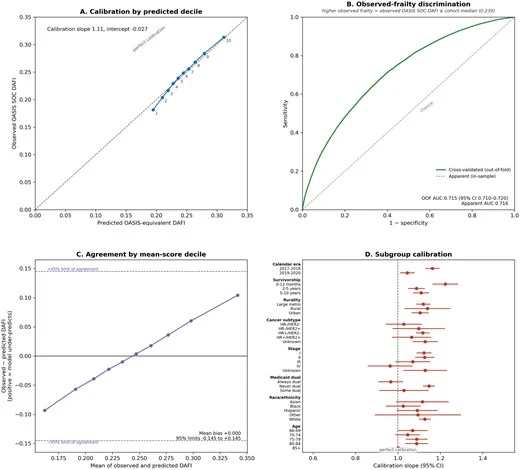
Limit: Unmet need was inferred from estimated frailty and Medicare use, not directly assessed
An observational study analyzed 347,953 yearly records from 134,410 older women with invasive breast cancer, two to 10 years after diagnosis. The records covered 2017–2020. Researchers estimated frailty—the accumulation of health problems—from insurance claims. They calibrated that estimate against assessments recorded when home-health care began.
They classified years meeting a frailty threshold as high need. Among those years, 59.6% had no Medicare home-health use, which the researchers defined as potential unmet need. Greater estimated frailty was associated with more Medicare home-health use. Longer-term survivors had similar estimated frailty but less home-health use than survivors two to five years after diagnosis.
Why it matters
Older breast cancer survivors may need help at home as health problems accumulate. The researchers concluded that broader Medicare coverage of personal care and community services may help address frailty-related needs.
Caveats
Potential unmet need was a proxy based on estimated frailty and lack of Medicare home-health use, not a direct assessment of unmet needs. The study covered women two to 10 years after invasive breast cancer diagnosis.
- Machine learning
- Invasive breast cancer
- Claims-based predicted deficit-accumulation frailty index
- Observed OASIS Start-of-Care deficit-accumulation frailty index
- Humans
The paper
University of Maryland School of Public Health; Johns Hopkins University School of Medicine
Journal of the National Cancer Institute, Oct 19, 2026