Models flag likely undiagnosed dementia in older adults
The model scored 0.85 for distinguishing cases without diagnostic codes from coded cases among older emergency department patients with probable dementia.
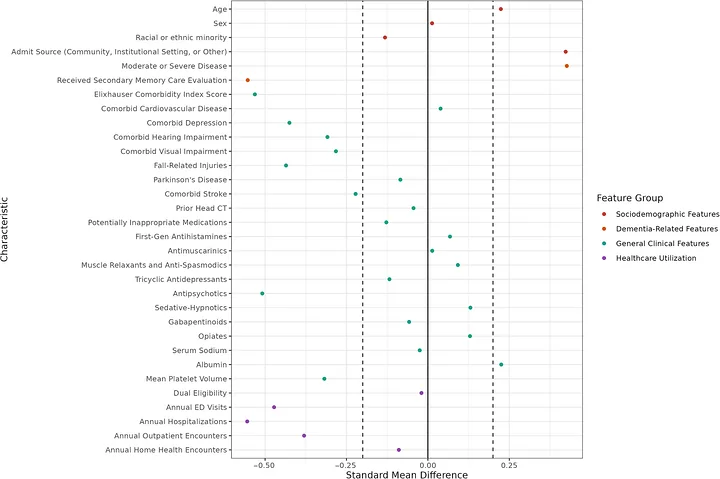
5,000 participants, cross-sectional study
Limit: People with mild cognitive impairment could be mislabeled as having dementia
In an observational study, researchers analyzed records from 5,000 people aged 65 or older who attended one of nine Yale New Haven Health System emergency departments between 2014 and 2022. They used a validated computer-based method to identify probable Alzheimer’s disease and related dementias and estimate severity. They defined undiagnosed cases as probable dementia without validated diagnostic codes.
Among 1,358 people with probable dementia, whose mean age was 86.7 years, 934 (68.8%) were undiagnosed by that definition. Researchers built prediction models using health-record data and assessed them through cross-validation, which tests models on portions of data withheld during development. The overall model scored 0.85 for distinguishing undiagnosed from diagnosed cases. Scores were 0.80 for mild disease and 0.91 for moderate to severe disease.
Why it matters
Alzheimer’s disease and related dementias bring different clinical needs as they progress. Severity-specific prediction may help guide efforts to recognize these conditions in older adults.
Caveats
The outcome was probable dementia without diagnostic codes, not a clinically confirmed missed diagnosis. Validation used subdivisions of the same cohort, all aged 65 or older and from one health system.
From the paper
- Participants
This process identified 102 cases of p-ADRD, with severity classifications.
- Result
Within the group of sociodemographic candidate features, presentation from an institutional long-term care setting was associated with a lower likelihood of undiagnosed status (OR 0.47, 95% CI 0.31 to 0.70), while older age was associated with a greater likelihood (OR 1.01, 95% CI 0.99 to 1.03).
- Limitation
First, this analysis was conducted within a single, large, integrated healthcare organization, which precludes assessment of performance across distinct organizational and regional contexts.
Quoted word for word from the full text on alz-journals.onlinelibrary.wiley.com.
- Machine learning
- Alzheimer's disease and related dementias
- Undiagnosed Alzheimer's disease and related dementias
- Fall-related injuries
- Humans
The paper
Department of Internal Medicine Yale School of Medicine New Haven Connecticut USA; Departments of Emergency Medicine and Population Health NYU Grossman School of Medicine New York New York USA
Alzheimer's & Dementia, Oct 15, 2026