CagriSema versus Semaglutide 2.4 mg monotherapy for weight management in adults with overweight or obesity, with or without type 2 diabetes: a systematic review, meta-analysis, and trial sequential analysis
Preregistered CRD420261380458
Abstract
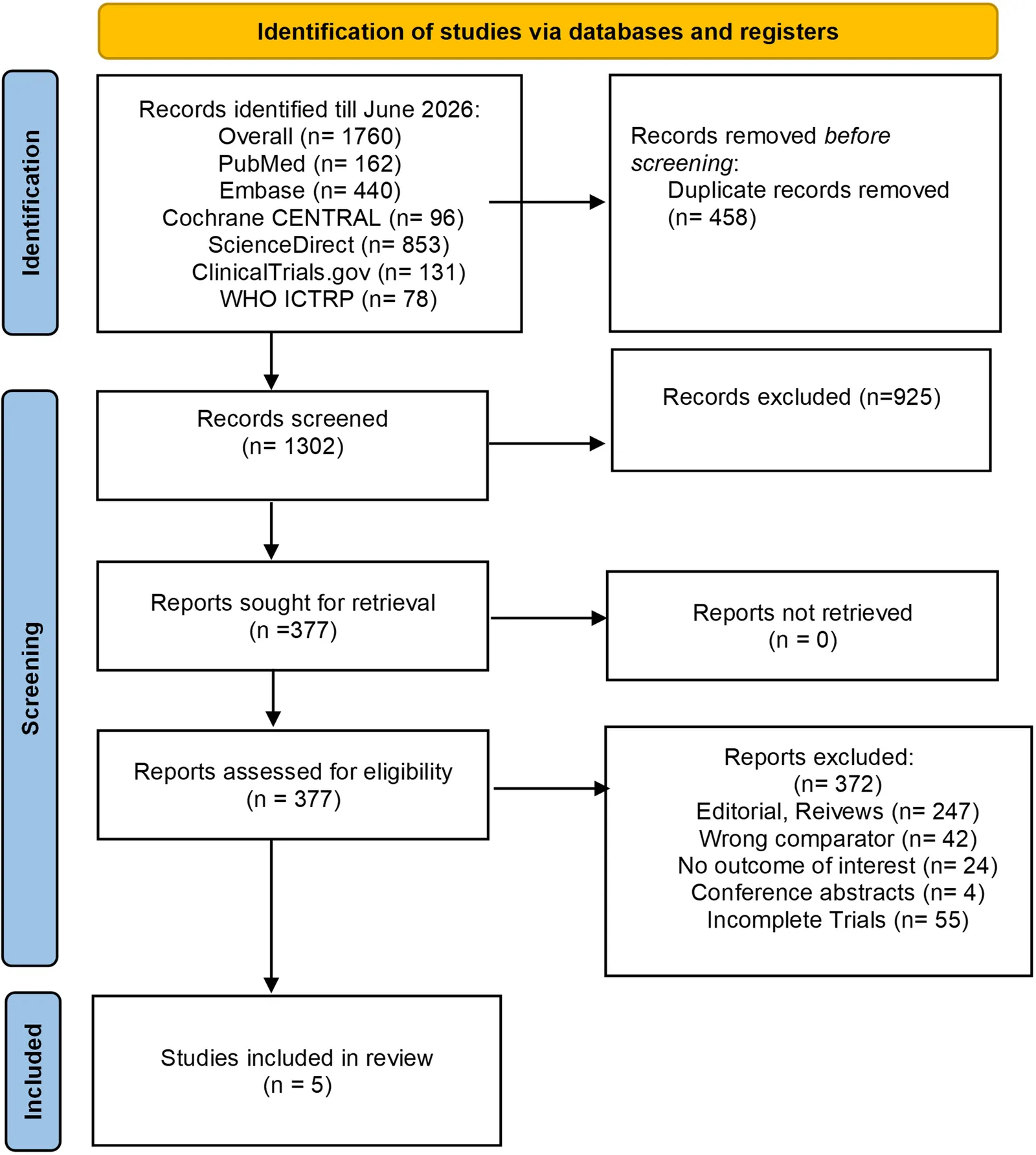
INTRODUCTION: Semaglutide 2.4 mg is the reference pharmacotherapy for weight management, yet many patients do not reach ambitious weight-loss targets. CagriSema, a fixed-dose combination of cagrilintide and semaglutide, may offer additional benefit through complementary mechanisms. We quantified its incremental efficacy and safety against semaglutide 2.4 mg monotherapy in adults with overweight or obesity, with and without type 2 diabetes. METHODS: This PRISMA 2020-compliant review (PROSPERO CRD420261380458) searched PubMed, Embase, Cochrane CENTRAL, ScienceDirect, ClinicalTrials.gov and WHO ICTRP to 30 June 2026 for randomised controlled trials comparing CagriSema with semaglutide 2.4 mg or placebo. Effects were pooled within two prespecified comparator strata using random-effects models with restricted maximum likelihood estimation of τ² and a Hartung-Knapp-Sidik-Jonkman small-sample adjustment, with prediction intervals, leave-one-out and phase-3a-restricted sensitivity analyses, trial sequential analysis. RESULTS: Five trials (4,746 unique participants) were included. Versus semaglutide 2.4 mg, CagriSema produced greater weight loss (mean difference -6.89 percentage points, 95% CI -8.70 to -5.06; I² = 33%; prediction interval -8.91 to -4.86), a greater absolute reduction in body weight (-7.16 kg, 95% CI -9.15 to -5.17) and in body-mass index (-2.41 kg/m², 95% CI -2.83 to -1.99), and roughly twice the likelihood of reaching a 20% reduction (RR 2.10, 95% CI 1.78 to 2.47). Waist circumference fell further (-4.07 cm, 95% CI -5.10 to -3.04). No incremental glycaemic benefit was detected, with intervals for glycated haemoglobin (-0.07, 95% CI -0.14 to 0.01) and fasting plasma glucose lying entirely within prespecified minimal important differences. Injection-site reactions were more frequent (RR 3.14, 95% CI 1.42 to 6.96); gastrointestinal adverse events were not significantly increased under the primary model (RR 1.09, 95% CI 0.97 to 1.21). CONCLUSION: CagriSema produces clinically meaningful additional weight loss and modest improvements in surrogate cardiometabolic measures compared with semaglutide 2.4 mg alone, at the cost of more frequent injection-site reactions and, at most, modestly more frequent gastrointestinal events. The evidence is insufficient to determine whether serious adverse events or neoplasms differ between treatments, and long-term durability, cardiovascular outcomes and body composition remain undetermined. SYSTEMATIC REVIEW REGISTRATION: https://www.crd.york.ac.uk/prospero/, identifier CRD420261380458.
From the paper
- Participants
… 4,746 unique participants …
- Primary outcome
The pooled mean difference across four trials was −6.89 percentage points (95% CI −8.70 to −5.06; p = 0.001), with τ² = 0.00 and moderate heterogeneity (I² = 33%; Q p = 0.22).
- Events by group
… 19.93 (95% CI 11.53 to 34.44) and 37.91 (95% CI 22.09 to 65.07) for thresholds of at least 5%, 10%, 15% and 20%; the very large estimates at the higher thresholds reflect the near-absent placebo response.
- Harms
Any adverse event was reported in 2,119 of 2,313 participants (91.6%) receiving CagriSema and 457 of 524 (87.2%) receiving semaglutide 2.4 mg (RR 1.03, 95% CI 1.01 to 1.05; I² = 0%), a difference well below the prespecified threshold for an appreciable effect.
- Limitation
First, only five randomised controlled trials met the eligibility criteria, and several outcomes are informed by only two.
Quoted word for word from the full text on frontiersin.org.
The paper
DePaul University; Services Institute of Medical Sciences
Frontiers in Endocrinology, Oct 2, 2026, Open access


