Benefits and Costs of Treating Obesity Among Adults in Commercial Insurance Plans
Abstract
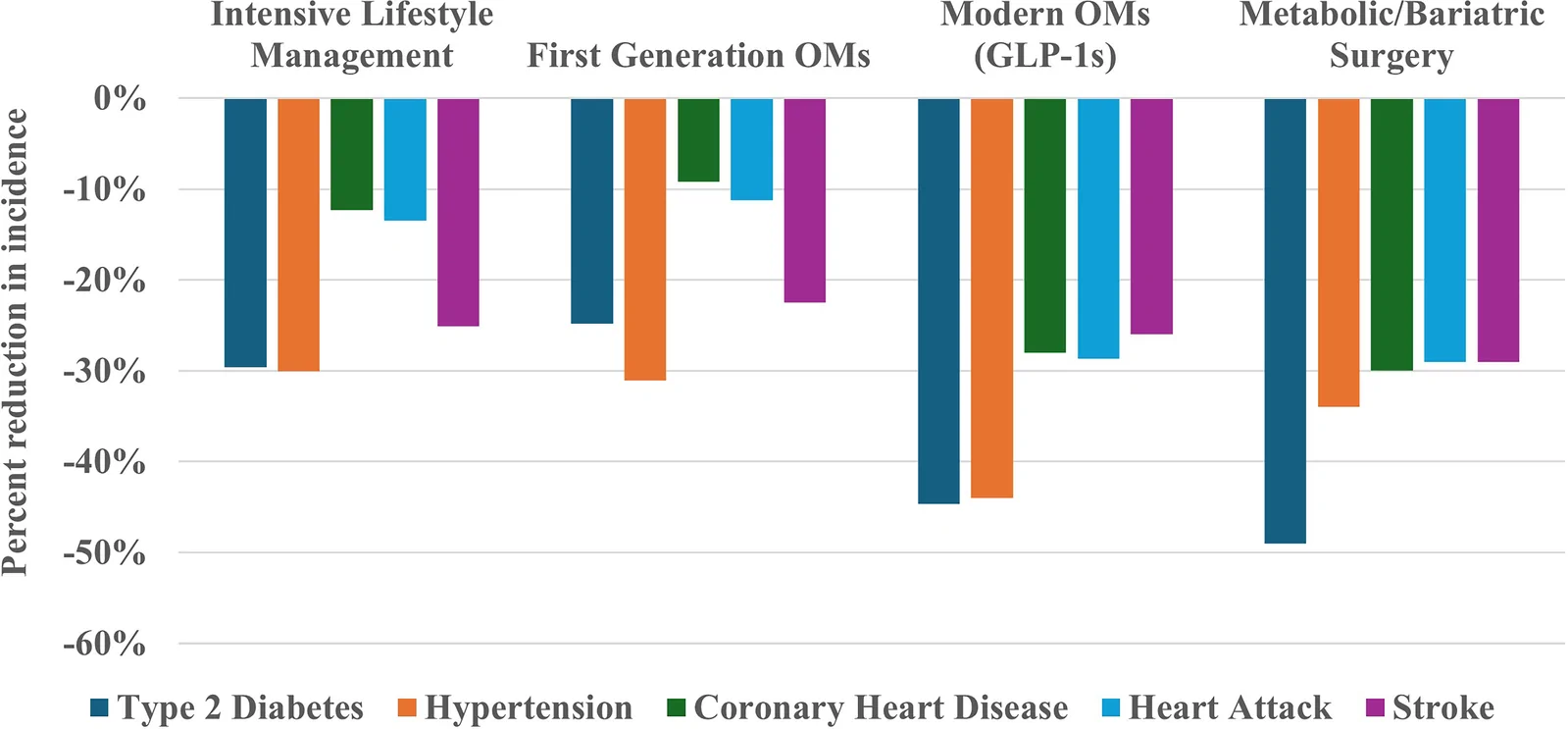
OBJECTIVE: To evaluate the clinical, economic, and social benefits and costs of evidence-based obesity treatment among commercially insured adults. RESEARCH DESIGN AND METHODS: Using a Markov-based microsimulation model, we projected 5-year clinical and economic outcomes of intensive lifestyle management, obesity medications, and metabolic/bariatric surgery, drawing on data from clinical trials, national surveys, and economic studies. RESULTS: This analysis focused on 47.3 million commercially insured adults with obesity who lacked access to treatment through existing clinical pathways. Over 5 years, cumulative medical savings per person ranged from $2,908 for lifestyle intervention to $2,450-$7,304 for obesity medications and $12,001 for surgery among adults without preexisting diabetes or cardiovascular disease. At the population level, access to treatment would yield 5-year benefits of $9.7 billion in medical savings, $25.8 billion in productivity gains, $38.8 billion in quality-of-life value, and $29.6 billion in mortality-reduction benefits, requiring $44.7 billion in total investment. Combined benefits produced net social value of $59.1 billion, with a $2.35 return per dollar invested and positive returns as early as the second year. CONCLUSIONS: Obesity treatment generates substantial social benefits through improved health outcomes and productivity gains. Medical and disability cost savings and workplace productivity improvements combined could recover 81% of treatment investment. Employees effectively finance coverage through premiums and reduced wages, and comprehensive benefit design that includes health outcomes and quality-of-life improvements more accurately reflects societal treatment value. Coverage decisions based solely on employer economic returns underestimate the full societal value of expanding coverage. UNLABELLED: Video 1.Video abstract48ed6990-a68e-4467-8080-ab264925c4c6doci250006video1.
- Intensive lifestyle management
- Metabolic bariatric surgery
- Obesity medications
- Obesity treatment
- Obesity
- Humans
The paper
GlobalData Plc; American Diabetes Association
Diabetes, Obesity, and Cardiometabolic CARE, Jun 7, 2026


