Global and Regional Risk Factors for Vision Impairment in 2020 and Multi-decadal Trends 1990-2020: A Meta-Analysis and Visual Display Based on Prevalence Data From the Global Burden of Disease study and Vision Loss Expert Group
Abstract
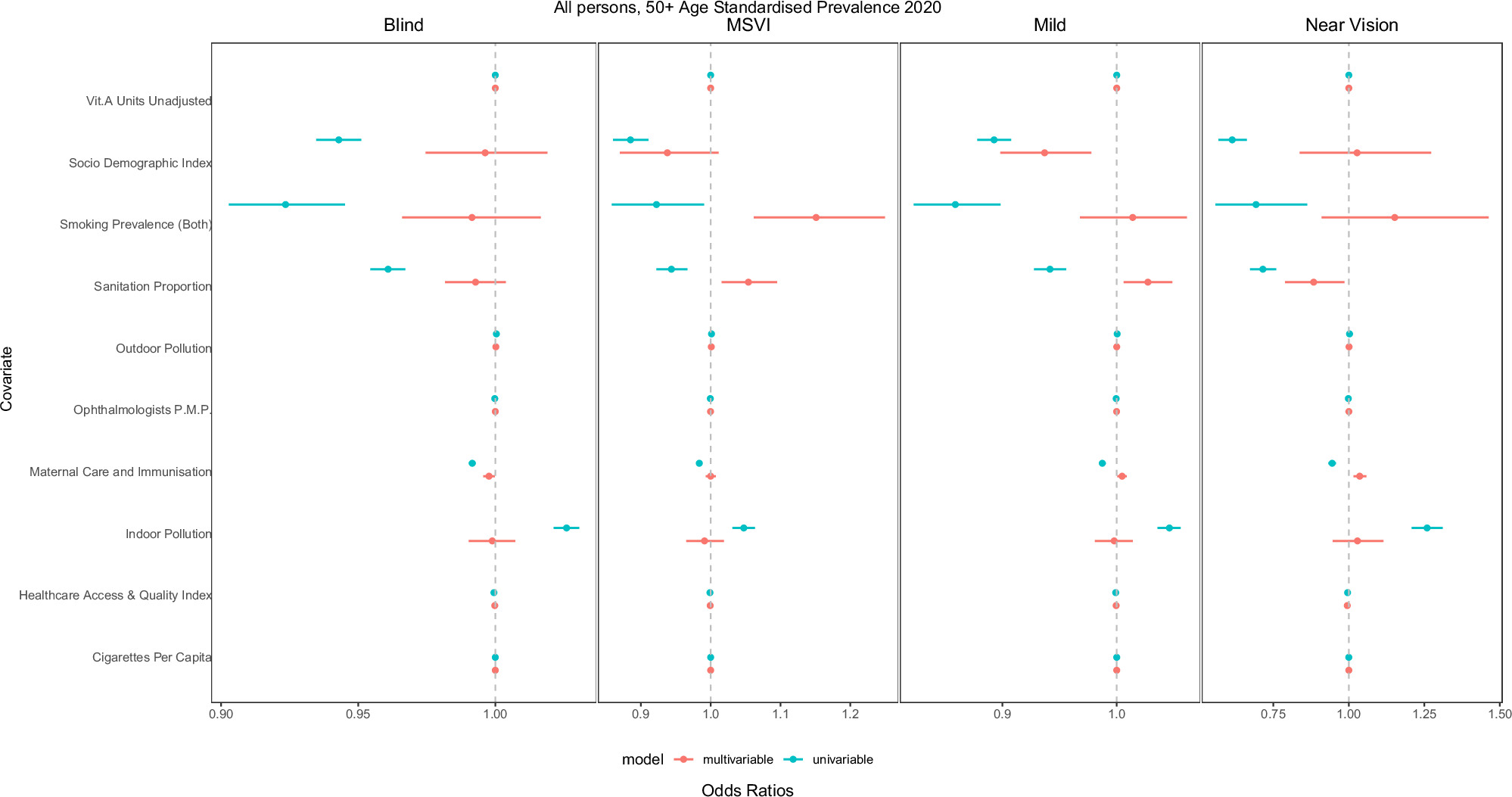
PURPOSE: To investigate global and regional risk factors for blindness and vision impairment pertaining to all geographical locations between 1990 and 2020. METHODS: (1) Twenty-four covariates were selected with a potential link to vision impairment from the Global Burden of Disease Study (GBD) Covariates database as predictive factors. (2) From these, the linear association was investigated, with crude and age-standardised prevalence estimates of blindness and distance and near vision impairment in 2020 by using data for the whole population, sex and 5-year age groups, and by stratifying severity through mild, moderate, severe and total impairment. (3) Analysis investigated whether percentage rates of change in risk factors were associated with rates of change in prevalence in 1990-2020. RESULTS: For adults (50+ years), for crude and age-standardised vision loss prevalence estimates for the year 2020, a significant negative association of smoking prevalence was found initially for all persons and for each sex, which appears to be due to ecological confounding and became a positive association using more granular regional and age group data. Maternal care and immunisation, sanitation proportion, Health Access and Quality Index and Socio-demographic Index were other significant age-standardised negative associations. Ophthalmologists/million population had a weak but significant protective effect, and positive associations were found for pollution (outdoor and indoor), stronger for greater vision impairment severities. Years in education per capita were weakly, negatively associated with vision loss prevalence, yet zero education proportion had a stronger but positive association for both sexes. CONCLUSIONS: This study confirmed associations at population level globally, which appear to be stable over decades. In addition, the study quantified the contribution of epidemiologically-based risk factors to vision loss at a GBD super-regional level, which is novel. This opens useful avenues for targeted intervention by policymakers. For example, reduction in sex inequity in blindness rates over 30 years has been positively associated with reducing overall prevalence of blindness.
From the paper
- Limitation
Modelling and age standardisation choices inherent in both VI estimates and covariates have a considerable impact on national results.
Quoted word for word from the full text on link.springer.com.
The paper
Ophthalmic & Physiological Optics, Oct 16, 2026, Open access


