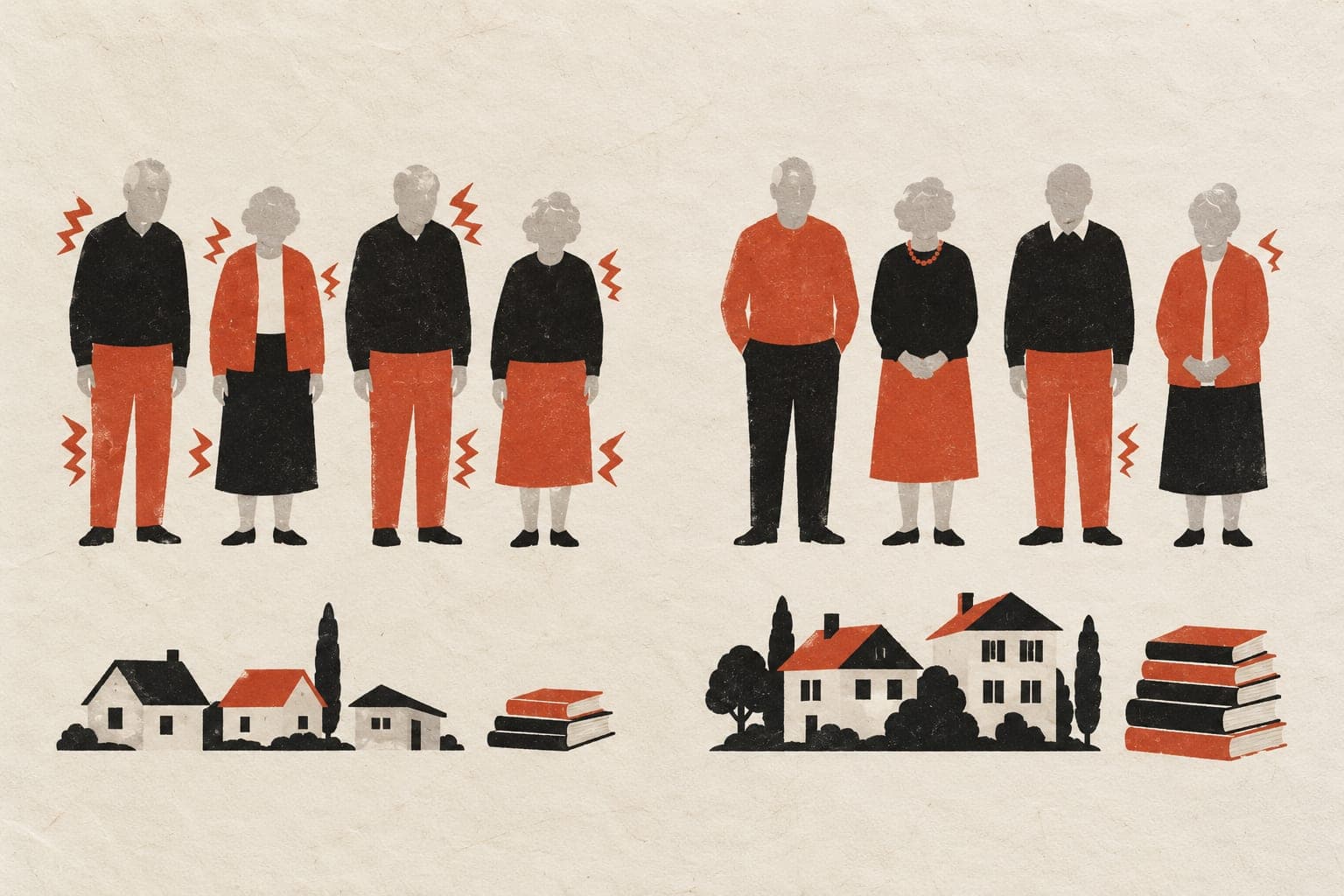
Late-life pain was more common where development ranked lowest
Any bodily pain in later life was 30.6 percentage points more common in countries with the lowest human development scores than in those with the highest.
Nature Medicine
In an observational study of 6,125,459 participants in 118 countries, researchers combined self-reported pain data from 902 population-based sources. They created reference curves showing how common pain was at different ages and a freely accessible platform for comparing other datasets with these patterns.
Pain prevalence ranged from roughly 2% for facial pain to 40% for back pain. The share of people reporting pain rose most steeply before age 55. Women reported pain more often than men at all 11 body sites. In later life, any bodily pain was 30.6 percentage points more common in countries with the lowest Human Development Index scores than in those with the highest. This index measures health, education and income.
Why it matters
Pain is the leading cause of disability worldwide, making its distribution in later life important for understanding older people’s health. The reference framework could inform more equitable monitoring and prevention.
Caveats
The analysis relied on self-reported pain. Its observational design could not establish why pain patterns differed between countries.
The paper
Show 90 more authors
Azin Zare, Jax Norman, Gianluca V Guglietti, Lise Hobeika, Abimbola Ayorinde, Ahmad Salimzadeh, Ahmad-Reza Jamshidi, Aqeel M Alenazi, Arash Tehrani-Banihashemi, Bader A Alqahtani, Beatriz Olaya, Benjamin Longo Mbenza, Bibilola Oladeji, Brenda Penninx, Buddhi Paudyal, Caique de Melo, Chantal Berna, Clarissa Humberg, Pascal Claudepierre, Elisa Smith, Elizabeth VanDenKerkhof, Erik J Giltay, Esther Garcia-Esquinas, Faisal Parlindungan, Fatima Qayyum Abbasi, Fernando Rodríguez Artalejo, Gareth T Jones, Gary Slade, Hanifa Bouziri, Herta Flor, Hiroyasu Iso, Ian Gilron, Imad Uthman, Ingris Peláez-Ballestas, Jean-Paul Divengi Nzambi, Jose Luis Ayuso-Mateos, Josep Maria Haro, Julia Wager, Juliana Barcellos de Souza, Kazutoshi Nakamura, Keiko Yamada, Lisa-Marie Rau, Makram Talih, Marcus J Beasley, María Dueñas, Marie Zins, Marta Miret, Melissa Wake, Mirza Zaka Pratama, Mohammed Almalki, Monique Chaaya, Muhammad Anshory, Naoki Kondo, Navid Moghadam, Norma Mansor, Omar Alsaed, Orawan Keeratisiroj, Oye Gureje, Pande Ketut Kurniari, Pardis Noormohammadpour, Pierrot Lebughe, Raga A Elzahaf, Ramin Kordi, Raquel Lucas, Rashmi Parekh Bhandari, Rosa Weiss Telles, Rudy Hidayat, Saba Samreen, Samar Al-Emadi, Sandhi Maria Barreto, Shima RoknSharifi, Shinsuke Inoue, Sudeep Adhikari, Suryo Anggoro Kusumo Wibowo, Sweekriti Sharma, Sylvia Villeneuve, Takahiro Tabuchi, Tayyeba Khursheed, Tie Yamato, Todd Jackson, Veronica Souza Santos, Wantana Siritaratiwat, Xianchen Liu, Zhen-Zhen Liu, IMAGEN Consortium, Susan M Sawyer, Saman Khalatbari-Soltani, Ólöf Anna Steingrímsdóttir, Gary J Macfarlane, Fiona Blyth,McGill University
Nature Medicine · 5 Oct 2026