An eight-ketohexose stereoisomer screen identifies d-allulose as a stereoselective suppressor of AGE-related autofluorescence in Caenorhabditis elegans
Abstract
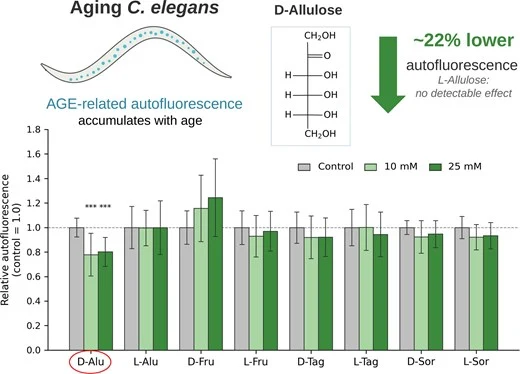
Advanced glycation end products (AGEs) accumulate with age and contribute to age-related disease. Using an autofluorescence assay in Caenorhabditis elegans, we screened all eight ketohexose stereoisomers. The response was highly stereoselective: only d-allulose significantly suppressed autofluorescence (∼22% at 10 mM and ∼20% at 25 mM; corrected p < 0.01), while its enantiomer l-allulose, assayed alongside it, had no detectable effect. The suppression was undetectable at 5 mM and did not deepen between 10 and 25 mM, and suppression was also detected at 25 mM with killed bacteria. Despite this in vivo suppression, d-allulose generated substantial glycation-associated fluorescence in a cell-free bovine serum albumin system at 60 °C, indicating that it is not chemically inert. These results establish a stereochemical activity map of ketohexoses toward AGE-related autofluorescence.
- D-allulose
- L-allulose
- AGE–RAGE signalling
- AGE-related autofluorescence
- Glycation-associated fluorescence
- C. elegans
The paper
Kagawa University; Toyo Institute of Food Technology
Bioscience, Biotechnology, and Biochemistry, Oct 16, 2026