Lung Function and Respiratory Symptoms as Factors Associated with Smoking Cessation Status in a Population-Based Study
Abstract
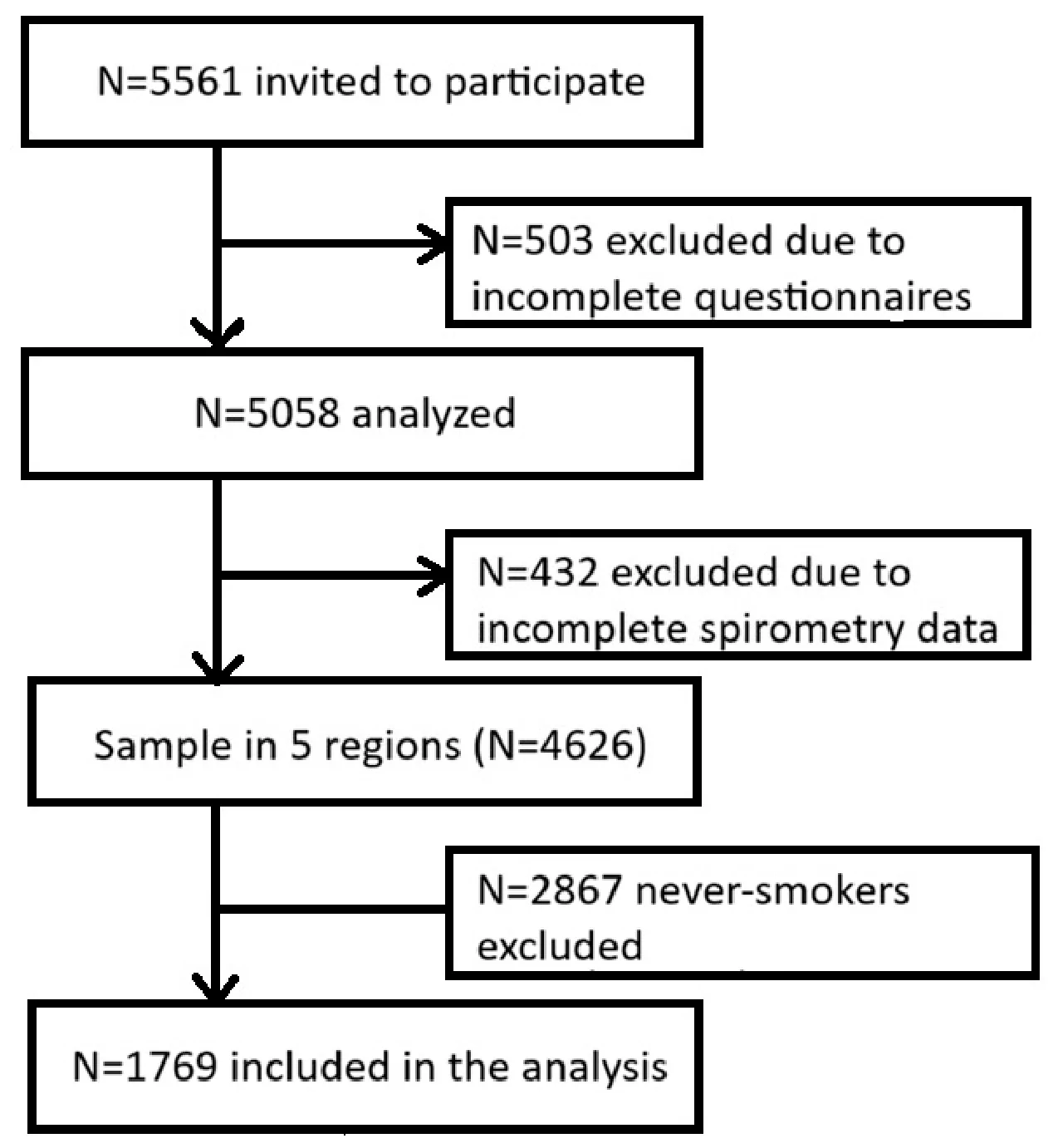
Background/Objectives: The aim of this study was to test the association of poorer spirometry and more respiratory symptoms with being an ex-smoker in a cohort of ever-smokers in a population-based study in Kazakhstan. Methods: We first enrolled 5058 subjects, of whom 1769 were classified as ever-smokers (63% current and 37% former smokers) from the general population in five cities in Kazakhstan and analyzed them hereinafter. They filled in a questionnaire and underwent spirometry with bronchodilation, in which z-scores of post-bronchodilation forced expiratory volume in one second (FEV₁) and forced vital capacity (FVC) were analyzed. Respiratory symptoms and spirometry were compared between continuing smokers and those who stopped in multivariate logistic regression models. Results: Current smokers smoked a median of 10 (interquartile range (IQR) 7;20) cigarettes a day. In the fully adjusted models, neither lung function (FEV₁, FVC and FEV₁/FVC z-scores and even FEV₁/FVC below the lower limit of normality (LLN)) nor symptoms could predict being an ex-smoker at present. Age (odds ratio (OR) 1.02; 95% confidence interval (CI) 1.01; 1.03), body mass index (BMI) over 25 kg/m² (OR 1.36; 95% CI 1.10; 1.68), lifetime exposure to vapor, gas, dust and fume (OR 0.77; 95% CI 0.62; 0.97), exposure to SHS (OR 0.34; 95% CI 0.27; 0.42) and electronic cigarette use (OR 0.58; 95% CI 0.34;0.99) were significantly associated with being a former smoker vs. a current smoker at the time of examination. Conclusions: Spirometry and early respiratory symptoms did not predict being a former smoker, but co-exposure to secondhand smoke, occupational exposures, and electronic cigarette use sustain continuing smoking.
The paper
Peoples' Friendship University of Russia; Semey Medical University
Journal of Clinical Medicine, 26 Sep 2026, Open access