Adherence to the Nordic Nutrition Recommendations 2023 and incidence of type 2 diabetes: a Danish cohort study
Abstract
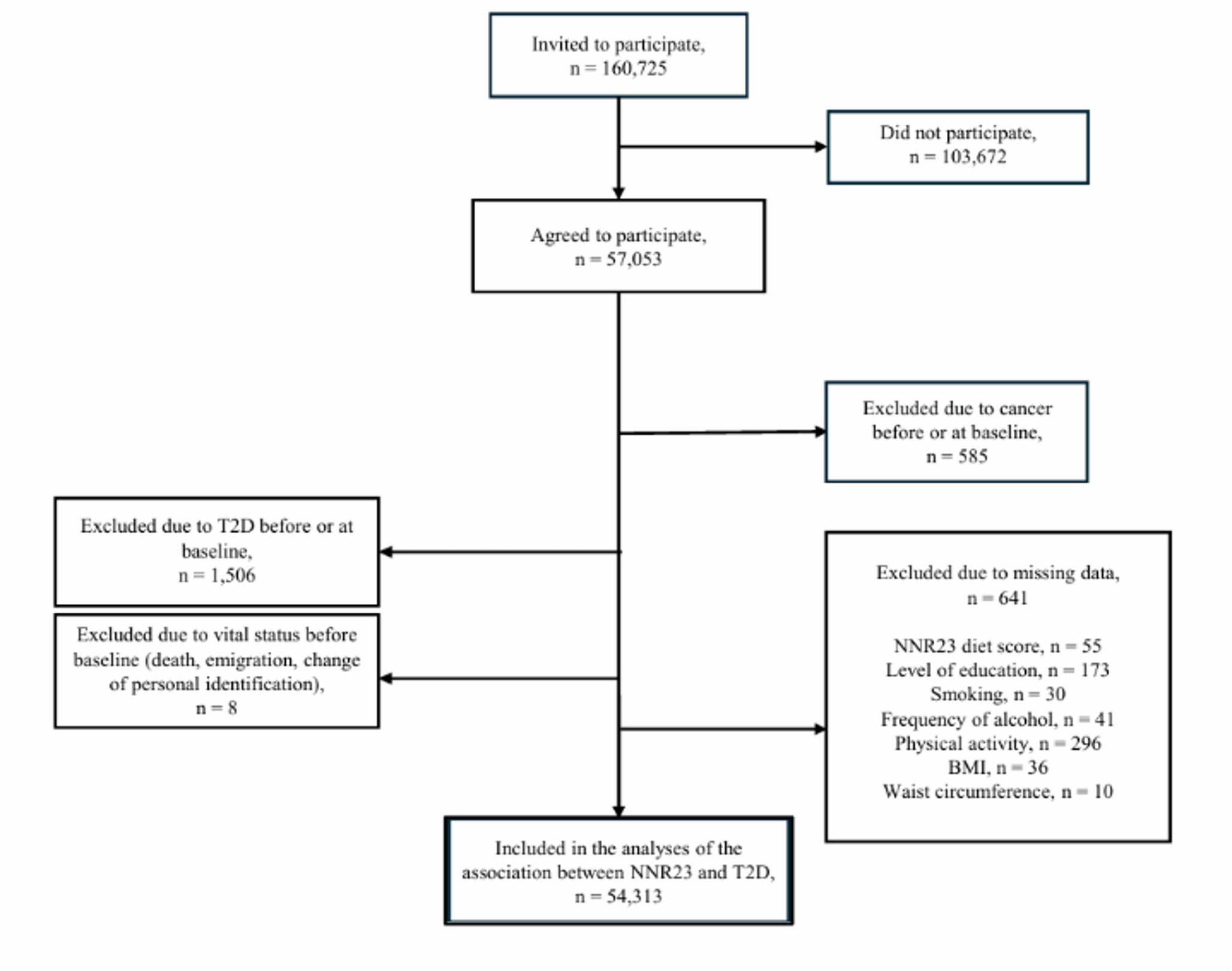
PURPOSE: Type 2 diabetes (T2D) is one of the most burdensome chronic diseases. Unhealthy dietary patterns are associated with greater risk of T2D, whereas plant-predominant and climate-friendly diets may be associated with lower risk of T2D. This study aimed to examine the association between adherence to the Nordic Nutrition Recommendations 2023 (NNR23) and risk of T2D in Danish middle-aged adults. METHODS: This cohort study used data from the Danish Diet, Cancer and Health cohort. The study population was defined among participants with complete baseline data and no cancer at baseline, excluding those with T2D at baseline (n = 54,313). Diet was assessed using a validated semi-quantitative 192-items food frequency questionnaire. Adherence to NNR23 was measured using the Nordic Nutrition Recommendations 2023 Food-Based Diet Score (range 0-15 points). Incident cases of T2D were identified through linkage to the National Diabetes Register. The associations were analysed using Cox proportional hazards regression. RESULTS: During a median follow-up time of 15.3 years, 7,143 participants developed T2D. Participants with moderate-high adherence (> 10-15 points) to NNR23 had a lower risk of T2D compared to those with low adherence (0-8 points) to NNR23 (HR: 0.63, 95% CI 0.57;0.70). Restricted cubic spline analysis showed a significant non-linear inverse association between adherence to NNR23 and T2D (p-value < 0.001 for non-linearity). CONCLUSION: Greater adherence to NNR23 was associated with lower risk of T2D, supporting the potential relevance of the NNR23 for T2D prevention.
- Adherence to the nordic nutrition recommendations 2023
- Type 2 diabetes
- Nordic Nutrition Recommendations 2023 Food-Based Diet Score
- Humans
The paper
Aarhus University
European Journal of Nutrition, 12 Oct 2026