Mass spectrometry-based screening for monoclonal gammopathy in individuals undergoing routine physical examinations: Analyses of consecutive 15,068 cases in China
Abstract
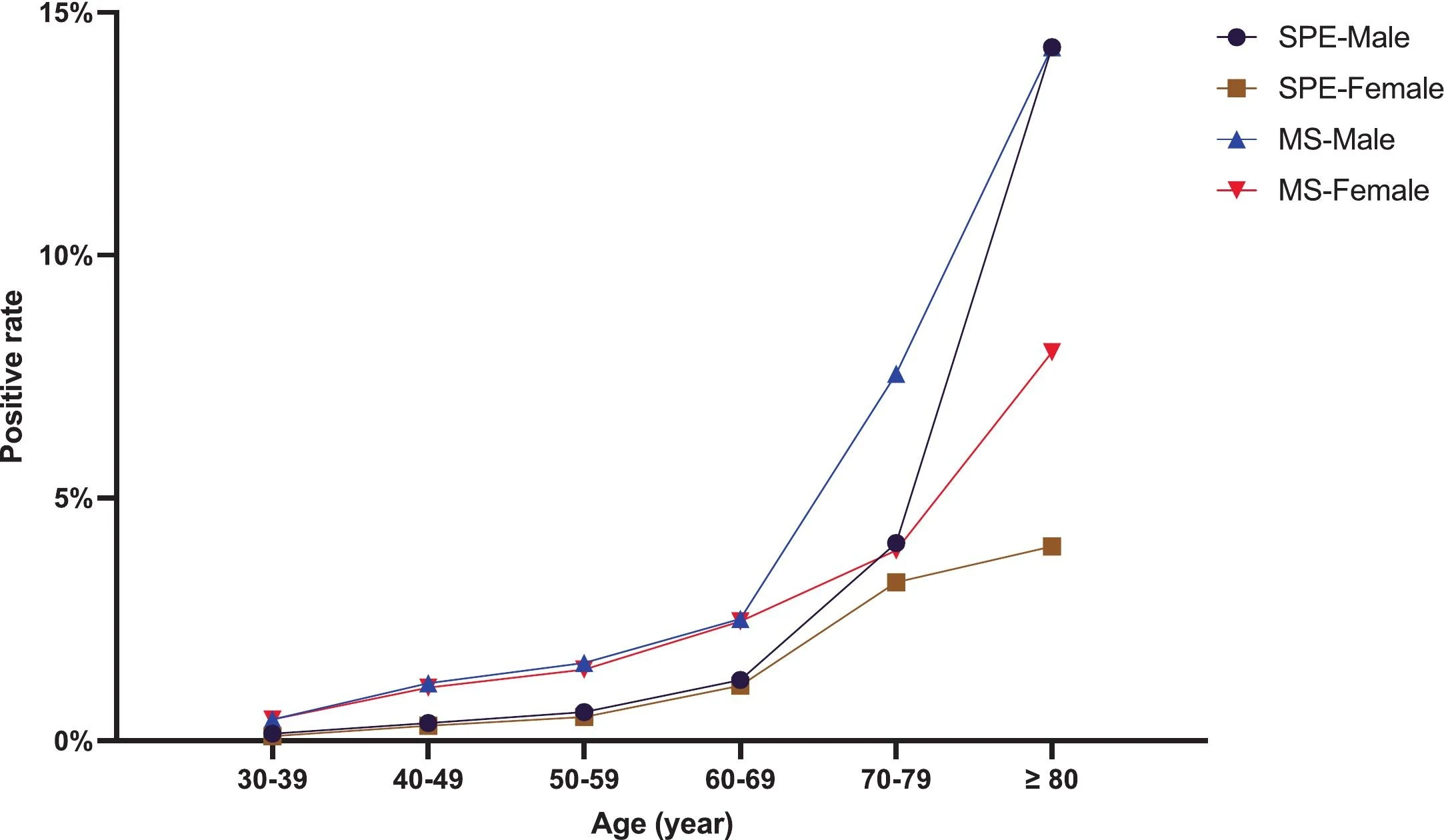
BACKGROUND: The intact M-protein Screening-Light Chain Assay (iMS-LC Assay) is a MALDI-TOF mass spectrometry (MS)-based method for M-protein detection without antibody enrichment. This study evaluated its feasibility for M-protein screening in comparison with conventional serum protein electrophoresis (SPE). METHODS: We prospectively enrolled 15,068 consecutive individuals aged ≥30 years undergoing routine physical examinations at Peking Union Medical College Hospital between December 2, 2024, and April 10, 2025. Residual serum samples from SPE were subjected to automated iMS-LC Assay screening. Samples positive by either MS or SPE underwent verification by serum immunofixation electrophoresis (IFE), free light chain (FLC) analysis, and MS isotyping. RESULTS: MS screening identified 201 positive cases compared to 70 by SPE (p < 0.001), demonstrating consistently higher detection rates across all age groups and more than a threefold increase among individuals under 60. MS positivity rates increased with age: males 30-39y (0.44%), 40-49y (1.19%), 50-59y (1.60%), 60-69y (2.51%), 70-79y (7.56%), ≥80y (14.29%); females 30-39y (0.44%), 40-49y (1.10%), 50-59y (1.47%), 60-69y (2.46%), 70-79y (3.92%), ≥80y (8.00%). CONCLUSION: The iMS-LC Assay demonstrated a higher detection yield than SPE for M-protein screening and identified additional low-abundance M-proteins, particularly in younger age groups.
The paper
Peking Union Medical College Hospital
Clinica Chimica Acta; International Journal of Clinical Chemistry, 11 Oct 2026