Retrospective Cohort Study on the Association Between a Laboratory Test-Derived Frailty Index and Mortality in Elderly Critically Ill Patients With Chronic Kidney Disease
90 days
Abstract
BACKGROUND/AIMS: Chronic kidney disease (CKD) represents a growing worldwide health concern. There is a need for easily obtainable markers that can improve risk evaluation in affected patients. Here, we investigated whether a laboratory-derived frailty index (FI-Lab) carries prognostic information for older CKD individuals admitted to intensive care. METHODS: A retrospective cohort design was adopted, drawing on the MIMIC-IV repository. Records of elderly ICU patients with diagnosed CKD were retrieved. The endpoints of interest were all-cause death within 30 and 90 days. Cox proportional hazards regression with incremental covariate adjustment and propensity score matching were employed to quantify the independent contribution of FI-Lab to survival. RESULTS: The analytic sample consisted of 5013 hospitalized CKD patients (mean age 77.9 ± 7.6 years; 61.4% male). Following full adjustment, a 0.1-unit rise in FI-Lab corresponded to a 94% higher mortality risk at 30 days (HR 1.94; 95% CI 1.57-2.40) and a 65% higher risk at 90 days (HR 1.65; 95% CI 1.43-1.91; both p < 0.001). Propensity-matched analyses yielded comparable estimates. No meaningful association emerged between FI-Lab and ICU or hospital length of stay. Conversely, higher FI-Lab values were accompanied by greater odds of acute kidney injury and continuous renal replacement therapy utilization. CONCLUSIONS: An elevated FI-Lab score at ICU entry is independently tied to elevated short- and intermediate-term mortality in older critically ill patients with CKD. Confirmatory prospective work is needed to establish its clinical role in this population.
From the paper
- Participants
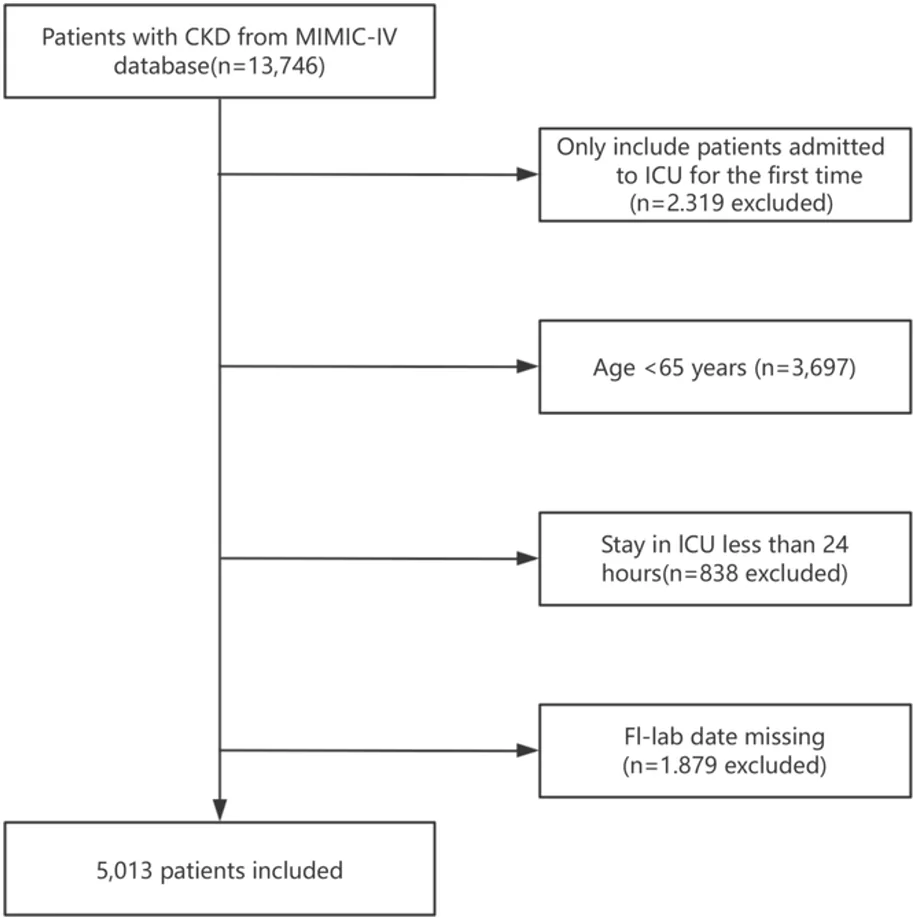
The analytic sample consisted of 5013 hospitalized CKD patients (mean age 77.9 ± 7.6 years; 61.4% male).
- Result
Following full adjustment, a 0.1-unit rise in FI-Lab corresponded to a 94% higher mortality risk at 30 days (HR 1.94; 95% CI 1.57–2.40) and a 65% higher risk at 90 days (HR 1.65; 95% CI 1.43–1.91; both p < 0.001).
- Limitation
First, FI-Lab was determined solely at the point of ICU entry; values may shift as the clinical trajectory unfolds.
Quoted word for word from the full text on onlinelibrary.wiley.com.
The paper
Qingyuan People's Hospital The Sixth Affiliated Hospital of Guangzhou Medical University Qingyuan Guangdong Province People's Republic of China; Department of Critical Care Medicine The Second Affiliated Hospital of Guangzhou University of Chinese Medicine Guangzhou Guangdong People's Republic of China
Health Science Reports, 8 Oct 2026