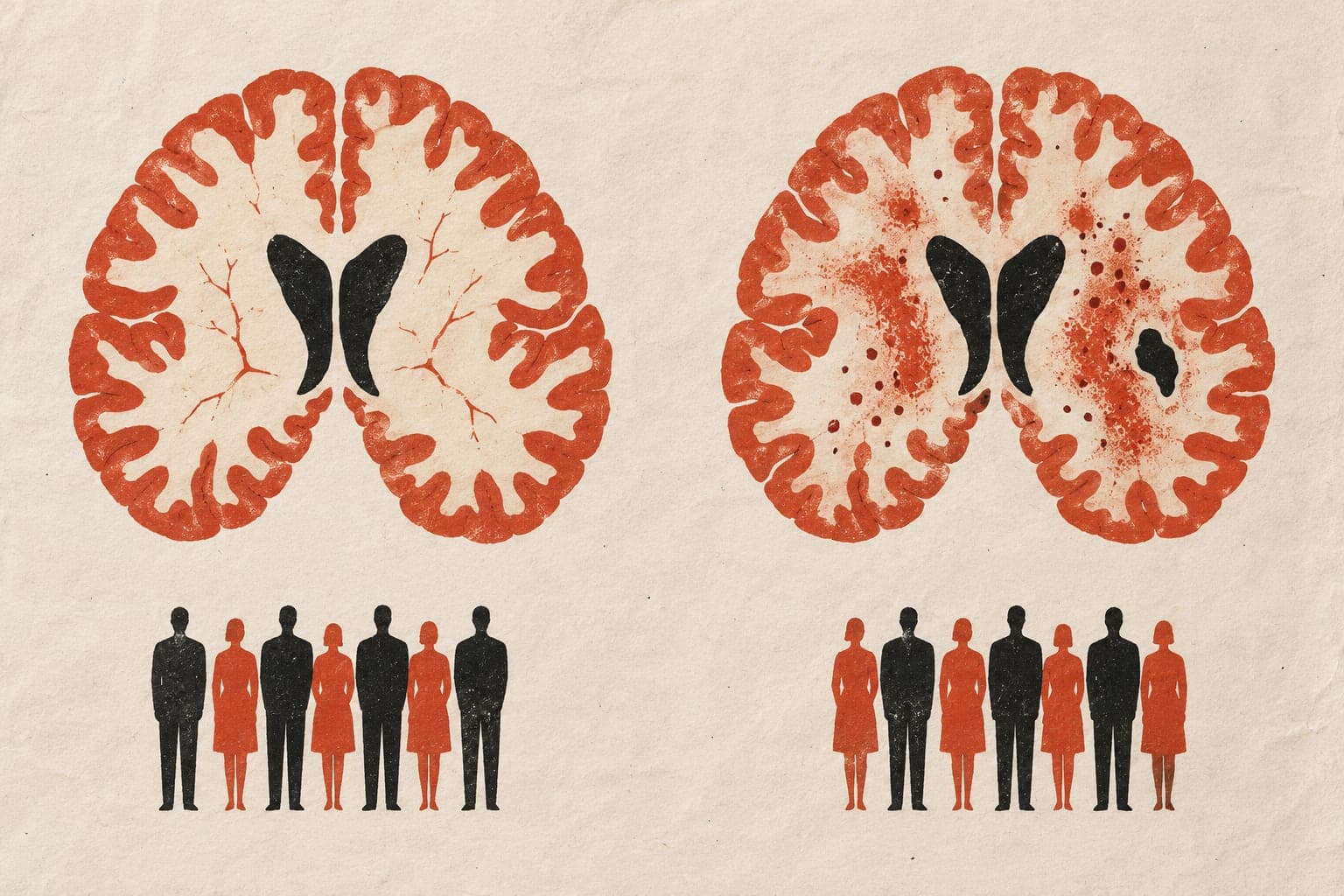
Severely enlarged brain vessel spaces predicted bleeding lesions
Over a median 5.1 years, bleeding-related lesions appeared in 33.7% of participants with severe enlargement versus 13.6% without severe enlargement.
Cohort study
An observational analysis studied 932 older adults who tested positive for amyloid, a protein, but had no cognitive impairment or bleeding-related brain lesions. Their average age was 71.7 years. Researchers used data from the Anti-Amyloid Treatment in Asymptomatic Alzheimer's Disease randomised trial. They assessed enlargement of fluid-filled spaces around brain vessels in the centrum semiovale, an area beneath the brain's outer layer.
Over a median 5.1 years, participants with severe enlargement were more likely to develop their first lesions related to cerebral amyloid angiopathy, a condition in which amyloid builds up in brain blood vessel walls. The lesions were small bleeds in the brain's lobes or iron deposits on its surface left by bleeding. Severe enlargement was not associated with early cognitive differences. Participants who developed lesions showed more pronounced cognitive decline.
Why it matters
Recognising cerebral amyloid angiopathy in older adults before bleeding begins may provide a foundation for research on preventing a first haemorrhage.
Caveats
This was an observational analysis within a randomised trial, so the association does not establish cause and effect. The findings concern amyloid-positive older adults without cognitive impairment or bleeding-related lesions at baseline.
- Cerebral amyloid angiopathy
- Cortical superficial siderosis
- Strictly lobar cerebral microbleeds
- Preclinical Alzheimer Cognitive Composite
- Severe enlarged basal ganglia perivascular spaces
- Humans
The paper
Hospital of the University of Pennsylvania
Annals of Neurology, 9 Oct 2026