Brain small vessel disease links to stroke and mortality risk
Compared with a zero score, participants with cerebral small vessel disease scores of 1 and 2 had hazard ratios of 1.48 and 1.52 for adverse events.
Our read
Biomarkers- Studied:
- Preprint: cohort study of 3,263 people (Dose-response)
- In the record:
- The 137th paper on cerebral small vessel disease with results in people; 665 on record in all. Its result on stroke agrees with all 8 other findings on record.
Editor of record: Boris Djordjevic · AgingResearch.News
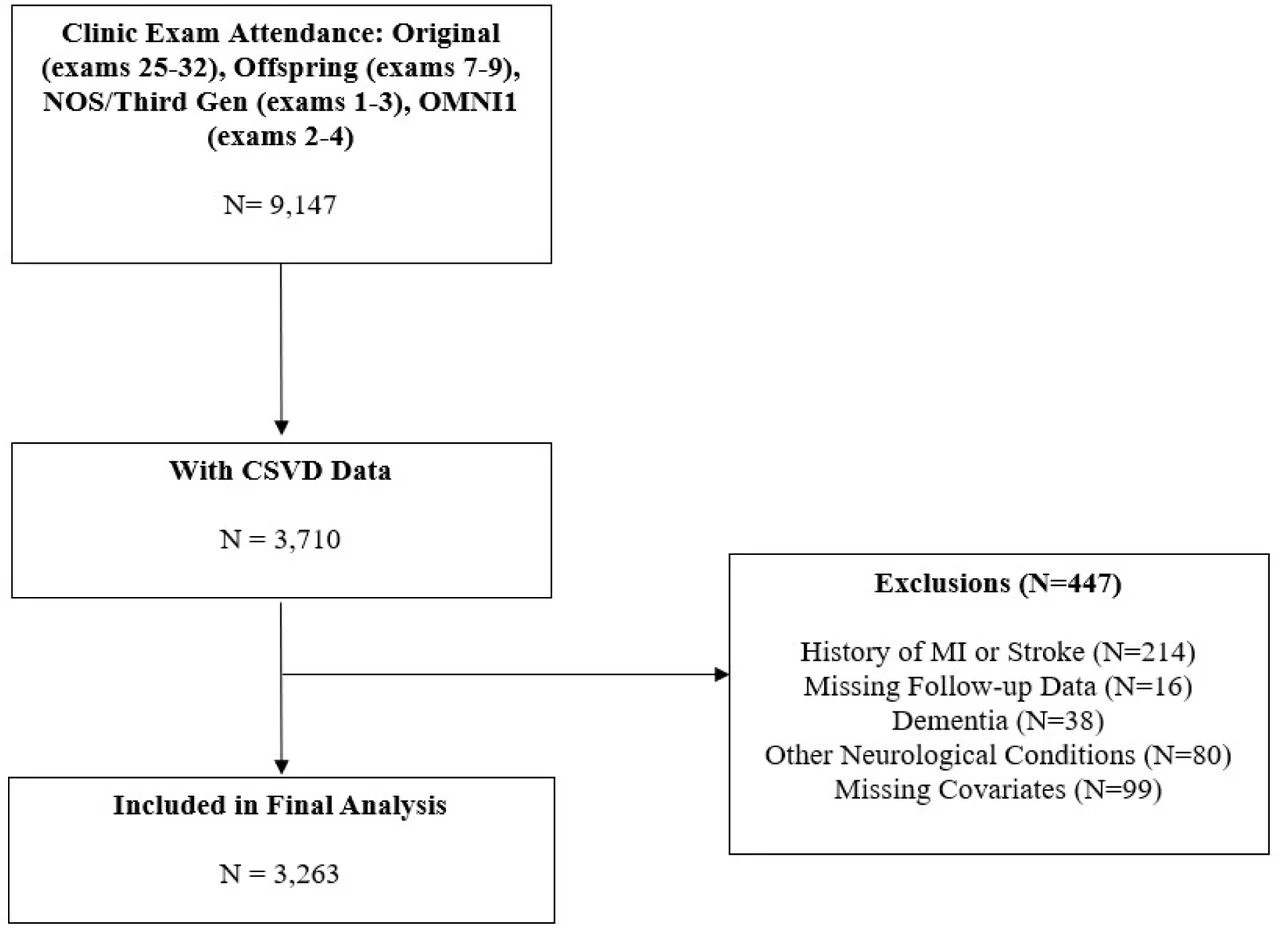
In 3,263 Framingham Heart Study participants free of stroke and dementia, researchers assessed cerebral small vessel disease using brain MRI scans. They scored participants from 0 to 2 or more based on covert infarcts, cerebral microbleeds, cortical superficial siderosis, perivascular space burden, and white matter hyperintensities. Overall, 31% had a score greater than zero, and higher scores clustered in older individuals with vascular risk factors.
Over a median follow-up of 8.4 years, 454 participants experienced stroke, myocardial infarction, or death. After adjusting for age, sex, and vascular risk factors, higher disease burden was associated with increased overall event rates. The score showed a dose-response relationship with all-cause mortality and an increased risk of stroke, but showed no significant link to myocardial infarction.
Why it matters
Subclinical microvascular brain damage may reflect broader systemic vascular aging, providing an imaging biomarker for mortality and vascular risk before clinical events emerge.
Caveats
This study is an observational preprint that has not yet undergone peer review. The observational approach cannot determine whether cerebral small vessel disease directly causes cardiovascular events or mortality.
From the paper
- Result
Participants with a CSVD score of 1 had approximately a 48% increased risk of experiencing any event (HR 1.48, 95% CI 1.19 – 1.85), and those with a score of 2 had a 52% greater risk (HR 1.52, 95% CI 1.17 – 1.97) compared to those with CSVD score 0.
- Limitation
In addition, this study had a predominantly White sample, which limits generalizability to some extent.
Quoted word for word from the full text on medRxiv.
The paper
Boston University
medRxiv, Sep 7, 2026, Open access, Preprint, not yet peer-reviewed

Comments
Be the first to comment.