Kinestesia: the prefrontal EEG response to a cognitive-motor intervention is graded by baseline cognitive status
Declared no competing interests
Abstract
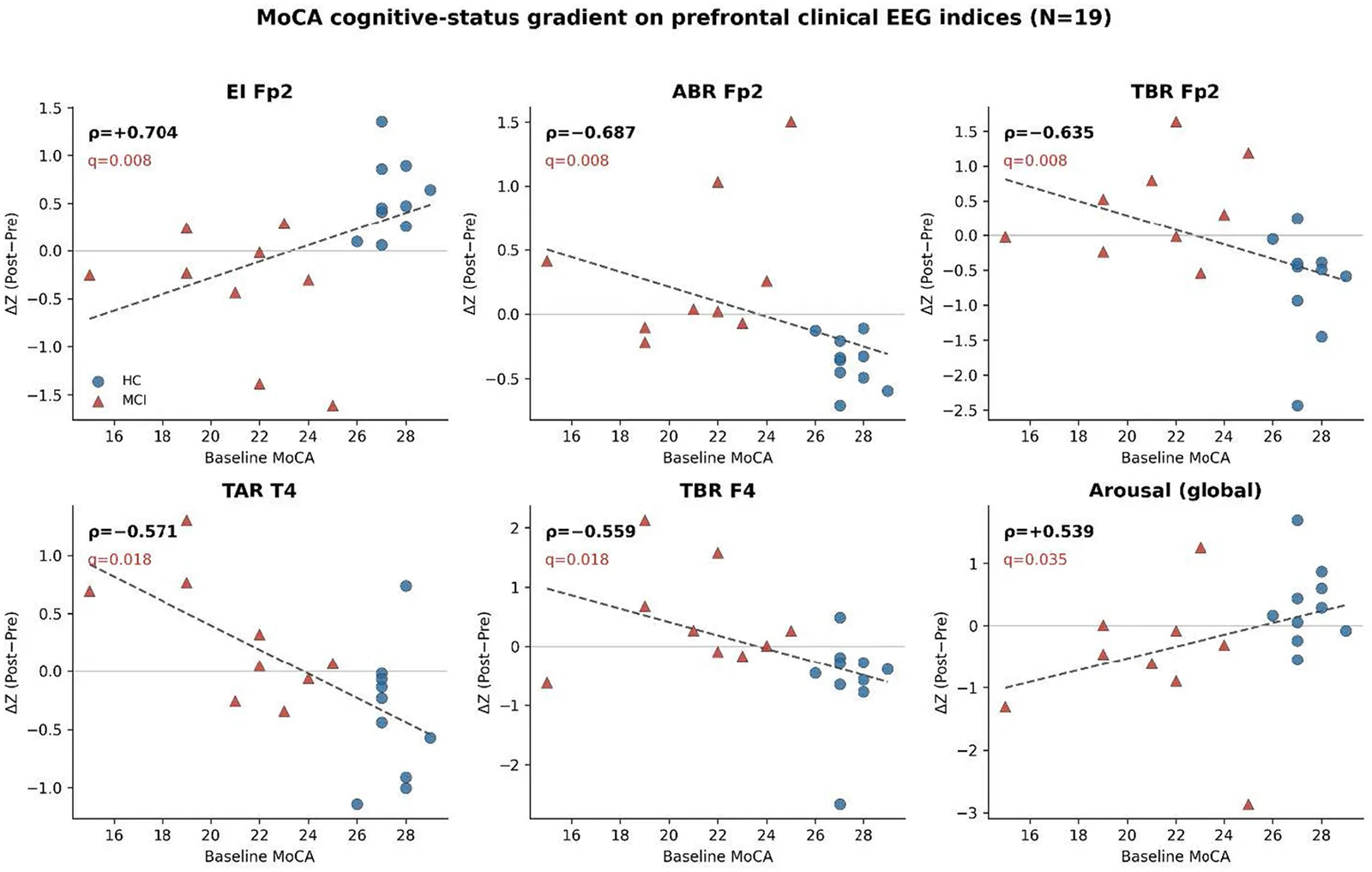
BACKGROUND: This is a companion neurophysiological study (N = 19) to a recently published exploratory pilot of the Kinestesia intervention - combining therapeutic videogames, rhythmic gait, and sensory stimulation - in older adults spanning the cognitively healthy (HC, n = 10) to mild cognitive impairment (MCI, n = 9) spectrum. That paper, published in Archives of Gerontology and Geriatrics, reported BH-corrected behavioural gains; here we ask whether the resting-state electrocortical response is graded by baseline cognitive status. METHODS: Resting-state EEG was recorded before and after 30 sessions in 19 participants (9 MCI, MoCA < 26; 10 HC, MoCA 26-29). Age-referenced Z-scores were computed for eleven pre-specified clinical EEG indices using the Harmonized Functional EEG Derived Phenotypes normative pipeline (HarFEDPNorms). The primary analysis treated the 19 participants as a single sample and correlated baseline MoCA with the pre-to-post change in each index (Spearman ρ), with Benjamini-Hochberg (BH) FDR correction. We assessed robustness to educational attainment using partial correlation. RESULTS: Eight of the eleven pre-specified indices showed a BH-corrected continuous association with baseline MoCA. The strongest were the Engagement Index (EI) and the Alpha/Beta Ratio (ABR) at Fp2 (EI: ρ = +0.704, q = 0.008; ABR: ρ = -0.687, q = 0.008): higher baseline cognitive status was associated with greater prefrontal activation after the intervention, and lower status with the reverse. MoCA and education were substantially correlated at the sample level (r = 0.596; 36% shared variance, driven by the HC/MCI contrast), and the primary prefrontal effect (EI Fp2) remained significant after adjusting for education (partial ρ = 0.50, p = 0.033). CONCLUSION: In this small, uncontrolled sample, the electrocortical response to Kinestesia was graded by baseline cognitive status, with a robust prefrontal engagement effect (EI and ABR at Fp2; BH q < 0.01). Findings are exploratory and hypothesis-generating, pending a randomised controlled trial. The HarFEDPNorms pipeline offers a device-independent framework for individualised EEG tracking in intervention research.
From the paper
- Participants
Briefly, N=22 older adults (≥60 years) were recruited from the Plan Vida center, in Queretaro, Mexico, following non-probabilistic purposive sampling from an initial screen of 70 individuals.
- Limitation
First, the EEG sample ( n = 19; 9 MCI, 10 HC) is small and the design is single-arm; all findings are exploratory and hypothesis-generating.
Quoted word for word from the full text on frontiersin.org.
The paper
Carl von Ossietzky Universität Oldenburg; Centro Internazionale Disturbi di Apprendimento
Frontiers in Aging Neuroscience, 22 Sep 2026