A protein helps zebrafish repair spinal cords without lasting scars
In zebrafish experiments, loss of Gata4 stiffened material around cells, delayed tissue rebuilding and impaired recovery of movement after spinal cord injury.
Cell Reports
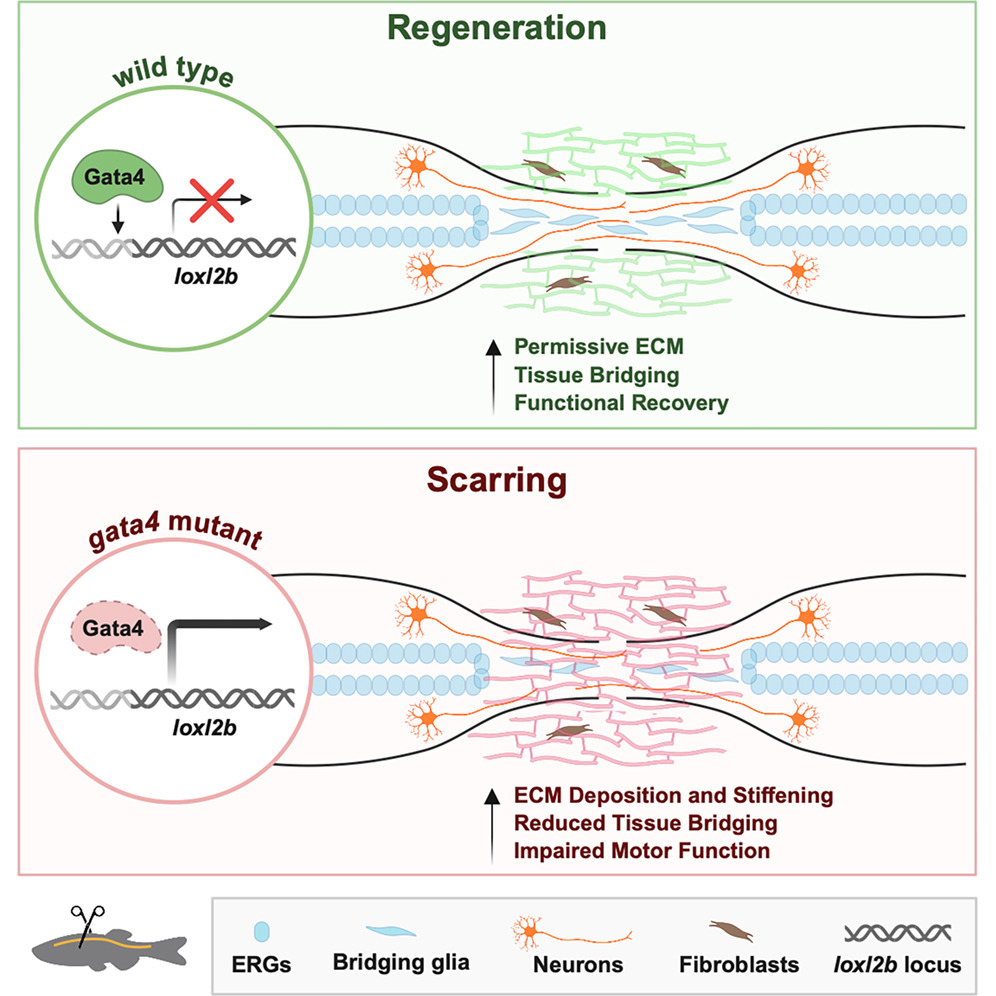
Experiments in zebrafish identified Gata4, a protein that controls gene activity, as a regulator of the material surrounding cells during spinal cord regeneration. After injury, activity of the gata4 gene rose mainly in ependymo-radial glial cells, supporting cells in the spinal cord. Gata4 preserved these cells’ identity and suppressed a pattern of gene activity resembling that of connective-tissue cells.
Loss of Gata4 increased gene activity for Loxl2b, an enzyme that links collagen fibres together. Excessive links stiffened the surrounding material and made it less favourable for regeneration. These changes delayed the formation of bridges made by glial cells and nerve fibres across the injury, and impaired recovery of movement. Pharmacological inhibition of Loxl2b restored the organisation of the surrounding material, tissue bridging and functional recovery.
Why it matters
Fibrotic scars hinder nerve regrowth in mammals. Understanding how zebrafish avoid persistent scarring may help frame future questions about tissue repair as bodies age.
Caveats
These were animal experiments in zebrafish, not studies in people. The abstract reports no tests of aging or lifespan.
The paper
A Gata4-Loxl2 axis controls ECM remodeling to enable scar-free spinal cord regeneration in zebrafish
Show 5 more authors
Paige E. Pfotenhauer, Hyosung Kim, Mawusi P. Sefogbe, Eman A. Akam, Ethan S. Lippmann,Cell Reports · 5 Oct 2026