Lung function declines in young adults in rural Uganda
FEV₁ declined by 10 mL per year across the cohort, and dropped 18 mL annually in individuals with normal baseline spirometry.
Journal of Global Health
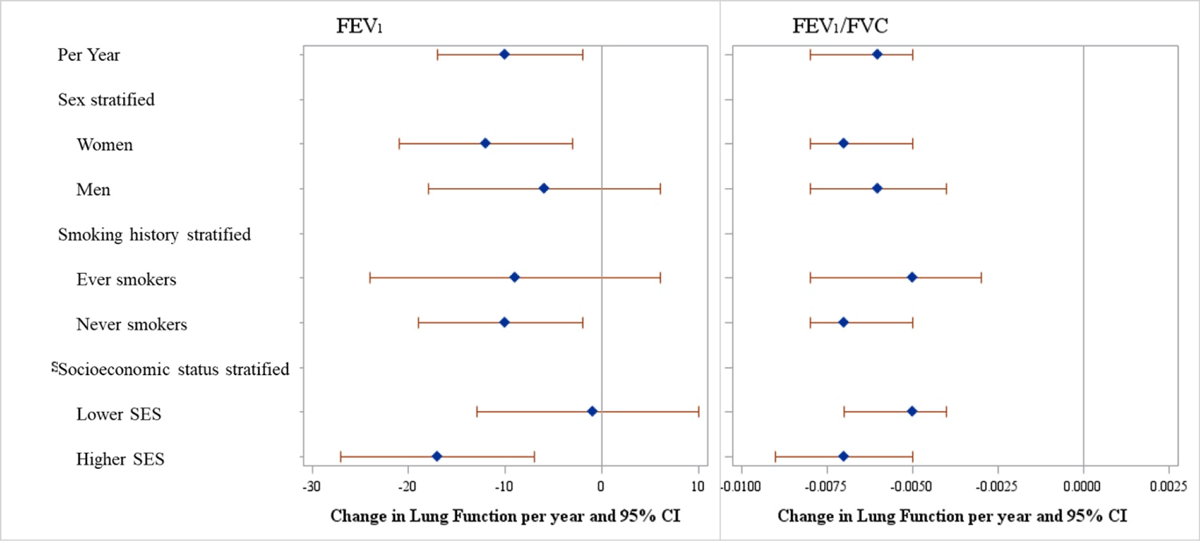
In a cohort of 902 adults in rural Uganda, researchers tracked respiratory health using up to three spirometry tests across four years. The participants had a median age of 35 years, 56% were women, and 75% had never smoked. At baseline, abnormal lung function affected 14% of participants, occurring more frequently in women and individuals with chronic respiratory symptoms. Across the cohort, forced expiratory volume in one second (FEV₁) declined by 10 mL per year, while the FEV₁/forced vital capacity ratio declined by 0.006 per year. Among participants entering the study with normal lung function, decline occurred faster, with FEV₁ falling by 18 mL per year and FEV₁/forced vital capacity dropping 0.66% predicted per year. Sex, smoking status, and socioeconomic status did not modify decline rates.
Why it matters
Age-related pulmonary decline often receives attention in older smokers, but these findings show measurable respiratory attrition occurring early in life among mostly non-smoking adults. Clarifying the trajectory of early lung function loss helps researchers identify environmental and non-smoking drivers of organ aging.
Caveats
The study was observational, followed participants over a four-year window, and was restricted to a single rural district in Uganda.
The paper
Show 11 more authors
Edwin Nuwagira, Charles Baguma, Patience Ayebare, Patrick Gumisiriza, Megan Lam, Mi‐Sun Lee, David C Christiani, Stephen Asiimwe, Bernard Kakuhikire, Alexander C. Tsai, Mark J Siedner,Massachusetts General Hospital · Harvard University
Journal of Global Health · 2 Oct 2026