Adults 80 and older with lung artery disease had higher death rates
Compared with younger adults, those 80 and older had 57% higher hospitalization rates and twice the mortality after adjustment for other factors.
Limit: Unrecorded cardiovascular and pulmonary diseases could explain some of the higher mortality in older patients
Edited by Boris Djordjevic · AgingResearch.News
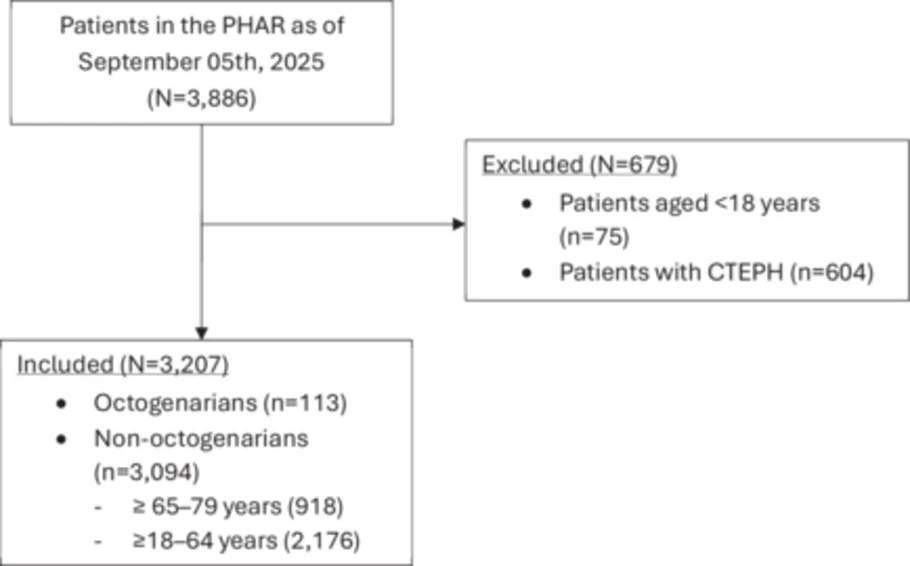
In a prospective observational study, researchers followed 113 adults aged 80 and older and 3,094 adults aged 18–79 with pulmonary arterial hypertension—high blood pressure in the lungs’ arteries. Participants came from specialist centers across the US and were followed for a median of 16.2 months. Death rates were 19.4 per 100 combined years of patient follow-up in the older group, versus 7.4 in the younger group.
The higher mortality and hospitalization rates remained after adjustment for factors including sex, disease cause and treatment. Older participants walked shorter distances in six minutes at enrollment and were more often taking just one drug for the condition. They also had lower pressures in the lung arteries.
Why it matters
Pulmonary arterial hypertension was historically viewed as a disease of young adults. Its course in the oldest patients raises questions about how aging, other illnesses and treatment response shape the condition.
Caveats
The observational design could not show that age or treatment differences caused worse outcomes, and hospitalizations were self-reported. Participants attended accredited US specialist centers; the study excluded people whose pulmonary hypertension resulted from chronic blood clots.
From the paper
- Participants
Of the 3,886 participants in the PHAR, we excluded 75 patients who were younger than 18 and 604 adults with CTEPH, leaving 3,207 adults with PAH.
- Follow-up
Study participants were followed for a median of 16.2 months (IQR: 1.5, 38.9).
- Result
… octogenarians had a significantly smaller improvement in 6MWD (aβ: ‐25.8, 95% CI: −40.3, −11.4; p < 0.001), greater increase in WHO FC (aOR: 2.70, 95% CI: 1.49, 4.89; p < 0.001), and higher REVEAL lite 2.0 score (aβ: 0.39, 95% CI: 0.11, 0.67; p < 0.001) over time compared to younger patients.
Quoted word for word from the full text on PubMed Central.
The paper
Pulmonary Arterial Hypertension in Octogenarians: The Pulmonary Hypertension Association Registry
University of Pennsylvania
Pulmonary Circulation, Sep 22, 2026, Open access



Comments
Be the first to comment.