Inter- and intra- individual variability in audiovisual multisensory processes in healthy ageing
Non-randomised trial, declared no competing interests
Abstract
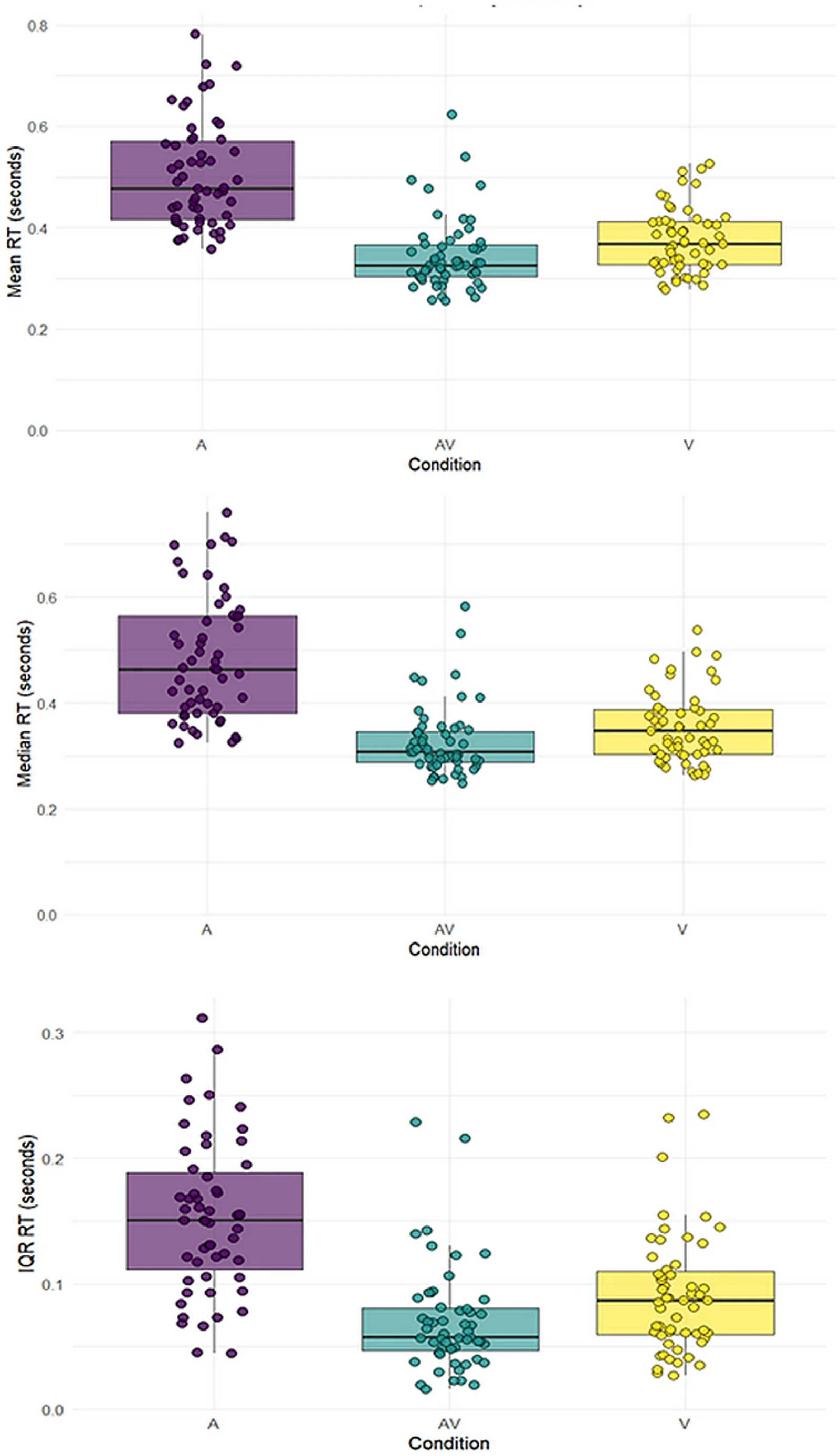
With an increasingly large segment of the population facing age-related cognitive impairment, understanding subtle changes before cognitive decline is crucial. Typically, sensory processing in ageing has been studied in isolation, and studies of multisensory processes have yielded mixed results. Furthermore, studies of reaction times (RTs) have often focused on aggregate measures, while a growing body of work shows the relevance of characterising intra-individual variability as a precursor to cognitive decline and fall risk. Lastly, changes in auditory processing of pitch have also been linked to cognitive decline. There is thus an imperative to identify cost-effective and accessible screening tools for assessing sensory and cognitive (dys)functions, particularly with ageing populations that may be reluctant to visit clinics or undergo brain imaging or extensive cognitive testing. Here, 55 cognitively healthy, older participants (aged 60-84 years) completed a simple detection task with auditory, visual, and simultaneous audiovisual multisensory stimuli. RTs to multisensory stimuli were significantly faster and less variable than those to either visual or auditory stimuli, and those to auditory stimuli were slowest and most variable. This speeding exceeded predictions based on probability summation, suggestive of integration prior to initiating motor responses. Further analyses revealed RT differences between auditory stimuli according to their pitch. On the one hand, the results underscore how multisensory contexts can improve stimulus processing during healthy ageing. On the other hand, the results highlight sensitivity to age-related changes in auditory sensory processing. Collectively, the results support detection tasks as a promising assessment of age-related changes in sensory processing.
From the paper
- Participants
We recruited 55 cognitively healthy participants, aged 60–84 years.
- Result
On the log scale, the model's intercept, corresponding to when Sensory Condition is Auditory, was significantly shifted and negative (β₀ = −0.71; 95% CI [−0.76, −0.65]).
Results, Differences in central tendency of reaction times across sensory modalities
- Limitation
There is no comparison group, nor have we considered age as a covariate in our analyses.
Quoted word for word from the full text on PubMed Central.
The paper
Centre Hospitalier Universitaire Vaudois
Aging Brain, 14 Sep 2026