Interferon shifted blood-cell development in cancer patients
Bone marrow samples from 10 people treated weekly for at least a year revealed parallel inflammatory and anti-inflammatory programs.
Our read
Interventions- Studied:
- Cohort study of 10 patients with myeloproliferative neoplasms, against pretreatment samples
- What changed:
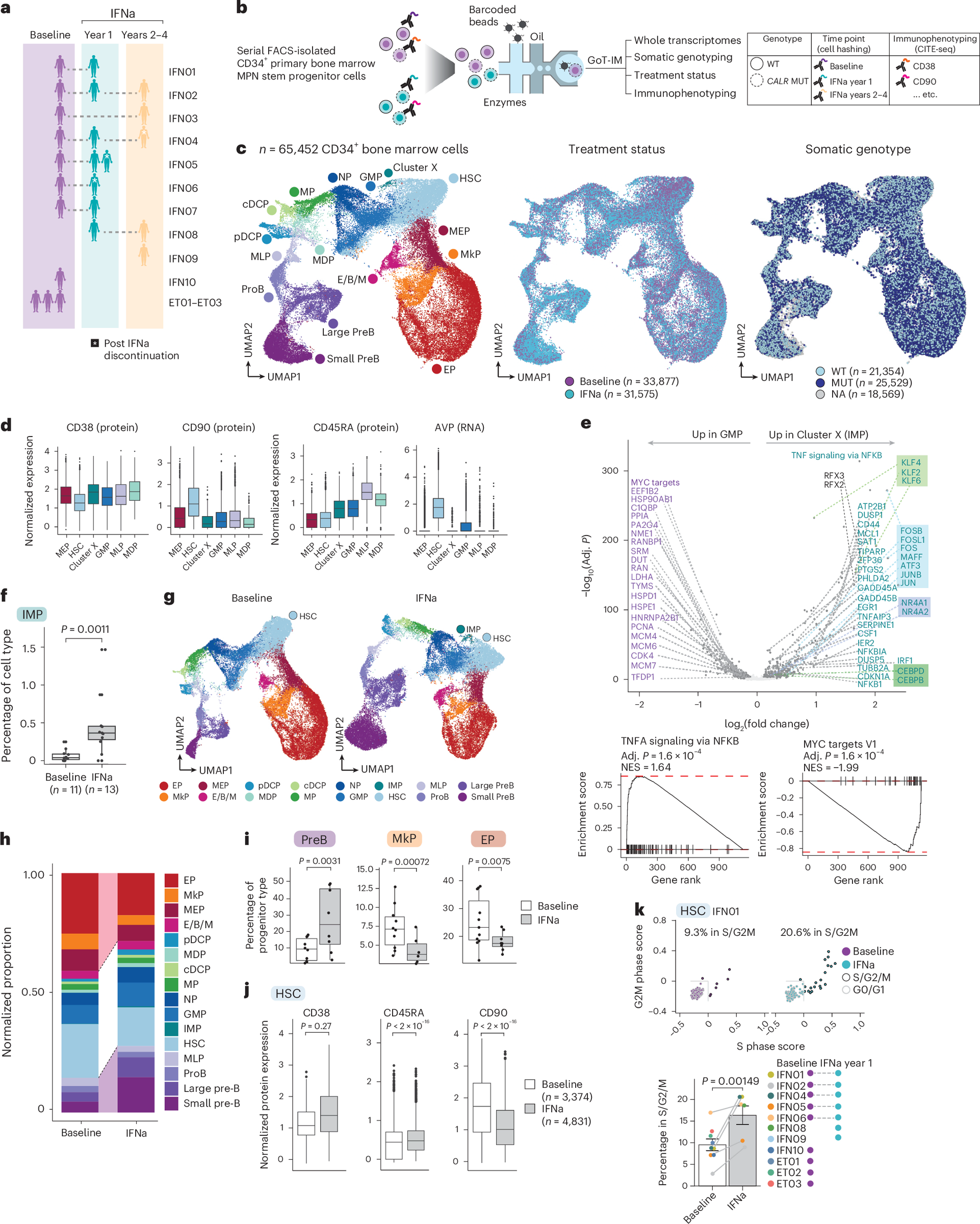
- Interferon increased lymphoid and inflammatory myeloid precursors and reduced platelet and red-cell precursors compared with pretreatment samples
- The catch:
- Serial single-cell profiling included only 10 individuals
- In the record:
- One of 4 papers on interferon-alpha on record: 2 with results in people.
Editor of record: Boris Djordjevic · AgingResearch.News
Ten people with myeloproliferative neoplasms, a group of blood cancers, provided bone marrow samples for an analysis within clinical trials of interferon-alpha. They received a long-acting form weekly for at least one year. Researchers measured mutations and gene activity in individual cells to distinguish mutated blood-forming stem cells from those without the mutations.
Interferon activated two routes of blood-cell development. One expanded precursors of lymphocytes, a type of immune cell, alongside an anti-inflammatory state. The other produced inflammatory myeloid precursors, immature cells that develop into other blood cells. The lymphoid shift countered the cancers’ usual skew toward myeloid cells and was associated with normalized blood counts. The authors attributed mutated stem cells’ competitive success during interferon exposure to their resistance to becoming inflammatory myeloid precursors.
Why it matters
Inflammation and competition among blood-forming stem cells are relevant to understanding aging blood systems. This work addresses how inflammation reshapes that competition in people with blood cancers.
Caveats
Some treated samples lacked matching pretreatment samples; three earlier baseline samples served as additional controls. The cell-level findings do not show whether patients lived longer.
From the paper
- Participants
Samples used for CD34+ cell analysis include 8 baseline and 13 treated samples (3 of which were collected post-IFNα discontinuation) collected from 10 individuals for GoT-IM.
Methods, Human bone marrow and peripheral blood mononuclear cell samples
- Who took part
To overcome interpatient variabilities, we applied GoT to fluorescence-activated cell sorting (FACS)-isolated CD34+ hematopoietic stem and progenitor cells (HSPCs) from serial (that is, baseline and treated) bone marrow biopsies from patients who were treated weekly with a pegylated form of IFNα for at least one year in clinical trials MPN-RC-111 and MPN-RC-112 (refs. ) (Fig. 1a, Extended Data Fig. 1a,b and Supplementary Table 1; n = 8 baseline samples, 13 treated samples; additional 3 baseline samples from previous work; 72% cells genotyped for CALR mutations …
- Hematopoietic stem cell activation
HSC rates of cell cycle entry were enhanced by IFNα, as reported in mice (Fig. 1k and Extended Data Fig. 2c,d).
- Stem-cell-differentiation
Altogether, these results indicated that IFNα induced HSCs into cell cycle entry, differentiation into an alternate IMP population and lymphoid expansion.
Quoted word for word from the full text on nature.com.
The paper
Type 1 interferon perturbates clonal competition by reshaping human blood development
Weill Cornell Medicine; Memorial Sloan Kettering Cancer Center
Nature Genetics, Sep 15, 2026, Open access

Comments
Be the first to comment.