Clinical and Laboratory Predictors of Bone Mineral Density Trajectories and Osteoporosis Progression: A Retrospective Longitudinal Cohort Study
Declared no competing interests
Abstract
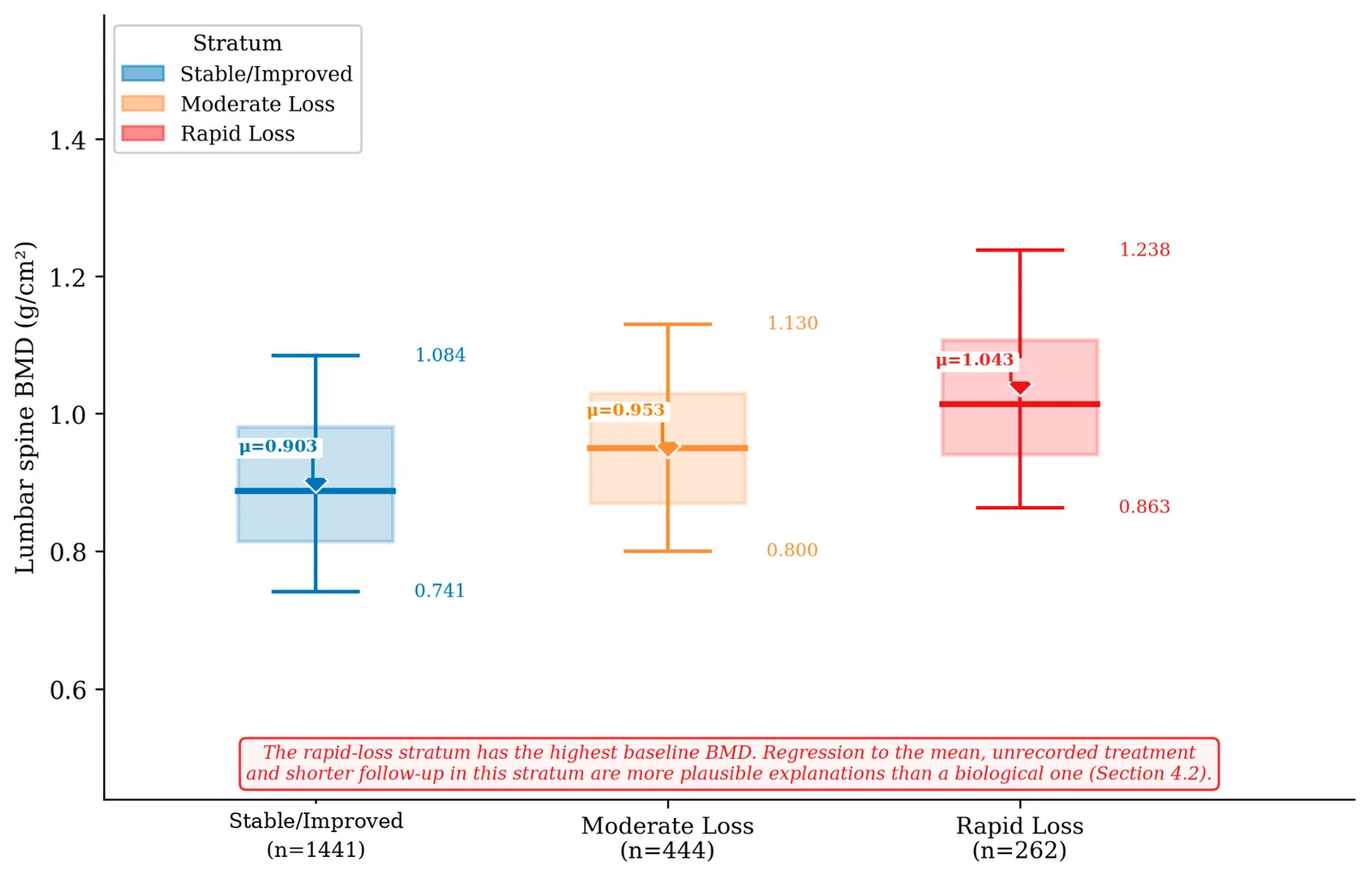
Background: Whether routinely available laboratory measures are associated with longitudinal bone mineral density (BMD) change in clinical practice remains uncertain, particularly when treatment exposure and other major skeletal determinants are incompletely recorded. This study examined BMD trajectories and incident osteoporosis in a Saudi dual-energy X-ray absorptiometry (DXA) cohort. Anti-osteoporosis therapy, glucocorticoid exposure and menopausal status were unavailable, limiting causal interpretation. Methods: This retrospective longitudinal cohort included DXA examinations performed at King Saud University Medical City (KSUMC), Riyadh, from 2016 to 2021. The trajectory analysis comprised 2147 patients with at least two scans and a minimum one-year interval. Diagnostic category was based on the lowest T-score across the lumbar spine, bilateral femoral necks and distal radius. Twenty linear mixed-effects (LME) models evaluated time-by-biomarker interactions with Benjamini-Hochberg correction. Cox proportional hazards (PH) regression was the primary analysis of incident osteoporosis among 789 patients without osteoporosis at baseline. Results: During 2045 person-years of observation, 107 patients developed osteoporosis (5.2 events per 100 person-years). No event occurred among 124 patients with normal baseline BMD, compared with 107 events among 665 patients with baseline osteopenia (log-rank p < 0.001). In the complete-case Cox model (n = 384; 53 events; C-index = 0.679), baseline osteopenia had a hazard ratio (HR) of 3.12 (95% Confidence interval (CI) 0.89-10.97; p = 0.076); no modelled covariate reached statistical significance. None of the 20 time-by-biomarker interactions remained significant after multiplicity correction (smallest q = 0.214). Four nominal terms with raw p < 0.10 were below the measurement-based clinical threshold and were compatible with chance variation. Conclusions: No routinely measured biomarker demonstrated clinical utility for identifying BMD trajectory in this cohort. Baseline DXA category separated the observed progression pattern, although this partly reflects the distance from the diagnostic threshold and should not be interpreted as a validated prediction model. The principal contribution is a carefully characterised null result. Prospective studies with explicit treatment tracking and repeated bone-turnover measurements are required for confirmation.
The paper
King Saud University; Umm al-Qura University
Journal of Clinical Medicine, 26 Aug 2026